Tidy
In this article
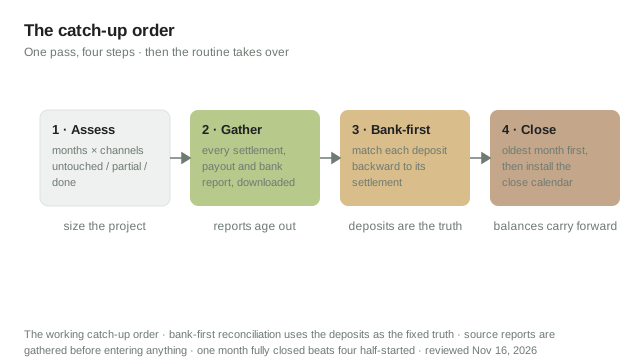
- Measure the backlog before working it: months behind × channels × statements, so the project has a size and an end date.
- Every marketplace keeps the source documents for you — settlement reports, payout records, transaction CSVs. Download them all before entering anything; reports age out of easy reach.
- Reconcile bank-first: the deposits that actually hit your bank are the fixed truth, and each one is matched backward to its settlement — never the reverse.
- Never book a plug entry to make accounts tie. A plug that forces the balance today hides a misposted fee forever; the unmatched residue is a to-do list, not a rounding error.
Assess the debt before touching the books #
“Behind on my books” is not a size. Measure it, because the measured shape decides the whole project: how many months are open, which channels have activity in them, how many bank accounts and payment methods are in play, and whether any period is partially done (a half-reconciled month is more work than an untouched one). A single-channel, twelve-month backlog on one bank account is a different project from three channels, two bank accounts and a partially-entered year — the first is a weekend routine applied patiently, the second is a project with a scope document.
Write the assessment down as a table — months across, channels down, each cell marked untouched / partial / done. The cells marked done are load-bearing: whatever convention the partial months used must be discovered and continued, or the catch-up will produce internally inconsistent books. This table is also the estimate: catch-up work reliably takes longer per month than the routine close (the month-end checklist that normally takes an hour takes an afternoon during catch-up), and an honest schedule prevents the project from dying in month three.
Gather the source documents first #
Every marketplace keeps the evidence for you — but not forever, and not conveniently. Settlement reports, payout records, transaction CSVs and order-level detail are all downloadable, and download windows and report formats shift. Before entering a single line, download everything for the full backlog window: each channel’s settlement or payout reports, the payment processor’s records for any non-marketplace gateway, the bank statements for every account, and the loan or card statements for anything the business borrowed on. One folder per month, one subfolder per channel.
This step is first for a hard reason: reports are the source of truth for what each fee and refund was, and back-office retention policies, account upgrades and platform migrations all make older reports harder to export. The books can be reconstructed at any speed; the reports cannot be reconstructed at all. Sellers who start entering data first and downloading second almost always find a report they needed is gone.
Work bank-first, not entry-first #
The counterintuitive core of the catch-up: start from the bank, not the sales. The deposits that actually hit the bank account are fixed, dated, objective truth — sales figures are estimates until money moves. So the working unit is one bank deposit at a time: for each marketplace credit, find the settlement or payout report that produced it (the deposit-versus-sales and eBay reconciliation guides show the matching routine), post that settlement as one balanced entry, and let the deposit clear the clearing account to zero.
Bank-first has three properties that entry-first lacks. It is self-checking — a month is done when every deposit is explained and the clearing balances return to zero, so you always know if you’re finished. It is prioritized — if you run out of time, the most recent deposits are done and the oldest month’s detail is what waits. And it is honest about gaps — a deposit that matches no settlement becomes a visible exception (worked through the unmatched deposits guide) instead of a silent number typed into a spreadsheet.
Channel by channel, close by close #
With deposits matched, the months close in sequence — and sequence matters. Close the oldest open month first on accrual books, because each month’s balances carry forward; close in whatever order is most motivating on pure cash-basis books, since cash months are independent. Within each month, work one channel end to end before starting the next: Amazon deposits explained, then eBay, then Shopify, then the credit-card and loan accounts, which often explain the expenses that the marketplace settlements never show (inventory purchases, supplies, software).
The per-month finish line is the same as the routine close: every clearing balance at zero, every account reconciled to a statement, fee lines matching the schedules, and a two-line close note recording anything that needed judgment. Then the next month. Expect the first month to take three times the second — the chart of accounts and mapping you build in month one is the asset that makes months two through N fast, which is exactly the asset the marketplace chart of accounts guide specifies.
The plug-entry trap #
Somewhere in month two, a $14.37 difference will refuse to explain itself, and the temptation arrives: book it to “reconciliation difference” and move on. One plug, small and documented, is defensible. The trap is that plugs are addictive at scale — a catch-up full of plugs has accounts that tie but mean nothing, and every future reconciliation inherits the noise. A plug placed in month seven of the backlog hides a misposted fee that month nine’s report would have explained in seconds, had the residue been carried forward instead of buried.
The honest alternative: carry the unexplained residue in a clearly named suspense account with a note per item, and work the list after the backlog closes — the unmatched deposits guide is exactly that discipline. A suspense balance that shrinks over time is a sign of a healthy catch-up. A plug count that grows is a sign the books will need this whole project again.
When to hire the catch-up out #
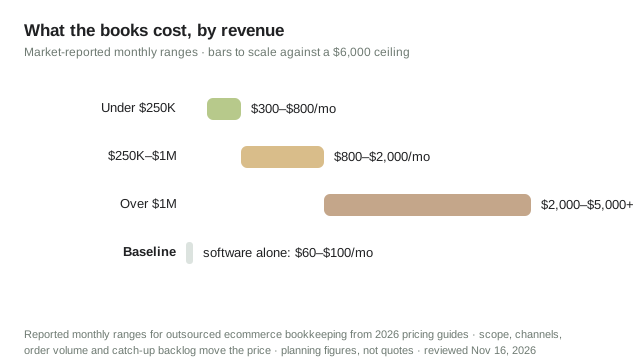
Self-assess with three questions. Is the backlog more than a year, multi-channel, and partially entered? Has a tax filing already been made on bad numbers (which adds restatement to reconstruction)? And does every weekend attempt so far have a half-finished spreadsheet to show for it? Three yeses is what catch-up specialists are for — the pricing logic is in our accountant guide, and the non-negotiable in any quote is that catch-up is scoped, written, and priced separately from the ongoing monthly work (the close routine then keeps it clean). Even when hiring out, the source-document gathering above is the part you can and should do yourself — it is hours of downloads, not judgment calls, and it cuts the bill directly.
One more boundary, stated plainly: tax filings already made on incorrect numbers are a tax professional’s territory (amended returns, and where relevant voluntary disclosures), not a bookkeeping redo. The catch-up produces the corrected numbers and the reconciliation that supports them; the filing strategy is a separate, licensed conversation.
Prevention: the calendar that keeps you caught up #
The catch-up ends the day the routine starts. The last month of the backlog closes with the same session installing the close calendar: a fixed monthly slot, the checklist run against it, fee accounts reconciled to schedules, and the backlog table from step one retired with every cell marked done. Sellers who skip this step meet the same backlog again in eighteen months — the books don’t drift because the owner is careless, they drift because nothing was scheduled. And this is precisely the loop TidyPayouts automates: every payout split, reviewed and matched while the month is still fresh, so the catch-up project never has a sequel. The channel setup guides are where the ongoing routine plugs in.
What the catch-up reveals about the business #
A finished catch-up is worth more than clean books — it is the first honest look at how the business actually ran during the missing months, and the reports consistently surface findings the owner never suspected. The fee-by-fee accounts expose fee creep (a category drifted onto a higher rate, a surcharge stacked, listing-fee renewals multiplied). The refund lines expose return-heavy SKUs whose posted margin was fiction. Unmatched-deposit investigations regularly surface money the seller was owed — unreconciled FBA reimbursements, fee credits that never posted, deposits that were simply missed. And the COGS pass turns inventory guesses into per-unit truth.
Three of these findings deserve follow-up rather than filing. Fee-rate drift goes to pricing (the take rates method recomputes with the real rates). Return-heavy SKUs go to listing quality. Unclaimed reimbursements go to the claims routine in the FBA reimbursements guide. A catch-up that ends with that three-item action list has paid for itself several times over — and produced exactly the numbers the ongoing routine needs to stay honest.
The tools that shortcut the work #
Three free browser tools remove most of the typing from a catch-up. The Amazon settlement analyzer reads a Seller Central flat file and reconciles every line against the deposit in seconds — during catch-up, run it on each backlog settlement before booking, so errors surface at import rather than at month end. The marketplace payout analyzer does the same for eBay, Walmart and Shopify reports, detecting the format automatically. And the fee comparison tool helps re-anchor pricing once the real effective rates are known.
For the bank-matching half, the payout reconciliation calculator and the period splitter handle the two steps catch-ups trip over: confirming a deposit belongs to a period, and splitting straddling settlements across months. All run locally in the browser with nothing uploaded — paste the report, get the buckets, book the entry. The free spreadsheets cover the same ground for sellers who prefer working in Excel.
Common questions #
How far back do I actually need to go?+
To the last period you can substantiate. If a prior year was filed and reconciled, the catch-up starts the month after it — opening years that were already done just to “check” multiplies the project. If nothing was ever done, the practical floor is the business’s first marketplace sale, and the IRS’s recordkeeping guidance expects records that support the returns you filed.
Should I catch up oldest-first or newest-first?+
Match to the bank working recent-first (deposits are freshest and easiest to trace), but close months oldest-first so balances carry forward correctly. On strict cash-basis books the months are independent, so close in whatever order keeps momentum — the discipline that matters is finishing each month completely before starting the next.
Can I just import my marketplace’s annual summary instead of every settlement?+
Annual summaries give one net number per channel — no fee detail, no refund timing, no clearing balance. That collapses every fee into a blur, makes bank reconciliation nearly impossible, and hides the misclassifications this whole site exists to surface. Use the settlement or payout reports; the annual summary is a cross-check, not a source.
What about sales tax I collected but never remitted?+
Facilitator-collected marketplace tax was remitted by the marketplace and needs no action beyond keeping it out of income. Self-collected tax from your own channels is a liability that accrued when collected — it needs remitting (and possibly a voluntary disclosure for past periods, per the sales tax guide), which is a conversation with a tax professional, not a bookkeeping entry.
How do I keep this from happening again?+
Schedule it: a fixed monthly close slot with the checklist, before month-end data ages out. Automation is the stronger version — software that splits and matches every payout while it’s fresh turns the close into a review. That is TidyPayouts’ entire premise: the books stay caught up because nothing waits for a weekend project.
Is a catch-up the same as a cleanup?+
They overlap but differ in scope: catch-up is entering the un-entered months; cleanup is fixing months that were entered wrong — misposted fees, double-counted sales, blended tax lines. Many backlogs need both, and the order is catch-up first (get the source truth in), then cleanup pass against the reports. Our duplicate-sales guide shows what a cleanup finds.
Sources and review date #
Written November 16, 2026 from general bookkeeping practice — there is no platform page to cite for a catch-up, because the method is the discipline this site teaches across its channel guides, linked throughout. Tax filing and remediation questions deserve a licensed professional; examples are illustrative.