Tidy
In this article
- Amazon reimburses sellers for inventory lost or damaged in fulfillment centers, certain customer-return claims and some fee errors — as credits inside settlements.
- A reimbursement is a recovery of a cost you already carried, not new income; booking it as revenue overstates both sales and profit.
- Match each credit to its claim or case, and keep the reimbursement report with your records.
- Watch for the awkward cousins: a unit reimbursed as lost and later found, and reimbursements valued on a basis different from your cost.
What Amazon reimburses #
Fulfillment by Amazon puts your inventory in Amazon’s warehouses, under Amazon’s processes. When that system loses or damages your stock, or a customer-return claim qualifies under the program’s rules, Amazon’s inventory reimbursement policy describes the cases that earn a credit back — as do certain fee adjustments when a measured weight or dimension is corrected. The policy’s details, including how reimbursed amounts are valued, have changed over time, so treat the policy page and your own account’s records as the authority and this article as the map.
What matters for bookkeeping is not the exact list of qualifying cases but the shape of the money: reimbursement credits arrive inside settlements, mixed among sales and fees, each with its own reference. They are not a separate payment, and they are easy to mistake for sales if your reconciliation is a single net number.
| Typical case | What happens to your books |
|---|---|
| Unit lost in a fulfillment center | Inventory write-off when confirmed; recovery when reimbursed |
| Unit damaged in the warehouse | Same pattern as lost units |
| Customer-return claim qualifying under FBA rules | Recovery against the cost already carried by the return |
| Fee correction after a weight/dimension review | Recovery against the fee expense line that was overcharged |
Program specifics evolve; confirm the current qualifying cases on Amazon’s policy page and in your account rather than from memory.
Where the credits appear #
Reimbursements show up as positive rows inside settlements, labelled with a reimbursement type and an identifier. On their own they are unremarkable — a few dollars to a few hundred. The reconciliation habit that pays off is grouping them by type each month, for three reasons. First, the total tells you how much of your deposit is recovery rather than revenue, which keeps income honest. Second, grouping by type makes patterns visible: a spike in lost-inventory credits says something about your storage situation worth knowing. Third, matching each credit to a case in the reimbursements report is the check that catches the errors this article is really about — credits that never arrived, and credits that arrived twice.
A worked settlement
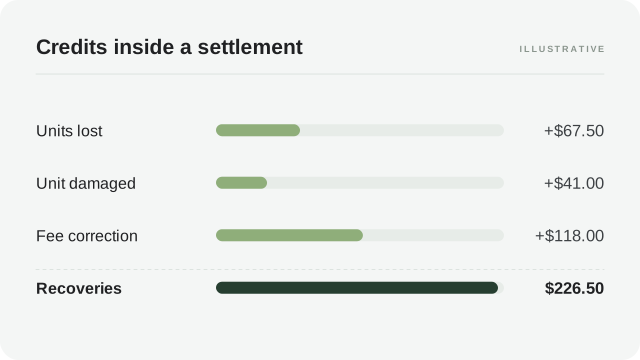
A fictional two-week settlement: sales $9,410.00, selling fees −$1,505.60, fulfillment fees −$1,320.40, refunds −$284.00, and three reimbursement credits: +$67.50 for two units lost in a fulfillment center, +$41.00 for a damaged unit, and +$118.00 crediting fulfillment fees after a weight correction. The deposit is $6,526.50. A single-line booking (“Amazon paid us $6,426.50”) buries $226.50 of recoveries inside what looks like sales; a grouped booking keeps every one of those credits attributable.
Illustrative figures. The sales, fee and refund lines sum to $9,410.00 − $1,505.60 − $1,320.40 − $284.00 = $6,300.00; adding the three credits gives the $6,526.50 deposit.
A recovery, not income #
The accounting question with any reimbursement is: recovered what? A lost unit’s cost was already carried — first as inventory, then, when the loss was confirmed, as a write-off. The credit returns that cost; it does not create profit out of nothing. Booking it as income double-counts: the sale of the unit may already have been reimbursed in a claim, or the unit’s cost already expensed, and income on top turns a wash into a windfall.
The cleaner pattern mirrors the loss:
- When the loss is confirmed, move the unit’s cost from inventory to a write-off line (or let your inventory process handle the adjustment).
- When the credit arrives, post it against the same line — a recovery that reduces the write-off, not a sale.
- Where the reimbursement relates to fees, post it against the fee account it corrects.
Exactly where the credit lands when there was no write-off — because the loss and the credit arrived in the same month — is a bookkeeping convention worth fixing once with your bookkeeper and noting on the account, as with the refund conventions in our chart of accounts guide. The principle that survives any convention: the credit should follow the cost it compensates.
TidyPayouts separates reimbursement credits from sales before anything posts, so your income is never inflated by Amazon returning your own cost.
The two errors to watch for #
The credit that never arrived. The reimbursement report is the record of what Amazon says it credited; the settlements are the record of what actually reached your payout. Reconciling the two — a case listed as reimbursed with no matching settlement credit — is the check that finds missing credits while they can still be queried. Do it monthly; a case older than the query window is a harder conversation.
The credit that arrived twice. Occasionally a unit reported lost turns up, or a claim is paid and then the case resolves again. A duplicate credit is not a bonus; it is money to flag and return or offset, and it is precisely the kind of row that disappears forever inside a net deposit figure. The same grouped view that finds missing credits finds duplicated ones.
A third, quieter issue sits between the two: valuation. Reimbursements are credited according to Amazon’s current policy basis, which may not equal your landed cost — our COGS guide explains why landed cost is usually higher than a bare product price. When the credit is less than your cost, the shortfall is a real, small loss worth seeing; when it is more, the excess is not profit. Either way, comparing credit to cost per case is a five-minute habit that keeps the inventory account honest.
A monthly reimbursement routine #
- Pull the reimbursement report for the period and group credits by type.
- Match every credit to its settlement row — amount, currency, settlement reference.
- Post the grouped totals through your mapping: recoveries against write-offs, fee credits against fee accounts, never into sales.
- Compare each material credit to the cost it compensates; note shortfalls and excesses.
- Query anything the report claims but the settlements lack, while the case is fresh.
Five steps, a few minutes a month once the mapping exists. The output is a books-vs-Amazon trail that survives an audit and, more practically, a margin report that does not quietly include your own inventory coming back.
Fee reimbursements: the quiet category #
Lost-inventory credits get the attention, but fee corrections are the reimbursement type most sellers meet first: a measured weight or dimension differs from the listing’s, fees are re-assessed, and credits or charges land in settlements until the record catches up. Two habits keep the category tidy. First, fix the listing data the moment a pattern appears — a reimbursement that repeats weekly is a data problem wearing a credit costume, and the books can only record it, not cure it. Second, book fee corrections against the fee account they adjust rather than into a general reimbursements bucket, so the fulfillment-fee line on your profit and loss reflects what fulfillment actually cost after corrections.
The same review discipline applies to the rarer cases — claims resolved in your favour after a customer return, or credits following an investigation. Each arrives with its own reference and its own reason; each is a recovery following a cost. The grouping-by-type routine in this article exists precisely so that a new credit type has an obvious place to land the first time it appears, instead of starting life as unexplained income.
A quarterly claims audit #
Monthly matching keeps the books current; a quarterly audit keeps the program honest. Set aside an hour each quarter and pull the full reimbursement report beside the settlements for the same window. Then ask four questions of it. Are there cases marked reimbursed with no credit to be found in any settlement? Are there duplicate credits for the same case? Do the credited amounts roughly track the cost of the units involved, or has the valuation basis drifted somewhere surprising? And is any category growing fast enough to deserve an operational look — a warehouse problem, a data problem, a packaging problem?
The audit’s output is short: queries to raise while they are still in window, corrections to post, and a note of anything systemic. Its value compounds quietly. A seller who audits quarterly meets problems while Amazon’s own processes can still remedy them; a seller who never audits meets them at year end, as an unexplained $1,400 of “other income” and a shrug. The second seller also pays tax preparation to figure out what the first seller’s bookkeeper already knew.
Common questions #
Is an FBA reimbursement taxable income?+
Generally a reimbursement that returns a cost you already carried is treated as a recovery rather than new revenue, but tax treatment follows your overall accounting and filings — confirm with your accountant or tax adviser. The bookkeeping job is to keep recoveries visible and separate so that conversation starts from clean numbers.
Where does the credit go if I never wrote off the unit?+
Follow the cost. If the unit was still carried as inventory, the credit effectively replaces it: reduce inventory value (or record the write-off and the recovery in the same month, per your bookkeeper’s convention), rather than posting income.
Do other marketplaces reimburse the same way?+
The pattern is common — credits for warehouse losses and fee corrections appear in Walmart and eBay flows too — but programs, valuations and timelines are marketplace-specific. Reconcile each channel’s credits against its own reports; the bookkeeping principle of recovery-not-income travels unchanged.
Sources and review date #
Reviewed October 26, 2026 against the provider guidance below. Reimbursement cases, valuations and timelines are set by Amazon’s current policy and your account terms. Examples are fictional; confirm treatment with your bookkeeper.