Tidy
In this article
- An unmatched deposit is rarely a mystery — work the short list of causes in order before assuming anything stranger.
- The commonest culprits: several payouts combined into one credit, a bank-side fee or conversion, and timing at period edges.
- Match on amount, currency and date window; a one-cent difference is a clue, not a rounding error.
- Whatever the cause, the fixing pattern is the same: find the pieces, post them to the clearing account, let the deposit match the whole.
The deposit that looks like nothing #
Every seller meets it eventually: a bank credit arrives, and no payout, settlement or invoice explains it. The amount is close to something familiar but not exact, or it is exactly twice something, or it lands in a currency you did not sell in. The instinct is to post it to suspense and move on — and suspense, unlike wine, does not improve with age. The good news is that the cause is almost always on a short list, and the list rewards order.
Work the causes in this order #
- Several payouts, one credit. Banks combine; marketplaces do not always disburse separately. Sum the payouts disbursed within a few days of the credit and compare totals — the commonest match by far.
- A payout, minus a bank-side deduction. Wire or ACH fees, and receiving fees on international transfers, are taken by the bank before the money lands. Compare the payout amount to the credit and look for a small, documented difference.
- A conversion you did not do. A payout in a foreign currency may be converted by the marketplace at payout, or by your bank on receipt — at different rates and costs. Check the currency of the settlement against the currency of the credit; our multi-currency guide follows this case in full.
- Timing at the edges. A payout disbursed on the last day of the month can land days later; a month-end reconciliation meets it as “unmatched” until the calendar catches up. Confirm it exists in the marketplace’s disbursement history and let it be in-transit.
- Not a marketplace payment at all. Refunds returned in bulk, ad credits, insurance payouts, a customer who paid by bank transfer outside checkout, or a family member paying you back — deposits do not have to be sales.
- A duplicate. The same payout credited twice, or a refund and its reversal both landing. Rare, and worth reporting to the marketplace when found — after you have re-checked steps one to five.
The order matters because the early steps are cheap and common. An hour of summing payouts beats a week of assuming the bank has invented money.
Two payouts, one credit
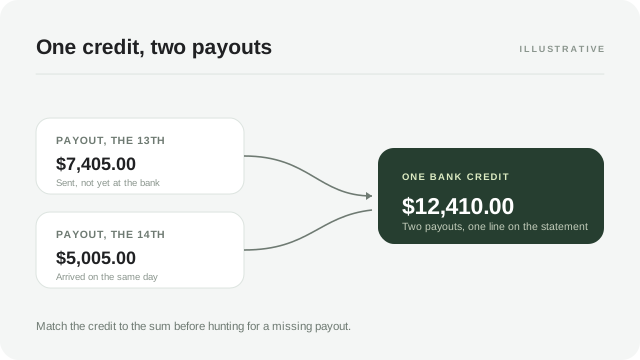
A fictional seller’s bank shows a credit of $12,410.00 on the 14th. No single payout matches. The marketplace’s history shows two disbursements: $7,405.00 on the 13th and $5,005.00 on the 14th. Together: $12,410.00 — the bank combined them. The fix is not in the bank at all: both payouts post to the clearing account as themselves, and the single bank credit matches the combined balance. The books keep the payouts separate; the bank keeps them merged; both are right.
Illustrative figures. One-cent mismatches deserve the same treatment — often a bank fee, a conversion rounding, or a payout adjusted after disbursement — and the settlement’s own adjustment rows are where the penny usually hides.
The clearing account makes this almost boring #
None of this detective work is needed on books where payouts land in a clearing account first. The clearing pattern — our chart of accounts guide sets it up — gives every payout an entry the moment its settlement posts, and the bank feed’s job becomes matching deposits to whatever combination of clearing entries they represent. One payout, one credit: match. Two payouts, one credit: match the credit against the pair, as in the worked example. A credit with no clearing entries behind it is, at last, genuinely new information — it is not a marketplace payment your books already expect.
QuickBooks users have a native version of the same idea: the Undeposited Funds account, which QuickBooks describes as the place payments wait until they are recorded as a deposit, so a bank deposit can match the group of receipts it actually contains. Whether the holding pen is a marketplace clearing account, Undeposited Funds, or both in their lanes, the principle is identical: the bank matches sums, the books keep parts.
TidyPayouts posts payouts to a clearing account before the bank sees them, so combined credits match in seconds — and truly unknown deposits stand out.
When you genuinely cannot explain it #
Occasionally a credit survives the whole list. The remaining moves are dull and effective: search the marketplace’s disbursement history across a wider date window and both currencies; check whether another bank account received the matching payout; ask the bank for the transfer’s origin reference; and, if a marketplace sum is implicated, open a support case with the settlement IDs and dates in hand. Until it resolves, the amount stays on a clearly-labelled suspense line with a note of what you checked and when — an honest placeholder, and a to-do that cannot be forgotten.
What never helps is forcing the match: posting the credit as income because the amount is approximately right, or burying it in the biggest nearby category. An unmatched deposit posted hopefully is a reconciliation error with a time delay — and the reconciliation differences in our deposit-versus-sales guide are hard enough to explain when they are real.
Prevention is a routine #
- Match weekly, not monthly. A deposit is easiest to identify within days of arriving; a month later the context has evaporated.
- Keep the disbursement history handy. The marketplace’s own list of payouts and dates is the first document to open, every time.
- One clearing lane per currency. Mixed-currency clearing re-creates the mystery you just solved.
- Clear suspense on a schedule. A suspense line older than one cycle gets a named owner and a next action, every month.
Unmatched deposits never quite reach zero — banks and marketplaces will always surprise a calendar now and then. The goal is that each surprise is identified, labelled and resolved on a routine, instead of accumulating into a suspense line nobody dares open.
A real walkthrough: the case of the $4,103.17 deposit #
Walk the method end to end on a fictional case. A credit arrives: $4,103.17, the 21st, no payout matches. Step one — sum the payouts disbursed within a window of a few days: $2,118.42 and $1,984.75, total $4,103.17. Case closed before step two. But suppose the sum had been $4,098.17, five dollars short. Step two: the bank’s fee schedule shows a receiving fee on marketplace transfers — five dollars, documented, dated the same day. The two payouts post as themselves; the fee posts to bank charges; the credit matches the whole. Suppose instead the amounts were nowhere close. Steps three through five follow in order — currency, timing, non-marketplace sources — and each eliminates a family of explanations until the residue is small enough to name.
The walkthrough’s lesson is the shape of the work: every step either closes the case with arithmetic or eliminates a cause with a document. Nothing at any point requires guessing, and the deposit that survives all five steps is rare enough to deserve a support case rather than a shrug.
What a healthy clearing account looks like #
The clearing account is this guide’s silent partner, and its month-end state is a diagnostic in itself. Healthy: a handful of entries, each a payout posted from its settlement, each matched to a bank credit within days; a balance that is either zero or exactly the payouts still in transit, each namable on demand. Unhealthy: entries aging past a settlement cycle, a balance that never quite zeroes, or a growing collection of “rounding” leftovers that nobody has claimed. Each failure mode points somewhere specific — aging entries mean payouts posted with no credit (or credits with no payout), drift means adjustments being netted instead of named, and rounding leftovers are usually bank fees being absorbed silently into the oldest habit in bookkeeping.
Five minutes of clearing-account review a month, with the disbursement history open beside it, is the entire preventive program. The account’s whole purpose is to make unmatched money conspicuous; give it the monthly glance that purpose deserves, and the five-step detective work above stays a rare event instead of a routine.
Common questions #
Can I post an unexplained deposit to income and fix it later?+
Resist it. Income posted hopefully distorts sales and rarely gets revisited. A labelled suspense line with notes keeps the amount visible, honest, and on someone’s to-do list until it is explained.
The bank combined three payouts but one was in another currency. How do I match that?+
Match the same-currency parts first, then handle the converted payout through your currency process — conversion fee rows and all — before matching the remainder. Splitting the credit by component beats matching one blended number.
How long should something sit in suspense?+
One cycle with notes, then escalate — bank reference trace, marketplace support case, bookkeeper review. Suspense is a waiting room, not storage; the monthly review is what moves cases out of it.
Sources and review date #
Reviewed October 26, 2026. The causes here are drawn from everyday marketplace-and-bank behaviour; your bank’s fee schedule and your marketplaces’ disbursement records are the authorities for your own cases. Examples are fictional; confirm treatment with your bookkeeper.