Tidy
In this article
- Conversion happens somewhere specific — at the marketplace’s payout, or at your bank on receipt — and the where decides which rows your books see.
- Reconcile in the deposit currency: it is the only number the bank will confirm.
- Conversion fees are real selling costs; give them a named line rather than letting them blur into the payout.
- Keeping books in more than one currency (multicurrency) adds real capability and real chores; whether you need it is a bookkeeper conversation.
One sale, two or three currencies #
Sell on Amazon in the UK from a US bank, or on Etsy with listing currency different from your deposit currency, and every payout crosses at least one exchange rate. The order is priced in one currency; your fees may be assessed in it; the payout is issued, converted and deposited in another; and if the marketplace does not convert, your bank will on arrival. Each crossing has a rate and often a fee, and each lands as rows your reconciliation has to read. None of it is exotic — but it breaks naive reconciliation, which assumes one currency end to end.
Where conversion happens, and what it looks like #
| Conversion point | What you see | What the books should do |
|---|---|---|
| Marketplace converts at payout | Statement rows in the listing currency, a conversion fee row, a deposit in your currency | Post the fee to its own line; deposit reconciles in your currency |
| Bank converts on receipt | A payout in foreign currency, a bank credit in yours, at the bank’s rate | Books carry the foreign amount; the bank’s rate sets the deposit; difference is a currency gain/loss for the bookkeeper |
| No conversion (foreign account) | Payout lands in a foreign-currency account and stays there | Books need multicurrency, or a standing convention agreed with the bookkeeper |
Marketplace conversion offerings, rates and fees vary by program and change over time; your settlement rows and bank statements are the record of what actually happened.
The first two rows produce the same deposit with different paperwork. Marketplace conversion keeps the arithmetic inside statements you already reconcile; bank conversion moves part of the story to the bank statement, where rates are less negotiable and less itemised. Which path your account is on is worth knowing deliberately rather than discovering from a mysterious shortfall.
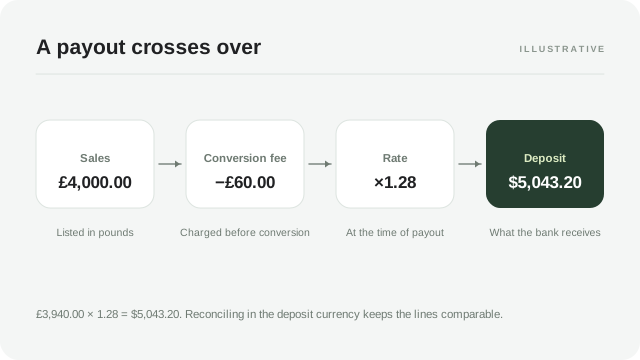
A fictional £4,000 payout, converted
A UK marketplace owes a US seller £4,000.00. At payout, the marketplace deducts a £60.00 conversion fee and converts the remaining £3,940.00 at a rate of 1.28, issuing $5,043.20 to the bank. The books, reconciling in dollars, see: the settlement’s sales total £4,000.00 as the gross story; the conversion fee as a named cost; and a deposit of $5,043.20 that the bank confirms to the penny. Nothing was estimated — each row carries its own currency and the statement ties them together.
Illustrative figures. Rates move constantly and fees vary; the amounts on your own rows are the ones to book. The habit that matters: never let the conversion be invisible inside a blended number.
Reconcile in the deposit currency #
The one rule that survives every setup: the reconciliation ties out in the currency the bank credits. The bank will confirm $5,043.20; it will never confirm “£3,940 at about 1.28”. So the payout review reads the statement’s foreign-currency rows for the story — sales, fees, conversion — and proves the deposit in your currency. Mixing the two, by comparing a foreign gross to a domestic deposit, manufactures differences out of nothing, which is why multi-currency sellers so often report payouts that “never match”. They match; the comparison was cross-currency.
Inside your books, the deposit currency is also where the familiar lines live: sales, fees, refunds, tax and the clearing account all carry the amounts your bank knows. If you keep no foreign-currency books, this single-currency view with named conversion-fee lines is a complete and defensible answer for many sellers — foreign amounts live in the statements attached to each posting, not in the ledger’s arithmetic.
TidyPayouts keeps foreign-currency rows and your deposits on one reviewable line-up, so conversions are explained, never guessed.
Multicurrency books: what they add and cost #
Keeping the ledger itself in more than one currency — QuickBooks calls the feature Multicurrency, and its guidance covers enabling it, foreign-currency accounts and exchange rates — becomes worthwhile when foreign money stays foreign: balances held in foreign accounts, suppliers invoiced in the selling currency, a real position worth tracking. What it adds is fidelity; what it costs is chores. Exchange rates must be maintained, balances revalued at period ends, and the resulting gains and losses posted — bookkeeper work, on a bookkeeper’s schedule. Turning multicurrency on for a single converted payout is usually machinery without a purpose; the single-currency pattern above already reconciles it cleanly.
If you and your bookkeeper do adopt it, one convention earns its keep immediately: keep the marketplace clearing lanes separate per currency, as our unmatched-deposits guide argues. A clearing account that mixes currencies re-creates, inside your own books, the very cross-currency confusion the rest of this article removes.
The monthly routine looks familiar #
- Group each statement’s rows in its own currency: sales, fees, conversion fees, refunds, tax.
- Prove each deposit in the deposit currency, to the penny, against the bank.
- Post conversion fees to their named line; hand exchange-rate effects to the bookkeeper’s process where multicurrency applies.
- Review conversion costs as a percentage of foreign sales — a rising line is either the market or a worse deal, and both are worth knowing.
Four steps, and the second one is the anchor: however many currencies the story is told in, the proof is always in the money the bank actually sent.
Choosing a conversion path, deliberately #
Marketplace conversion and bank conversion both work; they are not equal, and which suits you depends on what you value. Marketplace conversion keeps the whole story on statements you already reconcile — fee visible, rate stated, deposit matching your books’ home currency with no bank-side arithmetic — at the price of the marketplace’s rate and fee, which may not be the best available. Bank or receiving-account conversion can offer better economics, especially through multi-currency receiving accounts that hold foreign balances until you choose to convert; the price is paperwork, because part of the story moves onto the bank statement and, if balances persist, into multicurrency bookkeeping.
The comparison to run is concrete: take a representative month’s foreign payouts and price both paths — the marketplace’s stated fee and effective rate against the alternative’s, including your own admin time and any account charges. Sellers are often surprised in both directions. The decision is also revisitable: whichever path you choose, the bookkeeping pattern in this article stays the same, so switching paths is an operations change, not a books change. Choose for a reason, note the reason, and re-price the choice once a year.
One month, two currencies: a worked review #
Put the routine on a fictional month. A US seller’s UK marketplace settles three payouts: £1,850.00, £2,140.00 and £3,940.00 after conversion fees of £27.75, £32.10 and £60.00 respectively — each deposit landing at 1.28 as $2,332.48, $2,698.11 and $5,043.20. The monthly routine reads each statement in pounds — sales, fees, conversion fees grouped — proves each deposit in dollars against the bank, and posts conversion fees of £119.85 in total to their named line. At month end, the review asks the percentage question: conversion cost was about one and a half percent of foreign volume this month, in line with last month, worth an annual re-price and otherwise quiet.
The same month under a forced single-currency reading — comparing the UK statements’ £8,000-odd of gross against $10,000-and-change of deposits — would have produced a wall of unexplainable differences and, eventually, a wrong conclusion. The currencies were never the problem; the mixed comparison was. Every reconciliation in this series ends the same way: match each number to the record that owns it, and let no row be explained by vibes.
One rate per row, not one rate per month #
A subtle choice hides inside every converted posting: which rate to use. The honest answer for reconciliation is the rate each row itself declares — the marketplace states its conversion rate at payout, and the bank states its own on receipt. Using the actual rate per row keeps every line provable; using a single convenient monthly rate is faster and turns every deposit into a small rounding disagreement that someone has to explain later.
Where month-end revaluation or averaging is genuinely needed — multicurrency books with persistent balances — that is the bookkeeper’s layer, run on the bookkeeper’s schedule with the bookkeeper’s method. The payout review’s job stays the same underneath: read each row at its own stated rate, prove the deposit to the penny, and hand the ledger clean parts to whatever currency process sits above it.
Common questions #
Do I need to turn on multicurrency to record converted payouts?+
Usually not for payouts that arrive already converted. The single-currency pattern — deposit-currency lines, conversion fees named, statements attached — reconciles them completely. Multicurrency earns its keep when foreign balances or foreign-currency obligations persist; ask your bookkeeper which situation you are in.
Where do conversion fees belong in the books?+
In a named line of their own, grouped with selling costs rather than buried in fees or income. Their behaviour is distinct — they scale with foreign volume and move with rates — and visibility is the whole point of separating lines.
Why does the bank amount differ from the marketplace’s stated deposit?+
Because two conversions can apply — the marketplace’s at payout and the bank’s on receipt, at different rates and costs — or a receiving fee was deducted. Compare the settlement’s stated deposit to the credit; the difference is the bank-side story, and the bank’s fee schedule documents it.
Sources and review date #
Reviewed October 26, 2026 against the reference below. Conversion offerings, rates and fees vary by marketplace, bank and program and change over time; your own statements are authoritative. Examples are fictional; confirm currency and tax treatment with your bookkeeper.