Tidy
In this article
- A Walmart settlement is a periodic net figure: orders from many days, plus fees and corrections, paid as one deposit.
- Expect families of lines — sales, commission, fulfillment, refunds, reimbursements, adjustments and advertising — not a single number.
- The settlement period, the payout date and the bank date are three different dates; reconcile by settlement, not by week.
- Roll each settlement’s closing balance into the next one’s opening balance; a break in the chain marks the movement you have not found yet.
A settlement covers a period, not a sale #
Walmart Marketplace does not pay you per order. Sales accumulate, deductions are netted against them, and on the schedule shown in your Seller Center account the balance is disbursed to your bank — commonly every two weeks for many sellers, with the exact rhythm, cutoffs and any early-payment options varying by account and program. Each disbursement is backed by a settlement: a report that lists the orders, fees, refunds and corrections behind the deposit.
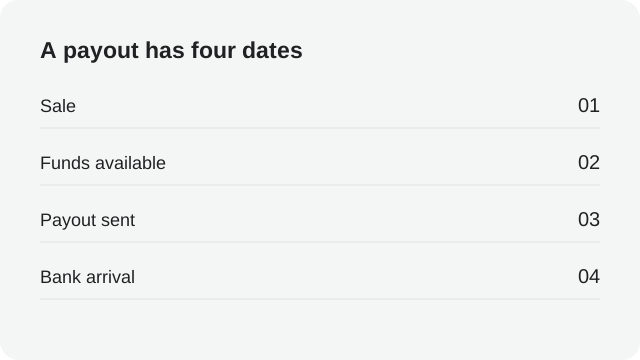
Three dates matter and they rarely coincide: the dates on the orders inside the settlement, the date the settlement is issued, and the date the money clears your bank. When someone asks “why doesn’t my deposit match last week’s sales?”, the honest answer is usually that the deposit does not correspond to any single week. It corresponds to a settlement period, which overlaps several selling weeks and carries corrections from even earlier ones.
That framing does most of the work of reconciliation. You are not matching the bank to the sales dashboard. You are matching the bank to a settlement, and the settlement to its own parts.
The reports to open #
Seller Center is the source of truth for your account. The payments area shows your balance and disbursement history; the reports area produces settlement detail that itemises what went into each deposit. Walmart’s seller help organises this under getting paid and settlements, and because program details differ by account, treat the in-account reports as authoritative over any general guidance — including this article.
Download both views for one settlement before you start: the summary that ties to the deposit, and the line-level detail that explains it. The summary answers “how much and when”. The detail answers “why”. A reconciliation that starts from the detail without the summary turns into archaeology; one that starts from the summary without the detail turns into hope.
Which record answers which question
“Did the bank receive the right amount?” — compare the disbursement record with the bank credit. “What is inside that amount?” — the settlement summary’s groups of lines. “Why is this order’s deduction that size?” — the settlement detail row for that order. Each question has exactly one record that answers it without guessing.
The lines you should expect #
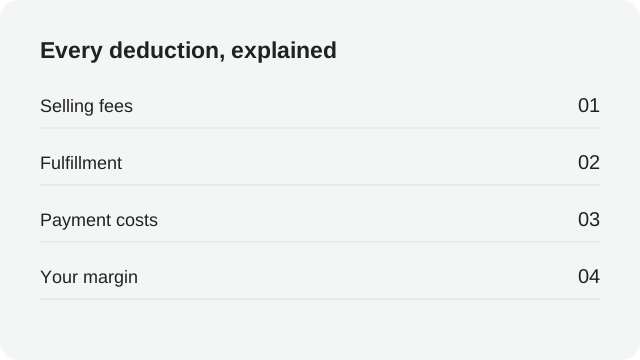
Settlement layouts vary by account and program, so learn the families of lines rather than memorising labels. Most of what you will see falls into one of these groups.
| Line family | What it represents | Effect on your books |
|---|---|---|
| Product sales | Order amounts for items sold in the period | Income |
| Customer shipping charged | Shipping the buyer paid | Income (shipping income) |
| Commission | Walmart’s fee for each sale | Expense |
| Fulfillment fees | Pick, pack and ship costs when Walmart fulfills the order | Expense |
| Refunds and reversals | Money returned to buyers | Refunds / contra-income |
| Reimbursements | Money owed back to you, such as lost inventory claims | Recovered cost — bookkeeper decides |
| Adjustments and corrections | Corrections to earlier settlements | Depends on the original line |
| Advertising charges | Walmart Connect spend netted into the payout | Advertising expense |
Sales tax collected by the marketplace may also appear as pass-through lines that net to zero, as on other channels; see your own settlement’s tax rows and confirm filing duties with your adviser.
The families matter because they behave differently over time. Sales and commission belong to the settlement’s period. Refunds usually belong to older orders. Adjustments belong to even older settlements. Advertising spend follows its own billing rhythm entirely. A settlement is therefore not a snapshot of one moment but a layered record — and reading it by family turns noise into structure.
A worked example: one settlement, fully explained #
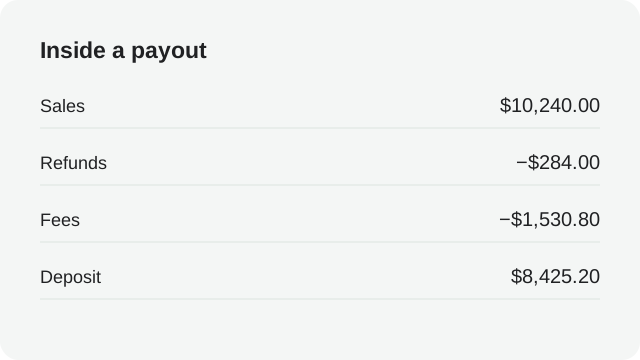
Here is a fictional two-week settlement for a seller who ships some orders through Walmart fulfillment. Every line sums exactly to the deposit.
| Settlement line | Amount |
|---|---|
| Product sales | $7,940.00 |
| Customer shipping charged | $612.00 |
| Refunds (product and shipping) | −$425.00 |
| Commission | −$1,282.80 |
| Fulfillment fees | −$907.20 |
| Advertising charges | −$118.75 |
| Deposit to bank | $5,818.25 |
Illustrative figures. The commission here works out to about fifteen percent of the order amounts including customer shipping — a round number chosen for the example only. Rates and the base they apply to vary by category and program; your settlement’s own rows are the source of truth.
Notice what the table proves. The deposit of $5,818.25 is now traceable: a bookkeeper can see that roughly $8,550 of orders produced it, that fees and refunds consumed about $2,730, and that advertising consumed the rest of the gap. Nobody has to email anyone asking what happened to the missing thirty percent. That is the standard each of your settlements should meet.
If your payouts arrive through a program that deducts additional service fees, or your account is on a payment schedule with carryover balances, the same method applies: add the extra line families, and roll the balance as shown below.
Commission and fulfillment fees #
Commission is the largest deduction on most settlements, so it is worth understanding rather than averaging. The rate depends on the item’s category, and the amount it applies to can include more than the item price — order totals with customer shipping and other charges are common bases across marketplaces, but the specifics for your account are stated in your own seller documentation and visible in the settlement rows themselves.
The practical check is internal consistency: for each order row, does the commission equal the stated rate applied to the stated base? Sampling a handful of rows per settlement catches rate mistakes, wrong-category classifications and double charges faster than any summary report. If you sell in categories with different rates, keep the commission rows separated by category in your books — otherwise a blended “marketplace fee” figure quietly hides which product line bears which cost.
Fulfillment fees behave differently. Where Walmart fulfills an order, the fee reflects the service performed — pick, pack, shipping materials — and varies with the item’s size and weight rather than its price. Two orders with identical revenue can carry very different fulfillment costs, which is why these rows deserve their own account in your books instead of being folded into a generic fee line.
Refunds, reimbursements and claims #
Refunds in a settlement usually reference orders from earlier periods, sometimes weeks earlier. That timing is the single most common source of reconciliation confusion: the refund reduces the current settlement even though the sale it reverses is long gone from the current reports. Keep the order reference on each refund row so the pair stays traceable across settlements.
Reimbursements are the mirror image. When the marketplace owes you money — an inventory item lost in a warehouse, a claim resolved in your favour — the credit appears in a settlement as its own row. It is not new sales, and booking it as income overstates revenue; it is typically a recovery against the cost that generated the claim. Where the recovered amount lands in your books is a bookkeeping decision, but it should be a deliberate one, made once, and applied consistently.
TidyPayouts maps settlement lines to your chart of accounts before anything is posted, so refunds, reimbursements and fees never blur together.
Ad spend and other deductions #
Advertising charges often appear inside the settlement rather than on a separate invoice, which surprises sellers who expect ad spend to live in their card statement. When ads are netted into payouts, two consequences follow. First, the deposit is smaller than the fee-and-refund arithmetic suggests, and the difference is ad spend. Second, the ad expense is only visible if it is separated at posting time — folded into a single net deposit, it disappears into income forever.
Some accounts instead charge advertising to a card or invoice outside the settlement. The bookkeeping is the same; only the timing differs. What matters for reconciliation is knowing which model your account uses, because it changes what you expect the deposit to contain. Check the settlement’s own deduction rows and your advertising billing settings rather than assuming either way.
The same “know your model” rule applies to sales tax rows, shipping programs, returns processing charges and any subscription or service fees your account carries. Each is a family of lines with its own rhythm; each deserves its own line in the books. Our guide to every fee hiding inside a marketplace payout covers the cross-channel versions of this catalogue.
Follow the balance across settlements #
When activity and disbursement fall out of step — a payout smaller than the balance, or a settlement with no payout at all — the balance rolls forward. The way to keep that honest is a roll-forward: one row per settlement, proving that opening balance plus activity minus payout equals closing balance, and that each opening matches the previous closing.
| Settlement | Opening | Net activity | Paid out | Closing |
|---|---|---|---|---|
| Settlement 1 | $0.00 | $5,818.25 | $5,818.25 | $0.00 |
| Settlement 2 | $0.00 | $4,930.60 | $4,930.60 | $0.00 |
| Settlement 3 | $0.00 | $6,204.10 | $4,000.00 | $2,204.10 |
| Settlement 4 | $2,204.10 | $5,410.90 | $7,615.00 | $0.00 |
Illustrative figures. Settlement 3’s payout was capped below its balance, so the remainder carried into settlement 4 — which is why settlement 4’s payout exceeds its own activity.
A roll-forward converts “my payout seems short” into a lookup. If settlement 3’s closing balance explains settlement 4’s extra payout, nothing is missing; the timing was just uneven. If the balances do not chain, the discrepancy is the amount of the movement you have not found — a correction row, a second payout, or a refund recorded in one settlement and reversed in another.
A repeatable settlement reconciliation #
- Identify the settlement behind each bank credit: amount, currency and settlement reference.
- Group the settlement’s lines into families: sales, shipping, commission, fulfillment, refunds, reimbursements, adjustments, advertising, tax.
- Check the families sum to the deposit to the penny.
- Sample order rows for rate checks: commission against rate and base, fulfillment against the service shown.
- Roll the closing balance into the next settlement’s opening balance.
- Post the grouped summary into your books with the settlement attached as the source document.
Six steps per settlement, and none of them require estimates. The first time you run it the work is real; by the third settlement it is a checklist you can hand to someone else — which is the point. A reconciliation that lives only in your head cannot be delegated, and cannot be audited.
Recording a settlement in your books #
The posting follows the grouping. Sales and customer shipping land as income — shipping income separated from product income if you want margin truth. Commission, fulfillment and advertising land as their own expense lines. Refunds net against income or sit as their own line, per your bookkeeper’s convention, applied consistently. Reimbursements recover costs rather than create income. Any pass-through tax moves a liability, not profit.
And the deposit itself lands in a clearing account that the bank credit then empties, so the bank feed always matches something exact. If those accounts do not exist yet, start with our chart of accounts for marketplace sellers, which uses this exact grouping. The Walmart-specific setup — connecting the channel and choosing mappings you can review — is in our Walmart to QuickBooks guide.
One warning from experience: resist the temptation to book settlements as a single net “Walmart income” number. It matches the bank, and it tells you nothing. The whole value of the exercise is that next quarter you can answer questions — which category is margin-thin, how much of revenue goes to fees, what advertising really cost — that a net figure can never answer.
Common questions #
How often does Walmart pay marketplace sellers?+
Many sellers are paid on a roughly two-week cycle, but the schedule, cutoffs and any early-disbursement options depend on your account and program. The payments area of your Seller Center account shows your actual disbursement dates; use it rather than general guidance.
Why is my settlement different from this week’s orders?+
A settlement covers its own period and carries corrections from earlier ones: refunds on older orders, adjustments, and fees on their own billing rhythm. Match the bank credit to the settlement, and the settlement to its lines — not to any single week of sales.
Why is my payout smaller than my settlement balance?+
Part of the balance may roll to the next disbursement, or a hold or reserve may apply to your account. Compare the settlement’s opening balance, activity and payout; the roll-forward shows exactly how much carried over and where it went.
Sources and review date #
Reviewed October 26, 2026. Settlement formats, fee categories and payment schedules are account-specific and change over time; Seller Center and its help centre are the source of truth for your own account. Examples are fictional; confirm account mappings and tax treatment with your bookkeeper.