Tidy
In this article
- TikTok Shop’s official US referral fee is 6% of the customer payment for most categories (jewelry sub-categories lower) — but multiple seller reports describe a rise to 8% for most non-food categories in August 2026, and TikTok’s own pages haven’t clearly documented it. Verify your rate in Seller Center.
- Payment processing is included in the referral fee — unlike eBay and Etsy, there’s no separate transaction or processing line.
- The biggest fee is one you set: affiliate commissions paid to creators, commonly 5–20% and averaging around 13% in beauty — the TikTok-native cost of demand.
- The real all-in for an actively promoted product often exceeds 20% once affiliate commissions, fulfillment, samples and ads stack — model it before setting prices.
How TikTok Shop prices selling #
TikTok Shop compresses three cost layers that other marketplaces separate: a referral fee (the commission TikTok takes, payment processing included), affiliate commissions (what you pay creators who sell your product through shoppable videos and LIVE), and fulfillment (Fulfilled by TikTok, or your own shipping). There is no monthly subscription and no listing fee. What makes TikTok different is the second layer: on most other marketplaces, demand generation is advertising you control; on TikTok, the affiliate program is the demand engine, and its cost is a dial the seller sets — which makes it both a strategy decision and, frequently, the largest fee on the settlement.
The fee structure is also the youngest and least settled of any major marketplace: rates have moved repeatedly since the US shop launched, category tables shift, and promotional waivers for new sellers come and go. Everything below carries its source, and where TikTok’s own pages disagree with seller reports, we show both.
The referral fee: 6% official, 8% reported #
TikTok’s official Seller University documentation publishes a 6% standard referral fee for most US categories (in effect since the 2024 phase-in), with lower rates for select jewelry sub-categories and pre-owned items around 5%. The referral fee is calculated on the customer payment less platform-side discounts and taxes, and — the good news against the eBay and Etsy patterns — payment processing is included: there is no separate 3% + fixed-fee line under the standard structure.
However: multiple independent seller reports from August 2026 describe the standard US referral fee rising to 8% for most non-food categories, and trade coverage since cites the 8% rate as current. TikTok’s own documentation has not clearly confirmed the increase, and rate tables in Seller Center may differ by account. Our treatment, consistent with how this site handles any unconfirmed schedule change: the official published rate is 6%, the reported operating rate is 8%, and the rate that matters is the one on your own settlement lines — check the commission percentage actually charged on your most recent orders before pricing anything. Our fee changes tracker logs the update as reported.
Affiliate commissions: the line you set #
The affiliate program is how most TikTok Shop demand actually works: creators attach your product to shoppable videos and LIVE streams, and earn a commission on attributed sales. The commission rate is set by the seller per plan or open collaboration — typically 5–20%, with category medians around 13% in beauty and personal care. It is charged on top of the referral fee, itemized on the settlement.
Two habits keep the affiliate line from eating the business. First, floor it: the contribution-margin ceiling from our FBA vs FBM arithmetic applies — an affiliate rate plus referral fee plus fulfillment that exceeds the margin ceiling means every creator-driven sale loses money at maximum volume. Second, separate the line in the books: affiliate commissions are a selling cost of a specific kind, and reading them separately is how you tell creators who earn their commission from creators who generate attribution without revenue. The advertising spend guide covers the account shape.
Fulfillment: FBT and self-fulfillment #
Orders can ship from your own stock (your postage and labor, as in any marketplace) or through Fulfilled by TikTok (FBT), which warehouses and ships for per-unit fees. FBT in the US has been invitation-only, with rate cards that have shifted toward lower fees on heavier single-unit items; reports put entry fulfillment around $4.28 per unit. TikTok has also experimented with shipping subsidies on qualifying orders. Because FBT access and rates change, the honest comparison is the same as every fulfillment decision on this site: your real postage plus labor versus the current FBT card, per SKU, using the FBA vs FBM worked method with the FBT column substituted.
New-seller promos and refund behavior #
TikTok has run new-seller promotions waiving or reducing referral fees for an introductory window (commonly the first 30–90 days), alongside free-sample programs that pair products with affiliates. Two caution lines: promo-period margins are not steady-state margins — price for the post-promo rate; and when orders are returned, the referral fee is refunded on eligible returns, with the reversal appearing on the settlement — the fee-list discipline of never letting negative lines vanish applies.
A TikTok-specific quirk worth knowing: sellers regularly report settlement timing and sample-program charges (products supplied to affiliates at no cost) appearing alongside sales. Samples are marketing spend, not cost of goods for the sold units — book them to the advertising/marketing line, per the advertising spend guide.
A worked order: the real all-in #
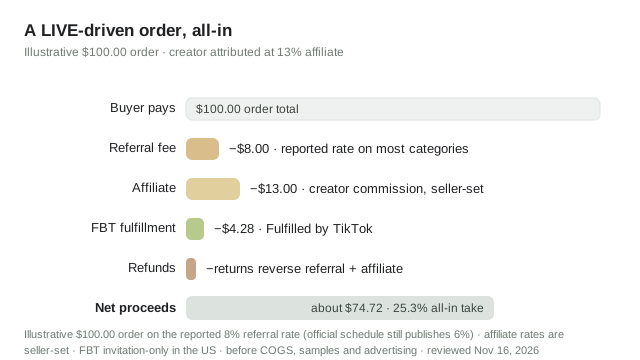
A $100 LIVE-driven order — fictional
A $100 order attributed to a creator’s LIVE at a 13% affiliate commission, fulfilled by TikTok, on the reported 8% referral rate. Referral: $8.00. Affiliate: $13.00. FBT fulfillment: ~$4.28. All-in platform + fulfillment: $25.28 — a 25.3% take before COGS, samples and ads. On the official 6% rate, the same order runs $22.28 — still north of any marketplace’s headline rate.
Read it as the price of the channel’s demand: TikTok’s LIVE-driven orders convert on impulse and reach buyers no other channel reaches, at a fee stack that assumes the margin is there. The sellers who do well on TikTok price from this worked example with their own affiliate rate, their own COGS, and their own volume — and revisit monthly, because the rates move.
Illustrative figures. Referral rates: 6% per TikTok’s published schedule, 8% per seller reports for most non-food categories since August 2026. Affiliate commissions are seller-set; FBT rates are invitation-dependent.
The books treatment #
TikTok Shop settles through its own payment flow (with deposit schedules set in Seller Center), netting referral fees, affiliate commissions and fulfillment inside the payout. The books pattern is the standard one: sales, refunds, referral fees, affiliate commissions, fulfillment and shipping subsidies on separate lines, reconciled to the settlement report monthly — the same discipline as the Walmart settlement walkthrough, adapted to TikTok’s line names. Affiliate commissions in their own account, refunds reversing sales, and samples in marketing — with those splits, the channel’s true margin is readable and the clearing-account pattern applies unchanged.
One growth-stage note: TikTok Shop volume often arrives fast (a viral video does that), and the books that can’t keep up are the ones that end up in the catch-up project. Set the account structure on day one of the shop, not day one hundred.
TidyPayouts splits every payout — TikTok lines included as they arrive — into reviewable books matched to the bank.
Ads and the promotion stack on top #
The referral and affiliate lines are the settled costs; TikTok’s ad products are the discretionary layer on top, and they are commonly the largest line after affiliate commissions for sellers scaling the channel. GMV Max and related campaign options promise automated bidding toward gross merchandise value — which makes the ad spend a fixed share of revenue by design, and makes it look like a fee even though it is optional spend. The books discipline holds: ads go to the advertising account, never blended into the referral line, so the advertising spend guide’s ROAS math stays possible. A seller running affiliates at 13%, ads at 10% of revenue and the referral at 8% is spending 31% of revenue on demand generation before fulfillment — a number that is fine on a 60%-margin product and fatal on a 35% one.
Which categories win on TikTok #
The fee structure prices categories unevenly, and the winners are predictable: impulse-friendly goods at healthy margins — beauty and personal care (where the 13% median affiliate rate is a rounding error on a 70% gross margin), novelty, snacks and drinks (reported to sit outside the 8% referral rise), and anything that demos well in fifteen seconds. The losers are heavy or oversized items (postage or FBT eats the margin), low-margin commodities (the affiliate floor prices them out), and anything where the buyer needs to think overnight — TikTok converts in the swipe, not the deliberation. The channel decision is category-first, the same way the take rates guide argues channel decisions are margin-first.
Common questions #
What is TikTok Shop’s referral fee?+
TikTok’s official US documentation publishes a 6% standard referral fee for most categories (around 5% for select jewelry and pre-owned items), with payment processing included. Since August 2026, seller reports describe the standard rate rising to 8% for most non-food categories — a change TikTok’s own pages have not clearly documented. Check the commission actually charged on your settlements; that is the number that counts.
Does TikTok Shop charge a payment processing fee?+
Not separately — payment processing is bundled into the referral fee under the standard structure, unlike eBay and Etsy where processing is a distinct line. That makes the referral rate the whole platform-side percentage, before affiliates and fulfillment.
What are affiliate commissions on TikTok Shop?+
Commissions you set and pay to creators whose shoppable videos or LIVE streams sell your product — typically 5–20% with category medians around 13% in beauty. They stack on top of the referral fee and are itemized on settlements. The affiliate program is TikTok’s main demand engine, so the rate is a strategy dial, not a hidden fee.
How much does Fulfilled by TikTok cost?+
FBT charges per-unit fulfillment fees (reports put entry rates around $4.28) and storage on held inventory — but access in the US has been invitation-only, and rate cards have shifted over time. Compare the current FBT card against your true self-fulfillment cost per SKU before routing inventory.
Do new sellers get TikTok Shop fee waivers?+
TikTok has run new-seller promotions reducing or waiving referral fees for an introductory window (commonly the first 30–90 days), alongside free-sample programs for affiliates. Promotions change frequently — confirm the current offer in Seller Center, and model steady-state economics after the waiver ends rather than pricing off the promo months.
Does TikTok refund the referral fee on returns?+
Yes — referral fees are refunded on eligible returned orders, with the reversal itemized on the settlement. Track the negative lines like any refund: netted against sales, never ignored, and reconciled to the settlement report in the monthly close.
How do I record TikTok Shop fees in my books?+
Book sales, refunds, referral fees, affiliate commissions and fulfillment charges on separate lines, reconciled to the settlement report, with the TikTok payment balance in a clearing account that sweeps to zero on deposits. Affiliate commissions belong in a selling/marketing cost line of their own; free samples sent to creators belong in marketing, not COGS.
Is selling on TikTok Shop worth the fees?+
Depends entirely on margin depth and whether the channel’s demand is additive. The all-in cost of an actively promoted product — referral, affiliate, fulfillment, samples, ads — often exceeds 20% of revenue, which is viable only where margin density supports it. Run the worked-order arithmetic with your own numbers monthly, and treat TikTok as a demand channel whose fees buy reach other marketplaces don’t offer.
Sources and review date #
Reviewed November 16, 2026. The referral-fee situation is genuinely two-sourced: TikTok’s official Seller University pages publish 6% while independent seller reports document an August 2026 rise to 8% for most non-food US categories — both are cited below, labeled as such in the text. Rates and promos change quickly on TikTok Shop; verify in Seller Center before pricing. Examples are fictional.