Tidy
In this article
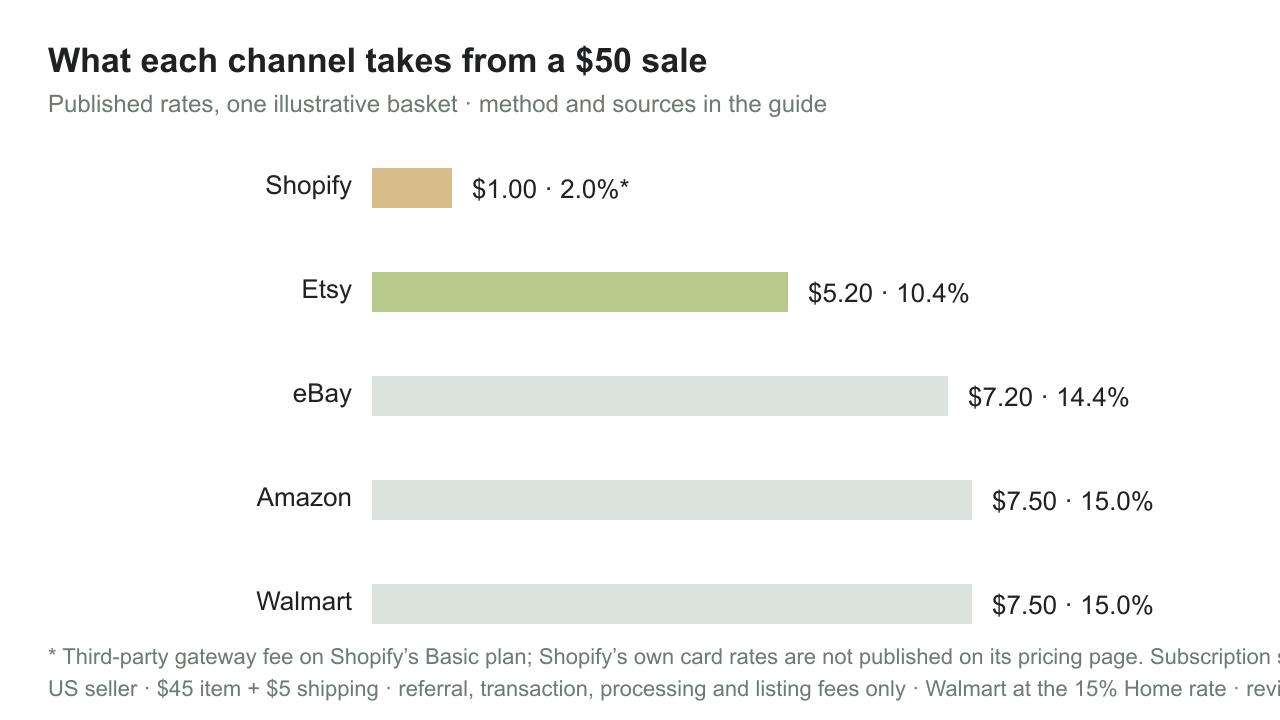
- On one $50 basket, published rates take $7.50 (Amazon, Walmart), $7.20 (eBay), $5.20 (Etsy) and $1.00 (Shopify, gateway fee only).
- The fee base differs by channel: shipping counts everywhere; sales tax counts on eBay and in Etsy’s processing fee.
- Fixed per-order charges (eBay’s $0.40, Etsy’s $0.25 processing minimum, Etsy’s $0.20 listing) weigh heaviest on cheap items.
- Shopify charges no per-sale marketplace fee; its costs are the subscription plus payment processing.
- Fulfillment, storage and advertising sit on top of every one of these numbers.
The $50 basket #
To compare channels honestly, hold the order constant and change only the fee schedule. The basket throughout this guide:
- A US seller, selling one item priced $45 with $5 shipping — a $50 order.
- No sales tax is collected on the order (so the tax rules below are noted, not applied).
- No advertising, no returns, no storage, and seller-fulfilled shipping.
- Only fees the marketplace publishes as standard percentages or fixed charges are counted; subscriptions are shown separately.
Real orders have taxes, ads and fulfillment costs. The point of a fixed basket is not to predict your payout — it is to make the published schedules comparable at all. Every number below was checked against the provider’s own fee page in October 2026, with sources listed at the end.
What each channel takes from $50 #
| Channel | Fees applied | Cost | Effective rate |
|---|---|---|---|
| Shopify | Third-party payment gateway, Basic plan (2%) | $1.00 | 2.0% |
| Etsy | $0.20 listing + 6.5% transaction + 3% + $0.25 processing | $5.20 | 10.4% |
| eBay | 13.6% final value + $0.40 per-order | $7.20 | 14.4% |
| Amazon | 15% referral (most categories) | $7.50 | 15.0% |
| Walmart | 15% referral (Home, Kitchen, Decor & Garden) | $7.50 | 15.0% |
Walmart’s rate is category-tiered: at the 8% Consumer Electronics rate the same order costs $4.00 (8.0%). Shopify’s figure is a gateway fee, not a marketplace commission; see the Shopify section for what is and is not included.
For the whole Shopify cost map — plans, Shopify Payments rates, the gateway fee, POS, apps and tax tools — see our Shopify fees guide.
The ranking is not a verdict. Etsy’s low headline cut assumes no Offsite Ads sale; Amazon’s 15% assumes a 15% category; eBay’s 13.6% is its most common category rate. What the table does show is where each schedule puts its weight: percentage-heavy on Amazon and Walmart, percentage-plus-fixed on eBay, stacked small fees on Etsy, and subscription-plus-processing on Shopify.
How much does Amazon take? #
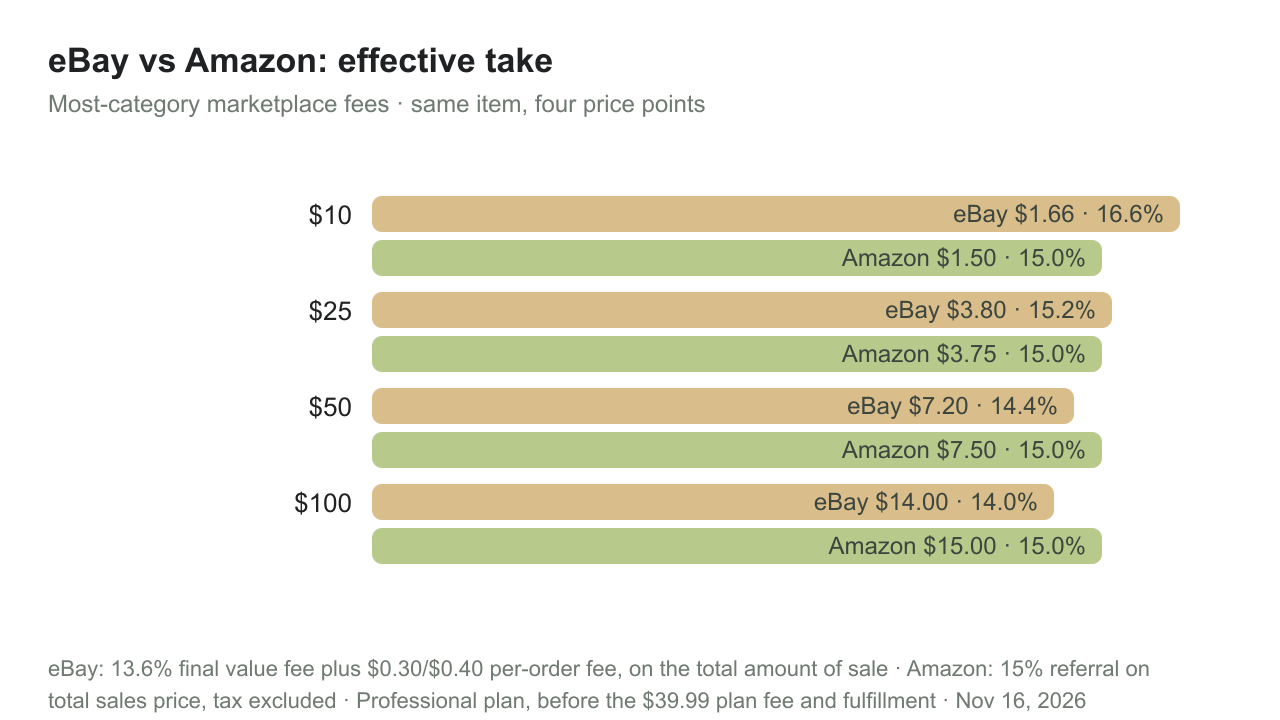
Amazon’s standard cut is the referral fee: 15% of the total price in most categories, with a $0.30 minimum. The total price means the item price plus shipping and gift wrap — which is why the $50 basket pays $7.50, not 15% of $45.
Two plan costs sit outside that percentage. The Professional plan costs $39.99/month; the Individual plan waives the subscription but charges $0.99 per item sold. Neither is in the $7.50 figure.
The 15% is not universal. Amazon’s own pricing page lists 8% for Computers and Consumer Electronics, 12% for Automotive & Powersports, and 5%/10%/17% tiers for Clothing depending on price, while Media categories add a $1.80 closing fee on top of 15%. Check your category rather than assuming 15%.
How much does eBay take? #
eBay’s final value fee is 13.6% on the total amount of the sale up to $7,500 (2.35% on the portion above that), in its most common categories — plus a fixed per-order fee: $0.30 on orders of $10 or less, $0.40 on larger orders. On the basket: 13.6% × $50 = $6.80, plus $0.40, or $7.20.
Two details widen the base beyond the item price. The final value fee applies to shipping the buyer pays, and to sales tax — so a taxed, shipped order pays fees on all three. Listing is free for the first 250 insertions each month, then $0.35 per listing.
How much does Etsy take? #
Etsy charges three separate fees on a normal sale, which is why its published percentages look low but stack up:
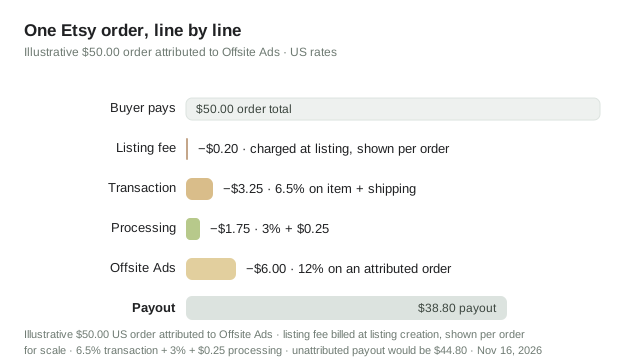
The same $50 basket on Etsy
Listing: $0.20 (charged every four months, auto-renewed after each single-quantity sale). Transaction fee: 6.5% × $50 = $3.25, on the item price plus shipping and gift wrap. Payment processing (US): 3% × $50 + $0.25 = $1.75, on the total amount of the sale including tax and shipping. Total: $0.20 + $3.25 + $1.75 = $5.20, or 10.4%.
On top sit Offsite Ads: when an Etsy-placed ad produces the sale, the fee is 15% of the attributed order for shops under $10,000 in trailing-365-day sales (opting out is allowed below the threshold) and 12% once the shop crosses $10,000, capped at $100 per attributed order. An attributed $50 sale at 15% would add $7.50 — more than the rest of Etsy’s fees combined. Sellers listing in a currency other than their payment account’s also pay a 2.5% currency conversion fee.
How much does Walmart Marketplace take? #
Walmart charges a single Referral Fee, a percentage of gross sales — the item price plus shipping and handling and gift wrap — set by contract category, with no separate payment-processing or listing fee. Most categories land between 8% and 15%.
The schedule is tiered in several categories: Apparel & Accessories is 5% up to $15, 10% from $15–$20, and 15% above $20; Grocery is 8% up to $15 and 15% above; Consumer Electronics is 8%; Home, Kitchen, Decor & Garden is 15%. The table above uses the 15% Home rate; the same basket in Consumer Electronics would cost $4.00. Walmart Fulfillment Services, storage and Walmart Connect advertising are separate costs.
What does Shopify charge instead? #
Shopify is your own store, not a marketplace, so there is no referral or transaction commission on the sale itself. Its costs have a different shape: a subscription — Basic at $19/month billed yearly ($27 month-to-month) — plus payment processing. If you use a third-party gateway instead of Shopify Payments, Shopify adds 2% on Basic, 1% on Grow, 0.6% on Advanced, 0.2% on Plus; on the basket, that is $1.00 on Basic. Shopify’s own card rates are not published on its pricing page; they vary by plan and region, so pull the rate from your own Shopify Payments settings.
The fee, however, was never the expensive part of a marketplace. On your own store you also pay for the traffic that marketplaces bring built in — which is why the 2% row in the table says less about total cost than any other number in it.
TidyPayouts splits each payout into sales, refunds and fee types, then matches it to your bank — so margin reports use what was actually charged, not a published estimate.
What a published rate misses #
Every figure in this guide is a floor, for the same reason: the schedules above exclude the costs that usually decide profitability.
- Fulfillment — FBA and Walmart Fulfillment Services charge per unit by size and weight; self-shipping costs postage and materials.
- Advertising — Amazon ads, Etsy Ads, Offsite Ads on attributed orders, eBay promoted listings, Walmart Connect.
- Storage and long-term fees — time- and volume-based, and absent from every percentage above.
- Subscriptions — Amazon Professional $39.99/month, Shopify from $19/month, Etsy Plus if you opt in.
- Returns, refunds and reserves — not fees, but they change the deposit; see why your Amazon deposit doesn’t match your sales.
For the full taxonomy of fee buckets and why they should stay on separate lines, read every fee hiding inside a marketplace payout.
Find your own take rate #
Your real take rate is measurable, not publishable: total channel fees for a month, divided by gross sales for the same month, per channel. The four-step fee list exercise shows how to label every charge from your own statements.
Then make the published rates above your baseline: put your measured rates, product cost and shipping into the marketplace fee and profit calculator and compare channels on profit, not on fees alone. When you are ready to book the real numbers, the channel integration guides cover importing each marketplace’s settlements into QuickBooks Online.
The rates as data #
The table above is built from the inputs below, checked against each provider’s own fee page on October 29, 2026. We publish them as a plain CSV so you can audit the computation, plug your own category into it, or load it into a spreadsheet: marketplace-fee-schedule-2026-10.csv. Each row has the rate, any fixed amount, what the rate is applied to, and the source page. Rates change, and categories vary, so treat it as a dated snapshot and confirm current terms for your own account.
If you cite these figures, link to this page and name the date. A schedule that is true on one date can be wrong a quarter later, and the date is what lets a reader tell the difference.
From take rate to profit per month #
The take rate answers “how much does the channel keep per sale?” — but businesses do not bank percentages, they bank months. The conversion is one multiplication: profit per month = units sold × (price − cost − take). A 15% take on a $50 item nets $42.50 per unit after fees — 200 units a month is $8,500 of contribution; an 8% take on a $40 item nets $36.80 — 90 units a month is $3,312. The lower-rate channel wins only if the units come with it, and they usually don’t: take rates and velocity are inversely related across channels because the higher-rate channels bring more buyers.
That is why the honest channel decision is per product, per month, using your own velocity data on each channel — the framework the worked examples above set up. Run the same SKU’s monthly volume on each channel through its real take (fees, fulfillment, ads included), and compare contribution. The basket above tells you which schedule is cheaper for a given sale; your Seller Central and Seller Hub dashboards tell you which channel actually sells your item. Profit per month is where those two answers meet, and it is the only version of this comparison that pays rent.
Recompute the basket for your own mix #
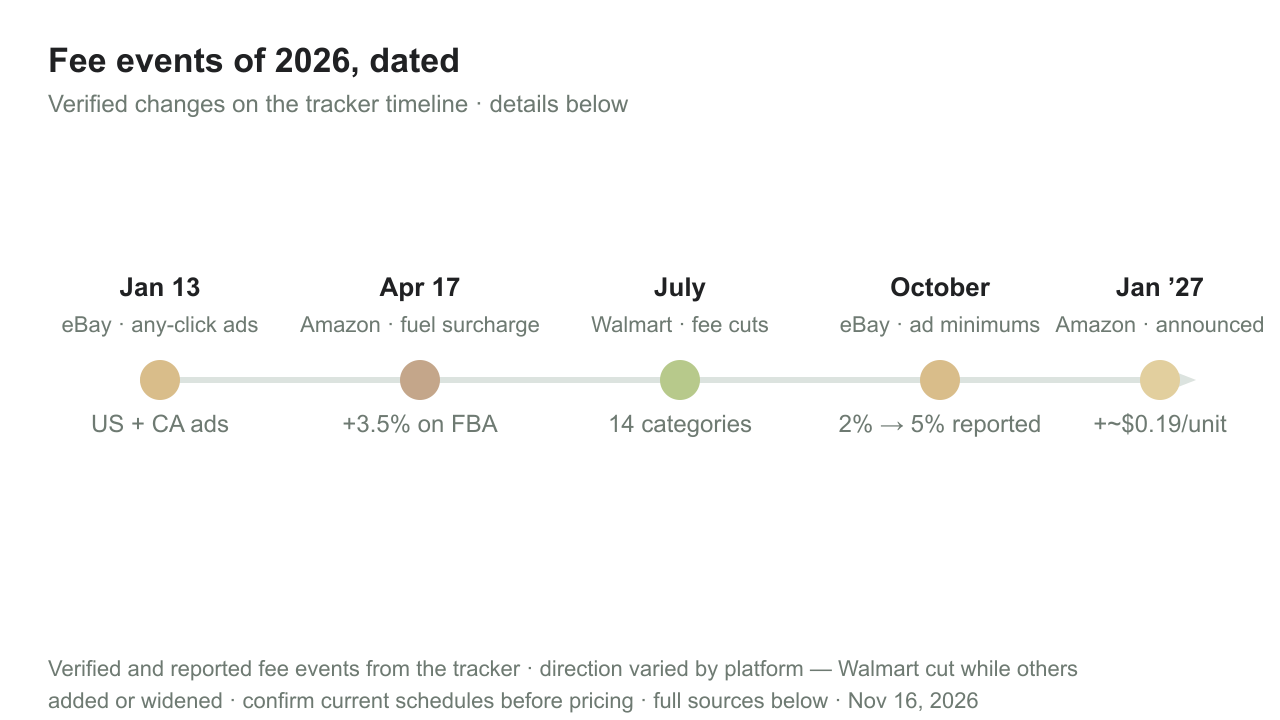
The $50 basket is a teaching device, and its assumptions are the first thing to replace with your own numbers. The method is mechanical: list your actual average selling price per channel (it differs — price points that work on eBay may not on Amazon), your actual shipping charge per order, your state-weighted sales tax rate, your fulfillment cost per unit as you actually fulfill, and your advertising percentage as you actually spend it. Then recompute each channel’s take with those inputs instead of the defaults above, using each channel’s official schedule for the percentage lines — the deep-dive guides for Amazon, eBay, and the Walmart category schedule carry the verified tables.
Two habits keep the recomputation honest. Use a median item, not your bestseller — bestsellers usually have negotiated economics that flatter the numbers. And recompute quarterly: fee schedules change (Amazon and Walmart repriced in 2026), categories get moved, and your own mix drifts. A quarterly one-page recomputation is the difference between “our take rate is around 15%” as a slogan and the same sentence as a number you can price against — which is the entire point of this guide.
Common questions #
What percentage does Amazon take per sale?+
15% of the total price (item plus shipping and gift wrap) in most categories, with a $0.30 minimum, plus $39.99/month for the Professional plan or $0.99 per item on the Individual plan. Exceptions include 8% for Computers and Consumer Electronics, 12% for Automotive, tiered rates of 5–17% for Clothing, and a $1.80 closing fee on media.
Is Etsy cheaper than eBay and Amazon?+
On this $50 basket, yes: $5.20 versus $7.20 and $7.50. The margin narrows on cheap items, where Etsy’s fixed $0.20 listing and $0.25 processing fees weigh more, and an Offsite Ads attribution adds 15% of the whole order. Compare with your own prices before switching channels.
Do marketplace fees apply to shipping and sales tax?+
Shipping counts in every marketplace fee base above. Sales tax counts on eBay’s final value fee and in Etsy’s payment processing fee; Amazon’s and Walmart’s referral bases cover item price, shipping and gift wrap but not sales tax.
Is Shopify cheaper than selling on a marketplace?+
Per sale, usually: no commission, and a 2% third-party gateway fee on the Basic plan versus 10–15% marketplace cuts. Per business, it depends — the subscription is fixed, and you pay to acquire the traffic a marketplace delivers. The two models are complements for most sellers, not substitutes.
How do I calculate my own effective take rate?+
For each channel: total of every marketplace-charged fee in a month, divided by gross sales in the same month. Label fees into buckets first so advertising and fulfillment stay out of the selling-fee rate, then compare that rate against the published baselines above to see what your mix adds.
Sources and review date #
Reviewed October 29, 2026 against each provider’s own published fee page. Rates change; verify current terms for your account and category before making decisions.
Change log. November 13, 2026: Page title and summary shortened for search results; the guidance is unchanged.