Tidy
In this article
- The final value fee is a percentage of the total amount of the sale — item price, shipping you charged and sales tax included — plus a fixed per-order fee: $0.30 on orders of $10.00 or less, $0.40 above.
- Most categories pay 13.6% up to $7,500 per item. Books, movies and music pay 15.3%; trading cards and coins pay 13.25%; watches step down to 3% on the portion above $7,500; athletic shoes over $150 pay a flat 8% with no per-order fee.
- Surcharges, international fees, currency conversion, advertising and store subscriptions sit on top of the headline rate. Refunds can earn fee credits — but the per-order fee is not always credited back.
- Percentage-based fees usually reduce the payout line; listing charges, stores and ads typically arrive on the monthly invoice. Books that record a single “eBay fees” number miss that split.
eBay fees at a glance #
eBay charges no monthly fee by default: you can open an account, list up to 250 items a month without paying an insertion fee, and owe nothing unless something sells. From that point on, almost every charge falls into one of the buckets below.
| Fee | When it applies | Typical amount (US) |
|---|---|---|
| Final value fee | Every completed sale | 13.6% of the total sale in most categories, plus 2.35% on the portion of an item’s price above $7,500 |
| Per-order fee | Every order | $0.30 on orders of $10.00 or less; $0.40 above $10.00 |
| Insertion fee | Listings beyond your free allotment | $0.35 per listing after the first 250 free each month |
| Listing upgrades | Optional, per listing | Roughly $1.00–$6.00 each; a reserve price costs $5.00 or 7.5% of the reserve (capped at $250), charged whether or not the item sells |
| Below standard surcharge | The month after a below-standard performance period | +6% on top of applicable final value fees; +7% after four or more consecutive months |
| Very high “item not as described” surcharge | After a very high INAD rate in a category | +5% on top of applicable final value fees; +6% after four or more consecutive months |
| International fee | Buyer address or delivery outside the US | 1.65% of the total sale; waived when the order ships through eBay International Shipping |
| Currency conversion charge | Funds paid to you in a different currency | 3.25% added to the base exchange rate; the conversion calculator compares this with other channels |
| Dispute fee | Certain payment disputes, such as chargebacks | $20.00 per dispute (excludes sales tax) |
| Advertising fee | Only if you run Promoted Listings campaigns | The ad rate you set, charged as a percentage of attributed sales |
| Store subscription | Optional | $4.95–$2,999.95 per month on yearly billing; $7.95–$349.95 on monthly billing |
US rates reviewed November 16, 2026 against eBay’s selling fees help pages. Your category, store level, listing choices and performance history change the amounts, and eBay revises its fee schedules periodically — confirm the numbers for your own account before making pricing decisions. Other eBay marketplaces publish their own fee schedules; this guide covers the US site.
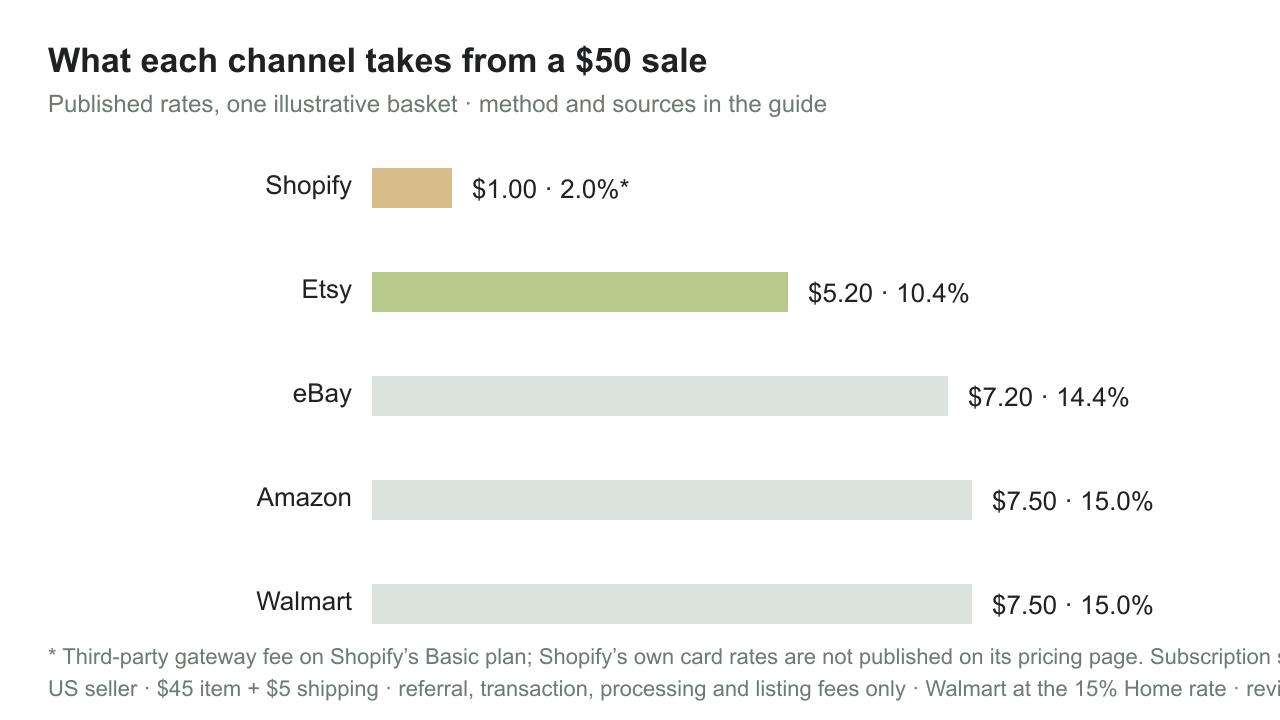
Added up, the charges usually come to more than the headline percentage. Our marketplace take rates piece computes one $50 basket across channels: eBay’s published schedule takes $7.20 of that order — 14.4% — once the 13.6% final value fee and the $0.40 per-order fee are both counted. The rest of this post walks through each bucket, then shows where every fee lands in your payout and your books.
The final value fee #
The final value fee is the main charge on every sale, and the one sellers most often miscalculate, because eBay does not compute it on the item price alone. eBay calculates it on the total amount of the sale: the item price, any handling charge, the shipping fees the buyer pays (with limited exceptions in some categories), applicable sales tax, and any other fees the buyer is charged.
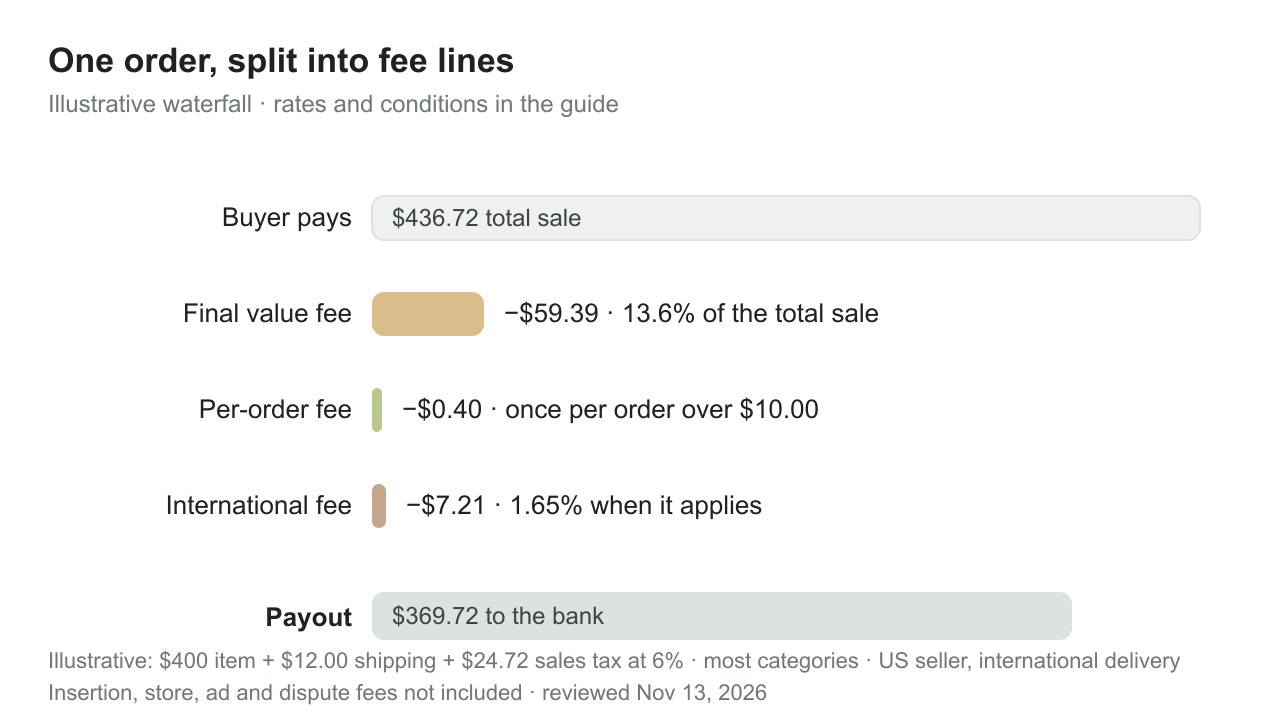
Two consequences follow. First, an item that sells for $400 with $12 shipping and $24.72 of sales tax pays a final value fee computed on $436.72, not on $400. Second, the sales tax component deserves special attention: under marketplace facilitator laws, eBay collects and remits that tax itself in most US states — you never touch the money — yet the final value fee is still computed on it. The tax side of that story is covered in our marketplace facilitator sales tax guide.
The shipping slice has its own wrinkle: when a listing offers more than one domestic delivery service, the fee base is calculated on the cheapest domestic option you offer, not necessarily the one the buyer picked. A listing offering standard shipping at $8.00 and expedited at $20.00 owes its final value fee on the $8.00 base even when the buyer pays for expedited — the extra $12.00 is real revenue that sits outside the fee calculation. Orders handed to eBay International Shipping are computed differently again: on what it costs you to ship to eBay’s US hub, not on what the buyer paid for delivery.
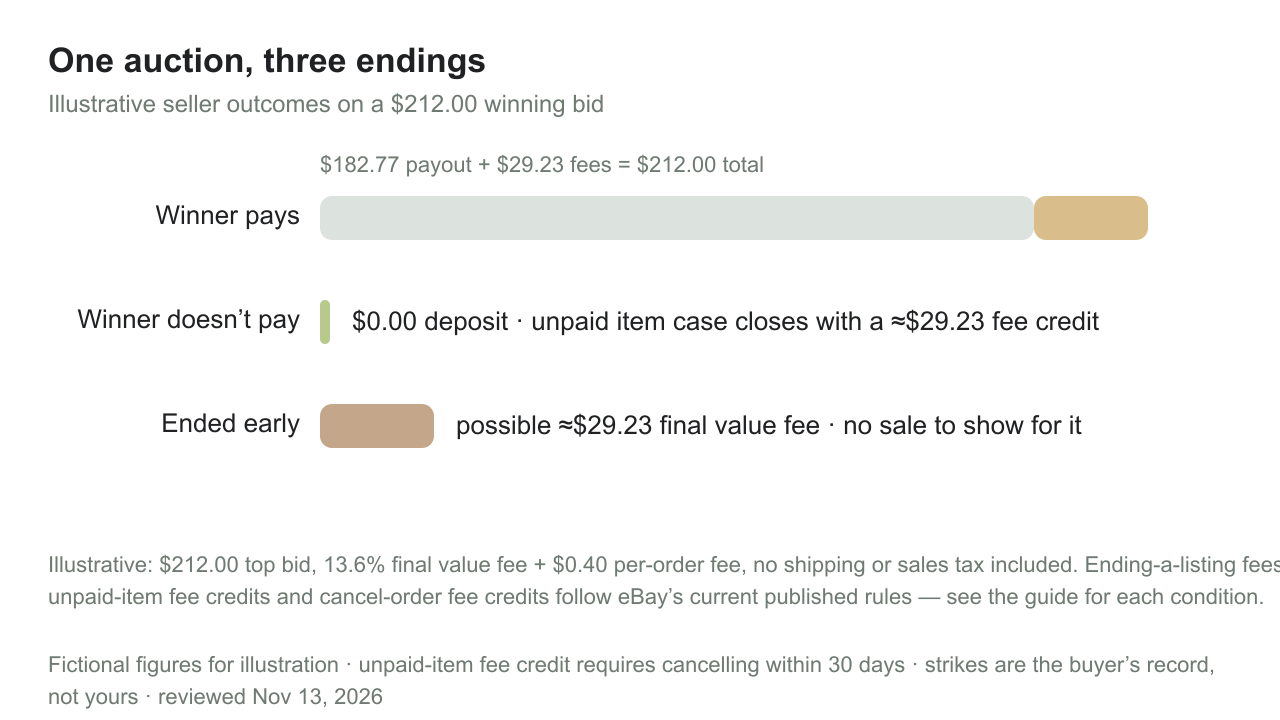
The fee is charged as a percentage by category plus the fixed per-order fee described below. If the buyer never pays, or the sale is cancelled or fully refunded in qualifying circumstances, fee credits may apply — covered under fee credits below.
Final value fee rates by category #
eBay publishes a per-category table. The tiers are per item: an item whose price crosses a threshold pays the lower rate only on the portion above it.
| Category | Final value fee |
|---|---|
| Most categories (including Motors Parts & Accessories) | 13.6% on the total sale up to $7,500 per item, then 2.35% on the portion above |
| Books & Magazines, Movies & TV, Music | 15.3% up to $7,500 per item, then 2.35% |
| Coins & Paper Money (excluding bullion) | 13.25% up to $7,500 per item, then 2.35% |
| Select collectibles, sports trading cards, collectible card games | 13.25% up to $7,500 per item, then 2.35% |
| Bullion (gold, silver, platinum) | 13.6% on sales of $7,500 or less; 7% above |
| Women’s bags & handbags | 15% on sales of $2,000 or less; 9% above |
| Jewelry & Watches (excluding watches, parts & accessories) | 15% on sales of $5,000 or less; 9% above |
| Watches, Parts & Accessories | 15% up to $1,000; 6.5% from $1,000 to $7,500; 3% above $7,500 |
| Guitars & Basses | 6.7% up to $7,500 per item, then 2.35% |
| Athletic shoes (men’s, women’s), sale of $150 or more | 8% — and the per-order fee is not charged |
| Athletic shoes, sale under $150 | 13.6%, plus the usual per-order fee |
| NFTs | 5% of the total sale |
| Select Business & Industrial (heavy equipment, commercial printing presses, food trucks) | 3% up to $15,000 per item, then 0.5% (a $20 insertion fee applies per listing) |
Summarized from eBay’s published selling fees table, reviewed November 16, 2026. Category boundaries and tier thresholds change occasionally — for example the jewelry and watches split — so read the current table for your exact category before you price.
Two structural points are worth internalizing. High-ticket categories use stepped tiers so the effective percentage falls as price rises — a $12,000 watch pays far less than 15% overall. And adjacent categories can sit on either side of a boundary line, so a listing re-categorized from “jewelry” to “watches, parts & accessories” changes the fee on the very same item. Listing one item in two categories is charged the insertion fee for each category but only one final value fee when it sells — the higher of the two category rates — so the second category buys search visibility, not a doubled fee.
The per-order fee #
Alongside the percentage, eBay charges a fixed amount per order: $0.30 on orders of $10.00 or less, $0.40 above $10.00. It is charged once per order, not per item. Three buyers each ordering a $40 item from the same listing in one combined checkout produce one $0.40 charge; the same three purchases as separate orders produce $1.20.
That combining effect is small but real: three $40 items in one order owe 13.6% × $120 + $0.40 = $16.72 in fees, while the same three items in three orders owe $17.52 — eighty cents more for identical merchandise. Encouraging buyers to consolidate a multi-item purchase into one order is one of the few fee levers that costs nothing.
The per-order fee also behaves differently from the percentage on refunds: in many refund situations the category fee is credited but the fixed per-order fee is not. See fee credits on refunds below.
Insertion fees and listing upgrades #
Listing an item is free up to eBay’s monthly allowance — 250 zero-insertion-fee listings per month for most sellers without a store, counted across most categories. Beyond that, each listing costs $0.35, and the charge is per category, per listing: the same item listed in two categories consumes the allowance (or incurs the fee) twice. One listing is still one charge, though: a multi-quantity listing or a bundled lot consumes the allowance once, however many units it eventually sells. Re-lists and the automatic renewals of a Good ‘Til Cancelled listing count as new listings too. Insertion fees are not refunded if the item does not sell.
A few categories break the pattern: Guitars & Basses carry no insertion fee at all, while select Business & Industrial categories such as heavy equipment charge $20.00 per listing. Real estate listings have their own much higher insertion schedule.
On top of insertion, optional listing upgrades are charged per listing when used — a subtitle, bold title, gallery plus, international site visibility, short 1- or 3-day auction durations, and reserve prices. The prices differ between auction-style and fixed-price formats (for example, a subtitle is $1.50 on an auction-style listing priced at or below $150 but $3.00 above it, while the equivalent fixed-price upgrade is $2.00 and $6.00). The reserve price upgrade deserves a special warning: it costs $5.00 or 7.5% of the reserve price, capped at $250, and it is charged whether or not the item sells. Upgrade fees are billed through the monthly invoice rather than deducted from a sale, since they exist independent of any transaction.
Performance surcharges #
eBay evaluates seller performance each month on two axes: your overall seller level and your “item not as described” (INAD) rate within each category. Falling short on either raises your fees for the following month:
- Below standard in seller level: an extra 6% is added to applicable final value fees for the next month. If you stay below standard for four or more consecutive months, the surcharge rises to 7%.
- Very high INAD rate in a category: an extra 5% on final value fees in the affected category for the next month, rising to 6% after four or more consecutive months.
- If both conditions apply at once, only the below standard surcharge is charged — they do not stack.
On a 13.6% category, a below-standard month means paying roughly 19.6% on every sale — a 44% increase in selling costs from performance alone. Surcharges also show up in your books as a change in effective fee rate with no change in price: a month where fee expense runs consistently high on ordinary sales is often the first visible sign that a seller level slipped. Check Seller Hub’s performance pages monthly rather than waiting for the invoice.
One edge case worth knowing: if you complete a sale off eBay with a buyer who found the item through your eBay listing — for example by steering them to another channel — eBay’s policy treats that as an avoided final value fee and can charge the fee anyway, even though no sale completed on the platform.
International and currency conversion fees #
Two charges attach to cross-border sales. The international fee is 1.65% of the total amount of the sale, charged when the buyer’s registration address or the delivery address is outside the US — even if you, the seller, never leave your living room. It is waived when the order ships through eBay International Shipping, eBay’s own program where you sell domestically and eBay handles the export leg.
Separately, if the funds owed to you are converted to your payout currency, eBay applies a currency conversion charge of 3.25% above the base exchange rate. For a US seller paid in dollars this usually does not arise; for sellers receiving in another currency, or holding balances in a different currency than their bank, it can silently consume more than the international fee itself.
Both fees belong in the books as their own category, not lumped into a generic fee total, because they scale with geographic mix rather than with effort: the same item, sold domestically and internationally, carries fees that differ by more than a percentage point. Our multi-currency payouts guide covers the recording side.
Dispute fees #
When a buyer escalates a payment dispute — opening a chargeback or a significant transaction problem that ends in a payment reversal — eBay can charge a $20.00 dispute fee per dispute (sales tax excluded). The charge applies in circumstances eBay defines, generally where the dispute is not resolved in the seller’s favor; winning a dispute avoids it. The fee exists independently of the underlying loss: a lost chargeback costs you the merchandise, the sale proceeds and the $20.00.
Prevention is worth more than accounting here: accurate descriptions, tracked shipping to the address on the order, and fast responses to “item not received” requests are the documented paths that keep disputes from being decided against you. Our chargebacks and payment disputes guide covers the bookkeeping when one lands anyway.
Advertising fees (Promoted Listings) #
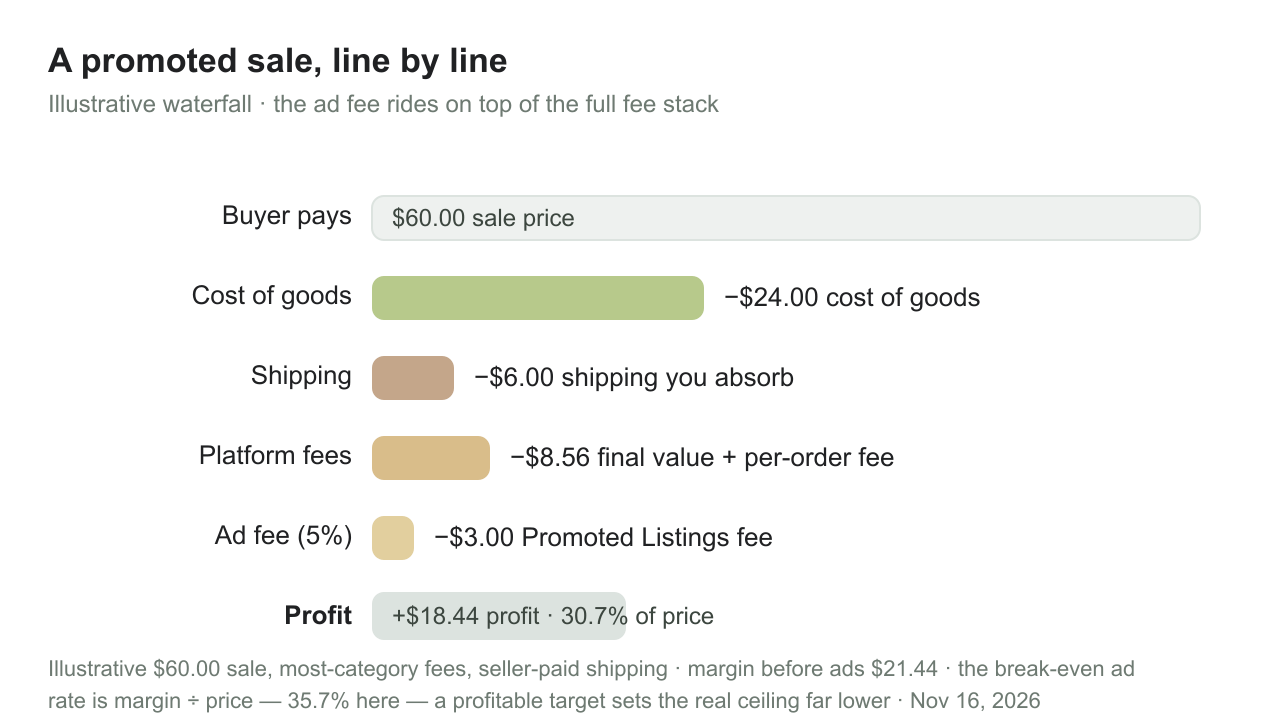
Promoted Listings — eBay Ads — is optional and charged only if you opt in, which makes it the one large fee bucket entirely under your control. The main campaign type, general priority, is cost-per-sale: you choose an ad rate (a percentage of the final sale price, subject to a category minimum), and the fee is charged only when a promoted listing sells through the ad. A second family of campaigns, priority, works on a cost-per-click basis with budgets and keyword targeting instead. eBay also runs off-site advertising that promotes listings on search engines and social platforms.
The mechanic that surprises sellers most is attribution. An ad-attributed sale is counted through eBay’s attribution rules — which sale counts as “from your ad” and over what window — and eBay has changed those rules over time, most recently announcing changes for US and Canada campaigns effective January 13, 2026. If advertising is a meaningful line for you, review the current rules in Seller Hub rather than relying on a blog post, including this one.
Ad fees typically appear on the monthly invoice rather than as a deduction from each payout, and they belong in a separate advertising expense account — not in selling fees — so that campaign return on ad spend is measurable. Our marketplace advertising spend guide covers the account structure.
Store subscriptions #
An eBay Store is a monthly subscription that raises your free-listing allowance and lowers final value fees in many categories. US pricing, per month:
| Store level | Monthly billing | Yearly billing | Zero insertion fee listings per month |
|---|---|---|---|
| Starter | $7.95 | $4.95 | 250 |
| Basic | $27.95 | $21.95 | 1,000 fixed-price + 250 auction-style |
| Premium | $74.95 | $59.95 | 10,000 fixed-price + 500 auction-style |
| Anchor | $349.95 | $299.95 | 25,000 fixed-price + 1,000 auction-style |
| Enterprise | — | $2,999.95 | 100,000 fixed-price + 2,500 auction-style |
US prices per month as displayed for each billing cycle, reviewed November 16, 2026 from eBay’s store subscription pages. Enterprise is sold on yearly billing only, and the auction-style allowances at Basic and above apply only in select categories such as collectibles, art and jewelry.
Subscribers also get reduced final value fee rates in many categories — eBay’s Seller Center cites 12.7% versus the standard 13.6% as an example of the saving — along with a monthly invoice, marketing tools and a custom storefront. Two details from eBay’s store fee table sharpen that discount. The discount arrives with the tier: Basic and above pay 12.7% in most categories up to $2,500 per item and 2.35% on the portion above, while a Starter store’s rates match the standard schedule — its value is the storefront and the monthly invoice, not the fee table. And for Basic and above the step-down threshold drops from $7,500 to $2,500, so on a $4,000 item the 2.35% tail rate applies from $2,500 upward — worth more than the headline point on high-ticket sales. The exact store-subscriber rates still vary by category — cameras, consumer electronics and video games drop as low as 9.35% at Basic and above — so read eBay’s store selling fees table for your categories rather than assuming a single discount.
Whether a Store pays for itself is arithmetic, not intuition. Suppose you consistently list 100 fixed-price items a month with no store. The first 250 listings are free, so insertion fees are $0 — the subscription must be paid for out of the final value fee discount alone, which a Starter store does not offer. At $40 average orders and Basic’s 0.9-point discount (13.6% → 12.7%), each sale saves $0.36, so roughly 61 sales a month justify Basic at $21.95 on yearly billing. A seller listing far more than 250 items a month, by contrast, accumulates $0.35 insertion charges: 400 over-allotment listings cost $140 without a store, or $100 at Basic’s $0.25 subscriber insertion rate — either way against a $21.95 subscription. Run the math on your own volumes; the crossover point depends almost entirely on how many listings and sales you actually carry.
Bookkeeping note: store subscriptions are charged monthly in advance (or annually for yearly plans), so a yearly plan paid in January covers twelve months and belongs in prepaid expense, released monthly — worth a conversation with your bookkeeper rather than a single January expense entry.
Fee credits on refunds #
When a sale is undone, eBay may return the fees it charged, as fee credits. The rules are more layered than “refunds get fees back”:
Cancellations before payment have their own path entirely — bids cancelled while the auction is live, ended listings and unpaid-item cases. See how to cancel a bid on eBay as a seller for the rules and the records each one leaves.
| What happened | What eBay credits |
|---|---|
| Buyer changed their mind (ordered by mistake, wrong size, found a better price…) and you refund in full | Category final value fee and the per-order fee |
| Item arrived damaged, defective, or not as described; or item not received; or you issued a voluntary partial refund; or you lost a payment dispute | Category final value fee only — the per-order fee is not credited |
| Partial refund | A proportional share of the category fee (a 20% refund earns 20% of the eligible fee); per-order fee not credited |
| You cancel the order for a reason outside your control | All fees |
| You cancel the order as out of stock (within your control) | Category final value fee only |
| You refund outside eBay (for example directly through the original payment method) | No automatic fee credit |
Summarized from eBay’s fee credits policy, reviewed November 13, 2026. Credits appear as separate lines in your transaction report; fixed per-order fee credits can take up to ten days to appear.
The pattern is consistent: eBay returns the percentage fee far more readily than the fixed one, and it credits proportionally, not all-or-nothing. The recording consequence matters — a $90 partial refund on a $800 order does not reverse the original fee entry, it adds a smaller credit line. Our eBay refunds and fees reconciliation guide walks through matching those credit lines to payouts without netting them into invisibility.
Three worked examples #
All three examples are fictional and use the rates verified above: most categories at 13.6%, per-order fee $0.30/$0.40, international fee 1.65%. Real payouts will differ by category, store level and shipping choices.
Example 1: a domestic sale with shipping and tax
A $400 camera lens sells with $12.00 shipping and 6% sales tax ($24.72). The total amount of the sale is $436.72. Final value fee: 13.6% × $436.72 = $59.39. Per-order fee: $0.40. Total fees: $59.79, leaving $376.93 before any other charges — an effective take of about 13.7%. Note that $3.36 of the fee is computed on the sales tax slice: money eBay collected for the state, then charged you a percentage on.
Example 2: the same sale, international delivery
Same order, but the buyer is in Canada and the item does not ship through eBay International Shipping. The 1.65% international fee adds $7.21 (1.65% × $436.72). Fees total $67.00 and the payout drops to $369.72. Had the order qualified for eBay International Shipping, the $7.21 would not apply — the single largest fee difference a US seller can control with a program choice rather than a price change.
Example 3: a small order
A $9.99 trading card sells domestically. Final value fee: 13.6% × $9.99 = $1.36. Per-order fee: $0.30 (the order is at or below $10.00). Total fees: $1.66 — an effective take of 16.6%. Small orders are where the fixed fee bites hardest, which is why the effective percentage in the next table falls steadily as order size grows.
eBay’s cut at different price points #
Using most-categories rates with no shipping, tax, or other fees, so the order total equals the total amount of the sale:
| Order total | Final value fee (13.6%) | Per-order fee | Total fees | Effective take |
|---|---|---|---|---|
| $9.99 | $1.36 | $0.30 | $1.66 | 16.6% |
| $25.00 | $3.40 | $0.40 | $3.80 | 15.2% |
| $100.00 | $13.60 | $0.40 | $14.00 | 14.0% |
| $500.00 | $68.00 | $0.40 | $68.40 | 13.7% |
| $2,000.00 | $272.00 | $0.40 | $272.40 | 13.6% |
| $10,000.00 | $1,078.75 | $0.40 | $1,079.15 | 10.8% |
The $10,000 row applies the tiered rates: 13.6% on the first $7,500 and 2.35% on the remaining $2,500, plus the per-order fee. Illustrative computations, not a quote.
Read the table as a pricing tool: below roughly $25 per order, every dollar of price carries an extra half-point of take compared with the headline rate, and a $10.00 order sits right on the per-order fee boundary ($0.30 or $0.40 depending on which side of it you price). None of this makes small items unprofitable automatically — it means the margin on them must be planned rather than assumed.
Where fees land in your payouts and books #
eBay operates on managed payments: fees that attach to a transaction are deducted from the funds the buyer paid, before the payout is sent to your bank. A payout line is therefore a net number — sales, minus refunds, minus percentage fees, plus fee credits. Charges that exist independent of any sale — insertion fees, listing upgrades, store subscriptions, advertising — are typically billed on the monthly invoice and charged to your payment method on file instead.
That split has a bookkeeping consequence people hit constantly: if you record only the payout as a sale with “some fees,” two different fee streams land in one number, one of them netted invisibly inside sales. The cleaner structure keeps sales, refunds, fee credits and fees by type on separate lines — selling fees (percentage and per-order), international and currency charges, advertising, store subscription, listing fees — with the monthly invoice booked as its own expense entry, not merged into payout fees.
eBay’s transaction report carries the fee detail per row, and the payout report reconciles to the bank credit. Setting that structure up in QuickBooks is our eBay to QuickBooks guide; the reconciliation routine lives in the refunds and fees reconciliation post; and the monthly close is in the month-end checklist.
TidyPayouts splits every eBay payout into sales, refunds, fee credits and fees by type, then matches the deposit to your bank before anything is posted.
Keeping eBay fees down #
Most eBay fees are the cost of the marketplace and cannot be waived; a surprising number of them respond to behavior, though. In rough order of impact:
- Stay above standard. The 6% performance surcharge is the single largest avoidable fee on the platform — a seller at 13.6% who slips below standard pays about 19.6% the following month. Monitor your seller level and INAD rate monthly.
- Run the store math once a quarter. Past roughly 60 sales a month at a $40 average, or about 65 over-allotment listings a month, a Basic subscription starts to win on arithmetic alone (see the store section). Re-run it when volumes shift.
- Ship international orders through eBay International Shipping where the program fits, and the 1.65% international fee disappears on those sales.
- Combine orders. One checkout is one per-order fee. A buyer purchasing three items separately costs $0.80 more in fixed fees than the same three items in one order.
- Mind the category boundary. Listing a watch as jewelry rather than watches, parts & accessories is a 15% versus 15%/6.5%/3% difference. Verify every listing’s category fee before you price, especially near boundaries.
- Skip paid upgrades that do not convert. Subtitles, bold and gallery plus are cheap individually and meaningless in aggregate; a reserve price costs real money whether or not the item sells.
- Price small orders with the fixed fee in mind. Below $10 the per-order fee drops to $0.30; at $9.99 versus $10.01 the fee difference is trivial, but the effective percentage difference is not — plan margins on small items explicitly.
- Audit advertising attribution. Promoted Listings fees are only as good as the attributed sales they ride on. Review ad rates against measured incremental sales each month, and pause campaigns that are paying for sales you would have gotten anyway.
One honest caveat: fee minimization has a floor. Chasing the last half-point by under-shipping, mis-categorizing or skimping on descriptions tends to return as INAD cases, disputes and $20.00 fees. The fees worth eliminating are the accidental ones — surcharges, wrong categories, unwatched ad rates — not the marketplace’s base cut.
Common questions #
How much does eBay take from a $100 sale?+
With most-categories rates and nothing else attached: 13.6% ($13.60) plus the $0.40 per-order fee, or $14.00 — an effective take of 14.0%. Shipping and sales tax raise it, because the fee is computed on the total amount of the sale; international delivery adds 1.65%; ads, store charges and surcharges sit on top.
Does eBay charge fees on shipping and sales tax?+
Yes. The final value fee is calculated on the total amount of the sale, which includes the item price, handling charges, the shipping fees the buyer pays (with limited exceptions in some categories) and applicable sales tax. eBay also collects and remits most of that sales tax itself under marketplace facilitator laws, and still computes its fee on it.
Which shipping option counts when my listing offers several?+
The cheapest domestic option you offer, not the one the buyer picks. If a listing offers standard and expedited delivery, the final value fee is computed on the standard base even when the buyer pays for the faster service. Orders shipped through eBay International Shipping are calculated on your cost to ship to eBay’s US hub instead.
What is the per-order fee?+
A fixed charge added once to each order: $0.30 on orders of $10.00 or less, $0.40 above that. It applies per order rather than per item, so combined checkouts carry one fee. Athletic shoes selling for $150 or more are the main exception — their 8% rate is charged without the per-order fee.
Do you get eBay fees back when you refund a buyer?+
Often, partially. Buyer’s-remorse full refunds typically earn back the category fee and the per-order fee. Refunds for item problems, item-not-received cases and partial refunds generally earn back the category fee proportionally, but not the fixed per-order fee. Refunds issued outside eBay earn no automatic credit. Check the credit lines on your transaction report rather than assuming a rate.
Why is my eBay payout lower than my own fee math?+
Usually one of five things: sales tax inside the fee base, an international or currency conversion fee, a performance surcharge, an advertising fee, or a refund whose fee credit is smaller than the original fee. Compare the payout to the transaction report rows for that payout ID rather than to a back-of-envelope calculation; the reconciliation walkthrough in our refunds and fees post covers the process.
When does eBay actually charge the fees?+
Transaction-based fees are deducted from the buyer’s payment before your payout is sent. Charges independent of sales — insertion fees, listing upgrades, store subscriptions, advertising — are typically billed on a monthly invoice and charged to your payment method on file. Your invoice shows which charges were invoiced rather than netted.
Is an eBay Store subscription worth it?+
It depends on volume, and it is checkable: subscriptions pay for themselves through lower final value fees and replaced insertion charges. Estimate your monthly over-allotment listings times $0.35, plus sales times your category’s store-subscriber fee discount, and compare the total against the subscription price for your billing cycle.
Are eBay fees tax deductible?+
Selling fees are generally an ordinary and necessary business expense for sellers operating as a business, typically deducted as commissions and fees; store subscriptions and advertising are generally deductible too. Deductibility follows your tax situation and structure, so confirm treatment with your tax professional and keep the transaction reports and invoices as support. Our 1099-K guide explains how marketplace reporting interacts with business income.
Sources and review date #
Reviewed November 16, 2026 against eBay’s published fee pages below. Rates, thresholds and policies change — confirm current figures on eBay’s own pages before making pricing or accounting decisions. Examples are fictional; tax and account-mapping questions deserve your bookkeeper.