Tidy
In this article
- A repeatable order beats a heroic one-off: cut off, collect reports, bridge, clear suspense, review.
- The bridge from gross sales to net deposits is the proof: every dollar between them has a name.
- Payouts that straddle the month boundary need a deliberate cutoff rule, applied the same way every month.
- Anything unexplained goes to a labelled suspense line with a note, not into income.
Start with the cutoff #
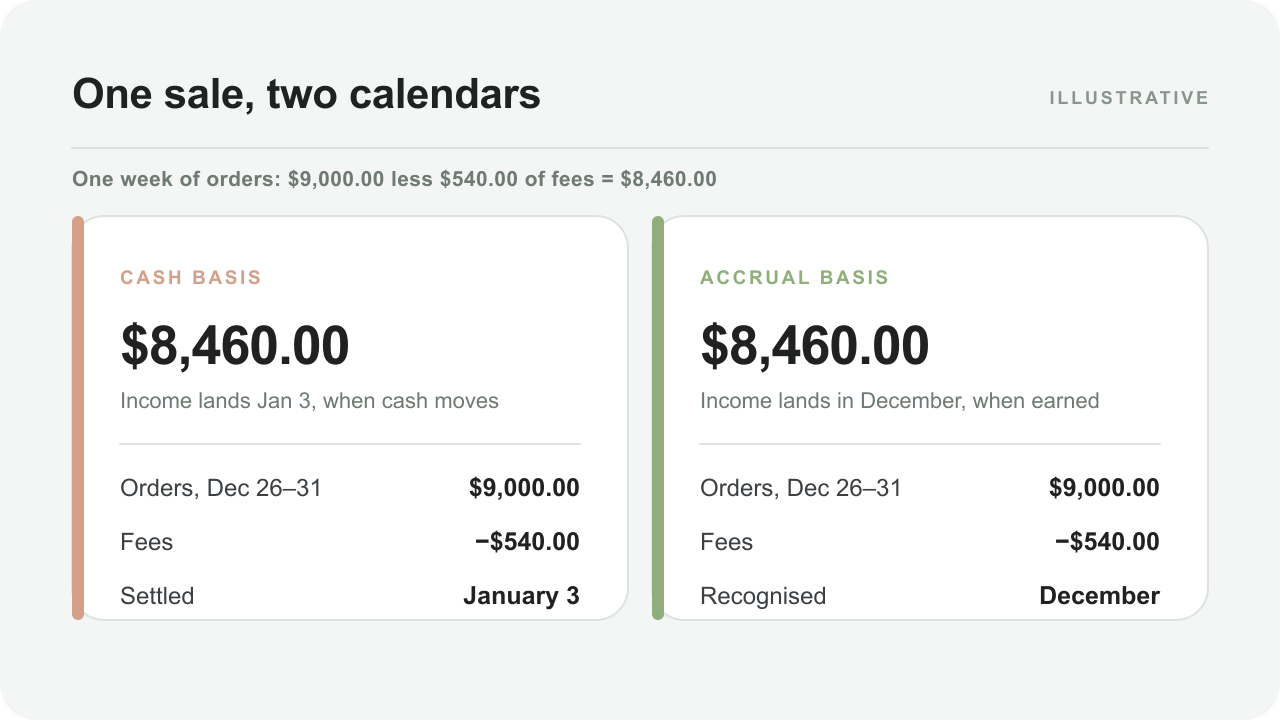
Marketplaces pay on their own schedules, so a payout rarely covers a calendar month. Decide how you treat payouts that cross the boundary — split by transaction date, or book whole periods and carry the difference — and write the rule down. The payout period splitter shows the split for a straddling payout, and our cash versus accrual guide explains why the choice changes your month.
The checklist #
- Collect. Download each channel’s payout or settlement reports, advertising reports and tax reports for the month.
- Cut off. Apply your rule to payouts that cross the month boundary.
- Break down. Split every payout into sales, refunds, fees, advertising, tax and reserves.
- Bridge. Prove gross sales to bank deposits line by line (example below).
- Match. Match deposits to the bank feed; see unmatched deposits for anything that does not.
- Clear suspense. Resolve or annotate every suspense item.
- Review. Compare fees, ads and refunds as a share of sales with prior months.
- Hand off. Give your bookkeeper the reports and the bridge.
A worked bridge #
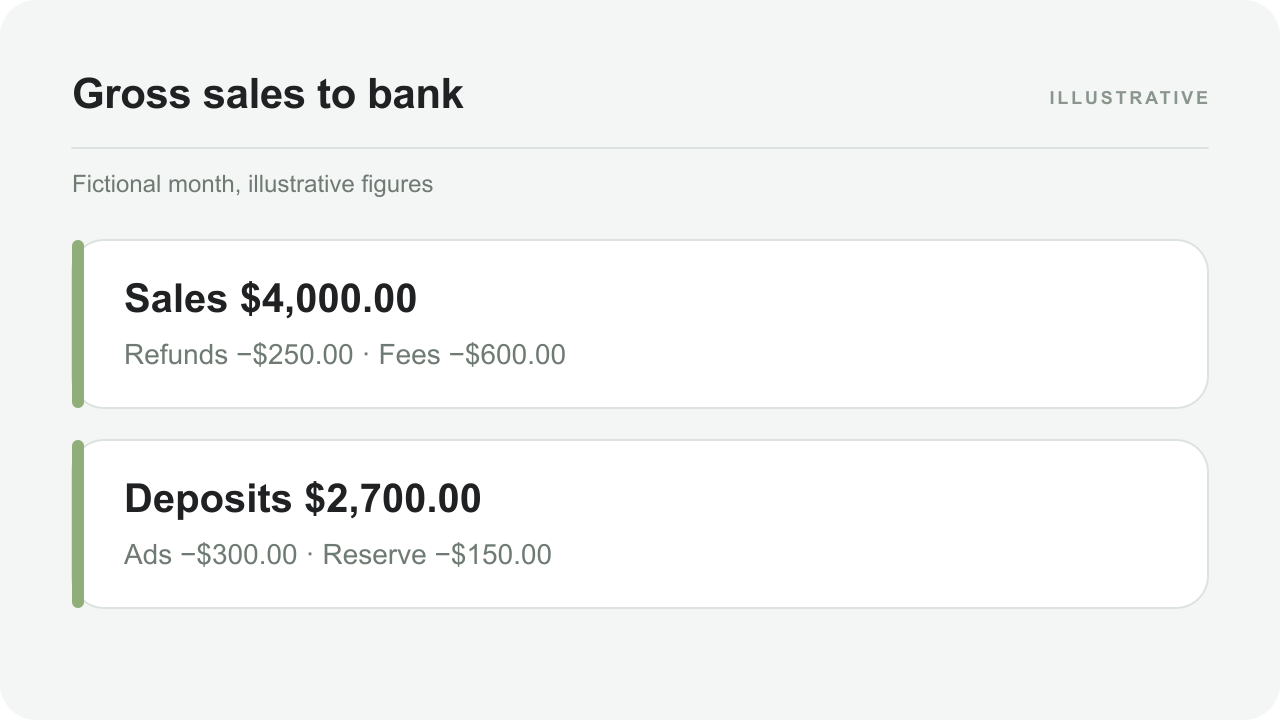
From gross sales to the bank
A fictional month shows $4,000.00 of gross sales. Subtract $250.00 of refunds ($3,750.00), $600.00 of fees ($3,150.00), $300.00 of advertising ($2,850.00) and a $150.00 net reserve increase ($2,700.00). The bank received $2,700.00 across the month’s payouts. If the bridge lands on the bank figure, the month is explained; if it misses, the size of the miss tells you where to look.
Illustrative figures. Real months also include tax, timing differences and adjustments.
When the bridge does not close #
A small miss is usually timing: a payout that belongs to the next period, or a refund booked in a different month than the sale. A round-number miss often points to a reserve or an advance. An odd miss near a fee amount suggests a missed fee line. Work it in that order, using the same source records each time, and note the result. Our deposit versus sales guide walks through the Amazon version.
Make it faster next month #
Keep reports in a consistent folder, reuse account mappings, and record the cutoff rule and any unusual items in a close note. The aim is that month three takes half the time of month one. Software helps most with the breakdown and bridge steps; the judgment calls stay with you and your bookkeeper.
A close calendar you can repeat #
A close goes faster when each day has a job. This is a template for a small seller with a few channels; stretch or compress it to fit your volume.
| Business day | Task | Output |
|---|---|---|
| 1 | Download payout, settlement, ad and tax reports; export the bank and card statements | One folder per month, one file per source |
| 2 | Apply the cutoff rule and break each payout into sales, refunds, fees, ads, tax and reserves | Payout breakdown sheet |
| 3 | Build the bridge and match deposits to the bank feed | Bridge that closes, or a short list of exceptions |
| 4 | Clear suspense and clearing items; review ratios against prior months | Annotated exceptions and a close note |
| 5 | Hand off to the bookkeeper and lock the period | Closed month |
The first month will take longer than five days. The aim is that by the third, the work is mostly checking rather than discovering.
What to collect before you start #
A close that begins without the right inputs turns into a scavenger hunt. Collect these for every channel before touching the books:
- The payout or settlement reports covering the month plus a few days either side, to catch time-zone and timing effects.
- Advertising reports and invoices, including programs billed to a card rather than deducted from payouts.
- Tax reports that show what each marketplace collected and remitted, and what you collected yourself.
- Bank and card statements for every account the channels deposit into or charge.
- Subscription, app and software statements, since monthly fees often never appear inside a payout.
- Your inventory or cost records for the month, if you track product cost by period.
Save each file as it was downloaded. If a number is questioned later, the original report is the evidence, and a re-downloaded version may have changed.
A bridge with two channels #
One channel is a simple bridge. Two is where the structure earns its keep, because the same line can mean different things on each.
Two fictional channels, one month
Channel A reports $6,000.00 of sales, $400.00 of refunds, $900.00 of fees, $350.00 of advertising and a $200.00 net reserve increase, so its deposits total $4,150.00. Channel B reports $2,500.00 of sales, $100.00 of refunds and $275.00 of fees, with no reserve and no advertising in the payout, so its deposits total $2,125.00. Combined: $8,500.00 of sales less $500.00 refunds, $1,175.00 fees, $350.00 advertising and $200.00 reserve equals $6,275.00 of deposits, which is $4,150.00 plus $2,125.00. Channel B also ran $120.00 of advertising billed to a card; it is not in any deposit, so it comes from the card statement and is booked separately.
Illustrative figures. Real months also include tax, timing differences and adjustments.
Bridge each channel on its own first, then add them. If the combined bridge closes only because two errors offset each other, the per-channel bridges will not.
Payouts that straddle the month end #
A payout that covers January 25 to February 7 belongs partly to each month on accrual books. A day-weighted split is the simple method: 14 days in total, 7 in each month, so a fictional $1,400.00 net payout splits $700.00 and $700.00. It is an approximation, because sales are rarely even across days. Where the report has dated transactions, splitting by the actual dates is more accurate and usually not much harder.
Whichever you pick, write it in the close note and use it every month. The payout period splitter does both versions and builds the accrual entries, and our cash versus accrual guide covers why cash-basis books can skip the split entirely.
Clear the clearing accounts #
If you post sales into a clearing account and then match the deposit against it, that account should be close to zero at month-end. What remains has an explanation, and the explanation belongs in a note: a payout in transit that will land next month, a reserve held back, or an entry that does not match anything yet.
| Balance left in clearing | Likely cause | What to do |
|---|---|---|
| One round amount | Reserve, advance or fixed adjustment | Move it to the reserve or advance account with a note |
| Roughly one payout | Payout in transit across the month end | Leave it; confirm it clears early next month |
| A growing balance | Sales recorded without the matching deposit, or recorded twice | Trace one payout end to end; see the duplicate sales guide |
| A negative balance | A deposit recorded without its sales | Find the missing sales batch |
Our unmatched deposits guide and duplicate sales guide cover the last two rows in more depth.
Review the ratios before you close #
Once the numbers tie, look at them as a set. Compare each channel’s fees, refunds and advertising as a share of sales with the prior months. You are not looking for a target; you are looking for a change you cannot explain. A fee rate that creeps up can mean a mix shift to products with higher fees. A refund rate that doubles can mean a quality problem or a policy change. An advertising share that falls to zero can mean a card-billed program that was never booked.
Write one line per surprise in the close note. Next month, the first thing to check is whether the same surprise has recurred.
Write the close note #
A close note is the shortest useful record of what you did. It can fit in a few lines and it saves the most time when someone else, or you in six months, has to answer a question about the month.
- The cutoff rule used and any exceptions made this month.
- The bridge result per channel, and the size of any remaining difference.
- Items left in suspense or clearing, with the reason and the expected resolution.
- Any change to account mappings, fee schedules or tools.
- The date the period was locked, and who reviewed it.
Accounting software usually lets you set a closing date so entries before it cannot be changed casually. Setting it after review is what makes the month actually closed rather than merely finished.
Year-end: what December adds to the close #
The December close is the monthly close with four additions, and each one is easier planned than improvised. Straddle accounting gets louder: holiday sales settle into January payouts, so the cutoff rule (sale dates on accrual, deposit dates on cash) matters more this month than any other — and the note should say which convention carried the year. The reserve and clearing balances need year-end proof packs: the roll-forward, the settlement lists, the bank deposit lists — the same artifacts the clearing-account guide describes, assembled once for the year. 1099-K season starts: January brings the forms, and the bridge template from our 1099-K guide is worth building in December while the reports are all open.
Fourth, the handoff: the year-end close is the package your tax professional receives — P&L by month, balance sheet with substantiated balances, the fee-by-fee account structure this blog teaches, and the close notes. Sellers who assemble the package in January from a year of clean monthly closes get a fast, cheap tax season; sellers who don’t get a bill for reconstruction. The December close is where either outcome is decided, which is why it is worth the extra hour.
Catching up: the close when you are two months behind #
Sometimes the close happens late — two or three months of settlements sitting unreconciled, the clearing balances growing, the bank feed full of unexplained deposits. The catch-up close has a defined order that keeps it from becoming an archaeology project. Start from the bank side, not the books: list every marketplace deposit received in the catch-up window, then work oldest first, matching each deposit to its settlement or payout report — the same ordered-causes routine as the unmatched deposits guide, applied in bulk. Book each matched pair as you go; the unmatched residue shrinks to a short list of genuine exceptions.
Then close each month in order, with its own bridge, using the cutoff convention you would have used on time — resist the temptation to “just net it out” across months, because the straddle rules are exactly what the tax year will ask about. Expect the first month to take three sessions and the third to take one; the backlog shrinks superlinearly because the routine relearns itself. And close with a written rule for next time: the close calendar from this guide exists precisely so the catch-up close is something that happens to other sellers.
Common questions #
How long should a month-end close take?+
For a small seller it can be an hour or two once the process is set. The first few months are slower while you establish account mappings and a cutoff rule.
Should I close on payout dates or sale dates?+
Either can work if you apply it consistently. Cash-basis books follow payout dates; accrual books follow sale dates. Ask your accountant which fits your business, then document the rule.
What do I do with a deposit I cannot explain at month-end?+
Put it in a labelled suspense line with a note, then trace it the next cycle. Do not book it as income to make the month tie.
Who should do the close: me or my bookkeeper?+
Often both. You collect the reports and answer questions about your business; the bookkeeper applies the cutoff, reviews the bridge and locks the period. Software can take the breakdown and matching steps, but the judgment calls remain human.
What should I do when a payout straddles two months?+
Apply one written rule every month: split by transaction date on accrual books, or book the whole payout when it is paid on cash books. The payout period splitter shows both versions side by side.
Sources and review date #
Reviewed November 13, 2026. A close routine is a process, not a rule; tax treatment depends on your accounting method. Examples are fictional; confirm account mappings and tax treatment with your bookkeeper.
Change log. November 13, 2026: Added a close calendar, a collection list, a two-channel bridge, a month-straddle example, clearing and ratio reviews and a close-note template, plus a Sources section.