Tidy
In this article
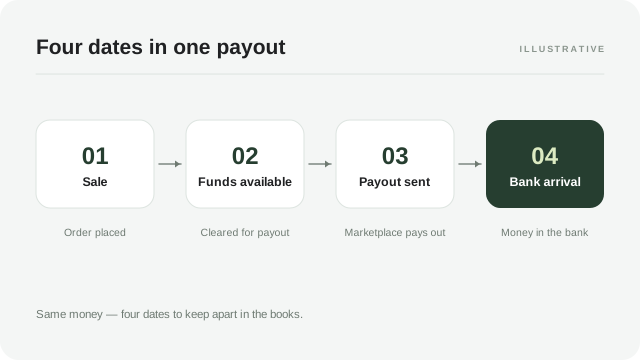
- Marketplaces drive a wedge between the sale and the money: the order date, the settlement date and the bank date are three different events.
- Cash method: income and costs land when money moves. Accrual method: when the sale happens. Same year, different months.
- Neither method makes settlement timing disappear — it only decides which period absorbs it.
- The method is a tax-side decision to make with your accountant; the bookkeeping job is recording events precisely enough to support either.
Two clocks on the same money #
Marketplace selling runs on at least two clocks. The sales clock ticks when orders happen — a rush before the holidays, a quiet January. The money clock ticks when marketplaces settle, and it lags by days-to-weeks and pays in batches. The IRS’s publication on accounting periods and methods distinguishes the two broad ways of putting those clocks onto a calendar: the cash method, where you generally report income when received and costs when paid, and the accrual method, where income is reported when earned and costs when incurred. Which methods a business may use involves its structure and size; that choice belongs to your accountant. This article is about what each one does to your monthly view, because sellers meet that consequence long before tax season.
Cash method: the books follow the bank #
Under the cash method, a December 30th order that settles on January 3rd is January income. Your profit and loss follows the payouts: a strong selling week before a settlement cutoff shows up — next period. The appeal is honesty about cash: the books say what the bank says, and a month with no payouts is a month with no income, whatever the orders dashboard claims.
The cost is distortion at the edges. A payout schedule that straddles month ends will push sales and their fees into whatever period the settlement landed in, and a big season’s tail lands in the doldrums month. Refunds behave the same way in reverse: a refund paid in February reduces February, even if the sale was December’s bestseller. None of that is wrong; it is what cash-basis means. But it means month-to-month comparisons need the payout calendar in hand — our payout schedules guide is the companion read.
Accrual method: the books follow the sales #
Under the accrual method, income is recorded when the sale is made (or the service performed), and the gap until the payout becomes a receivable — money owed to you, which is exactly what it is. December’s rush is December’s income, regardless of when settlements catch up. Costs pair with the sales they relate to, which is why accrual is the natural home of matching principles like COGS, as our COGS guide describes.
The cost is machinery: receivables for pending settlements, the clearing account doing its pass-through, and period-end care about which sales belong to which month. The reward is a profit and loss that describes the business rather than the payment schedule, and a balance sheet that shows what the marketplaces owe you — a number cash-basis books leave invisible.
One holiday week, two calendars
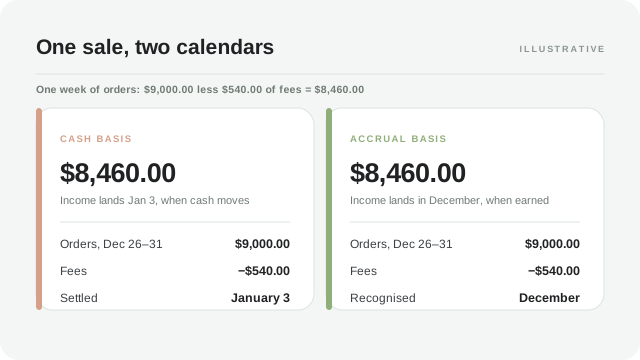
A fictional seller takes $9,000.00 of orders from December 26th to 31st, with $540.00 of fees on those orders. The marketplace settles on January 3rd. Cash-basis books: December shows nothing; January shows $8,460.00 of income net of fees. Accrual-basis books: December shows $9,000.00 of income, $540.00 of fees, and an $8,460.00 receivable that the January payout clears. Same business, same money; the only disagreement is which month owns it.
Illustrative figures. Under either method the year agrees — the difference lives at the boundaries, which is why year-end, not mid-year, is where the method matters most.
What does not change, either way #
- Line discipline. Sales, refunds, each fee family and tax keep their own accounts under both methods; only the dates move.
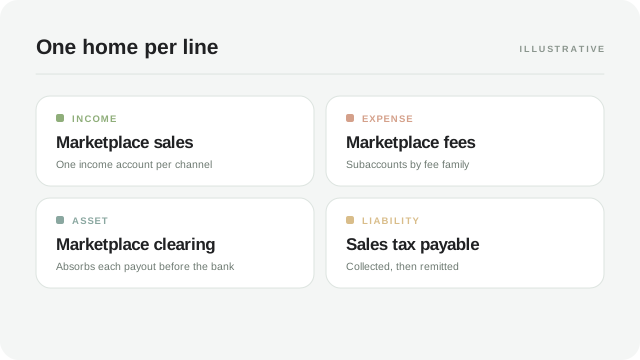
- The clearing account. It absorbs payouts and clears against the bank under either method; accrual simply fills it a little earlier.
- Reconciliation. Payouts are matched to settlements and settlements to the bank the same way; the method does not excuse a deposit that matches nothing.
- Plateaus are timing, not trends. Whichever method you use, a month that looks wrong is often just the settlement calendar; check it before reacting.
The last point is worth restating, because method confusion and payout-schedule confusion produce identical symptoms. Before diagnosing a “bad month”, ask which clock the number came from, and when the settlements landed.
Switching methods is a tax conversation #
Businesses do change methods, and accounting method changes have rules of their own — approvals, adjustments and timing — that live firmly in accountant territory. What the change needs from your bookkeeping is history recorded precisely enough to support it: payout-level records with order dates, settlement dates and line detail, kept continuously. That is the same machinery this blog keeps recommending, and it is exactly what makes a method change a form instead of a forensics project.
TidyPayouts keeps payout lines with their dates and detail, so your books answer to the method your accountant picks — not the other way round.
Practical reading of the same payout #
Whichever method governs the tax return, sellers read payouts with both lenses in mind. Cash lens: when will this settle, and what will it net — the question the payout forecaster answers. Accrual lens: what did we actually earn this period, net of the fees and costs those sales carried — the question the grouped payout review answers. A bookkeeping system that keeps the lines and dates intact serves both at once, which is why this guide refuses to pick a side: the side is your accountant’s call, and the records are your job.
The failure mode worth avoiding is mixing the two in one report — accrual income with cash-basis costs, or a month that switches clocks halfway. Consistency, not sophistication, is what makes a trend line readable. Pick the clock per report, label it, and keep it for the whole report.
Inventory is where accrual earns its keep #
Sellers who carry stock meet the method question in miniature long before their accountant asks it formally. Buy $6,000 of goods in March, sell them across April and May, and cash-basis books show a March loss, a mediocre April, and a May windfall — the cost and the revenue in different months, the margin in neither. Accrual’s matching instinct fixes exactly this: the cost travels with the unit and lands as COGS when the unit sells, as our COGS guide describes. That is why sellers with real inventory often find accrual’s version of their year recognisable, while cash-basis months read like weather.
The lesson generalises even if the method never changes: the more your money and your sales part company in time — inventory, settlement lags, deposits at season edges — the more a cash-only view misdescribes the business, and the more deliberately you have to read it. You do not have to run accrual books to think in accrual terms when pricing or planning; you only have to know which lens a given report is using.
The two-report pattern #
Practical sellers often settle on a working compromise that is entirely legitimate: tax books on one method, and a management view on the other, kept clearly separate. The management view is usually accrual-flavoured — sales when ordered, costs when incurred — because it is the lens that answers “how did we do?”, while the tax books follow the elected method because they must. The pattern fails in exactly one way: when the two silently merge, and a management number is quoted as a tax fact or vice versa.
Keeping them honest takes labelling, not software. Every report says which clock it reads — “cash-basis, tax” or “management view, orders” — and the payout reconciliation anchors both, because it is the same settlement-to-bank matching either way. The two-report pattern is also the cheapest insurance against the most common month-end argument in small ecommerce: why the bank and the profit and loss disagree. They disagree because they are answering different questions; the labels are how the answers stop being mistaken for each other.
Refunds under each method #
Refunds are where the two methods feel most different day to day. Cash-basis books record the refund when its settlement lands, in whatever month that is — simple, and occasionally jarring, as a busy refunds month follows a strong sales month for reasons of pure plumbing. Accrual books can carry the refund back to the sale’s period, because the sale and its reversal belong to the same event; the mechanics need the same order-level traceability that COGS matching does. Neither approach changes what the customer received — only when the books notice.
The practical advice is the same under both: keep refunds in their own line, paired to their orders where references allow, and resist the urge to net them against the week’s sales for tidiness. A refund line that trends upward while sales hold steady is telling you something real, and it can only say it if it is allowed its own row.
Common questions #
Which method can my business use?+
It depends on your business structure, size and other factors set out in IRS guidance; many small businesses qualify for the cash method, but eligibility and elections are tax questions. Ask your accountant — then tell your bookkeeper, so every record supports the answer.
My books are cash-basis. Are my payout reconciliations different?+
No — reconciliation matches payouts to settlements and the bank either way. The method changes which period the posted results belong to, not whether the deposit matches its settlement to the penny.
Why does my profit and loss disagree with my bank balance?+
Often because the two speak different clocks: accrual-basis income counts unsettled sales, and even cash-basis books show costs paid by card that have not cleared a marketplace payout. The clearing account and the receivable lines exist to make that disagreement legible rather than alarming.
Sources and review date #
Reviewed October 26, 2026 against the IRS reference below. Method eligibility and elections are tax matters; confirm yours with your accountant or tax adviser. Examples are fictional.