Tidy
In this article
- An inventory purchase is an asset, not an expense; cost of goods sold belongs on the books when the unit sells, not when you pay the supplier.
- Landed cost — price, freight, duties, prep — is the honest unit cost; shipping it to a generic “supplies” account hides every margin decision you will make later.
- Third-party fulfillment does not change ownership: stock in a marketplace warehouse is still your inventory until it sells.
- Reimbursements for lost inventory are recoveries against the cost you already carried, not sales.
An inventory purchase is not an expense #
The most common inventory mistake in small ecommerce books happens at the first step: a supplier invoice for $4,000 of stock is posted straight to an expense. It feels right — money left the bank. But the stock did not stop existing; it moved from the supplier’s shelf to yours (or, with FBA or Walmart fulfillment, to theirs on your behalf). Until a unit sells, its cost is an asset — inventory — sitting where your balance sheet can see it.
Cost of goods sold enters later, and precisely: when a unit sells, the books move that unit’s cost out of inventory and into COGS, the same period the sale is recorded. That pairing — revenue and the cost of the thing that earned it — is what makes a gross margin number mean anything. Post everything as an expense at purchase and every month lies twice: heavy buying months look like losses, heavy selling months look like windfalls.
What counts as the cost of a unit #
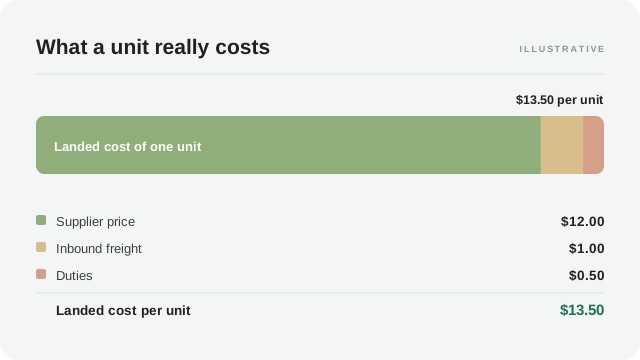
The honest unit cost is the landed cost: everything you spent to get one sellable unit to the warehouse. That usually includes more than the supplier’s price.
| Component | Example | Belongs in unit cost? |
|---|---|---|
| Product price | $12.00 per unit from the supplier | Yes |
| Inbound freight | $400 of shipping for a 1,000-unit order | Yes — $0.40 per unit |
| Duties and import fees | Customs charges on the shipment | Yes |
| Prep and packaging | Labelling, poly-bagging, kitting | Usually yes |
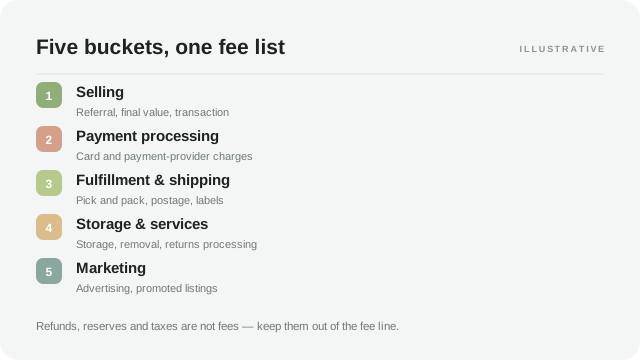
| Marketplace fulfillment fees | FBA pick-and-pack per order | No — a selling cost, kept separate |
| Storage fees | Monthly warehousing charges | Generally no — bookkeeper’s call |
Conventions vary by business; agree the boundary with your bookkeeper and apply it consistently. What matters is that fulfillment and storage stay visible somewhere — folding them into unit cost makes margins unfalsifiable.
The line between product cost and selling cost is worth defending. Fulfillment fees are a consequence of selling, priced by the marketplace, and they belong with selling costs where they can be compared against channel revenue. Landed cost is a consequence of buying, and it belongs in the unit.
A worked example: from purchase to payout #
Here is a fictional product through one cycle, with every number carried through.
- Buy: 500 units at $12.00, freight $500, duties $250. Landed cost = $6,750, or $13.50 per unit. Books: inventory $6,750; cash $6,750.
- Stock: all 500 units go to a marketplace warehouse. Still inventory; only the location changed.
- Sell: in one month, 180 units sell at $29.99. Income $5,398.20; COGS 180 × $13.50 = $2,430.00. Gross margin: $2,968.20 — about 55%, before selling fees.
- Pay fees: fulfillment and referral fees on those orders, say $1,180.40, posted to their own lines, not to COGS.
- Count: 320 units remain, carried at $4,320.00. The inventory account and the warehouse report should agree; if they do not, the difference gets investigated, not ignored.
The pattern to notice: the payout shows $5,398.20 of sales minus fees; the books show the same sales minus $2,430.00 of product cost; margin is the story between the two. A seller who posted the whole $6,750 as an expense at purchase would have shown a terrible month in month one and free money in month two. Neither was true.
Stock in someone else’s warehouse is still yours #
Sellers sometimes treat FBA or Walmart-fulfilled inventory as if paying the marketplace for fulfillment transferred the goods. It does not. The units sit in the marketplace’s warehouse as your inventory, and the marketplace’s own reports — received, in stock, unfulfillable — are the records your books should agree with. When a unit is lost or damaged there, the cost does not vanish; it becomes a write-off unless the marketplace reimburses it, which it often does under its own policies and timelines. Our guide to booking FBA reimbursements follows those credits through the books.
TidyPayouts keeps selling fees, storage and product cost on separate lines, so gross margin stays a number you can defend.
Methods: average cost is the workhorse #
When units in stock cost different amounts — bought across several purchase orders at rising prices — the books need a rule for which cost a sold unit carries. The common choices are first-in-first-out, last-in-first-out, or a weighted average, and each is a convention with tax and reporting consequences rather than a physical fact about your boxes. Accounting software typically applies one method consistently; QuickBooks, for example, values inventory at average cost in its own guidance on inventory and COGS. Which method suits your business, and what your tax filing assumes, is a bookkeeper-and-CPA decision — the reconciliation job is simply to know which rule is in force and let the software apply it.
Where COGS shows up in your payout review #
A payout reconciliation and an inventory system answer different questions, and the handoff between them is where margin either becomes visible or dissolves. The payout review says: this month’s deposits contained $5,398.20 of sales and $1,180.40 of selling fees. The inventory records say: those sales carried $2,430.00 of product cost. Put the two beside each other — a per-channel margin view — and pricing decisions get honest: which channel’s fees eat the margin, which product’s landed cost has crept up, which promotion was genuinely profitable.
That comparison is the reason we keep fees, storage and COGS as separate lines throughout TidyPayouts, and why our fee comparison tool takes your product cost as an input: channel decisions are made on contribution margin, and contribution margin needs all three numbers kept apart.
Month-end checks that keep inventory honest #
- The hand-off: units received at the warehouse agree with units the supplier shipped; the difference is in-transit, not missing.
- The tie-out: the inventory account balance agrees with the marketplace’s inventory reports, adjusted for timing.
- The margin sanity check: gross margin percentage this month is in line with the last few; a jump usually means a cost or a sale landed in the wrong account.
- The write-offs: damaged and unfulfillable units were written off deliberately, with a record, rather than drifting out of the balance silently.
- The in-transit tail: purchases shipped but not yet received are tracked, so a month-end does not lose a supplier invoice between two periods.
None of these checks require software more complicated than a spreadsheet — only the discipline to run them monthly and to expect the numbers to tie.
Pricing backward from landed cost #
Landed cost earns its keep twice: once in the books, and once before a price is ever set. Working backward is a short exercise. Start with the landed unit cost — say $13.50, as in the example above. Add the channel’s selling costs on a $29.99 price: referral or transaction fees, fulfillment, processing. What remains is contribution margin, and the question answers itself: does the remainder carry your overhead and leave a profit, or merely look busy on a dashboard?
Run that arithmetic honestly and two discoveries are common. First, some products are contribution-thin on some channels — the same unit that earns well direct can barely pay its marketplace fees, which is exactly what our fee comparison tool is for. Second, landed cost drift: freight and duties move, and a price set two suppliers ago may now sit closer to the bone than anyone remembers. A quarterly repricing check — current landed cost, current fees, current price — keeps the drift visible while it is still a spreadsheet fix rather than a margin autopsy.
When costs change mid-cycle #
Real catalogues do not buy once. A resupply arrives with higher freight, a tariff changes, a supplier rounds up, and suddenly two batches of the same product sit in stock at different unit costs. Under an average-cost method the software blends them; under FIFO the older cost leaves first. Either way the transition months are where inventory accounts quietly drift, because every unit sold that month is a small negotiation between the old cost and the new.
The safeguard is attention, not precision: when a cost step is material, expect the gross margin percentage to move, and check that it moved by roughly the amount the new cost implies. A margin that jumps more than the cost change explains means something else slipped into COGS — a supplier invoice posted twice, a non-product cost routed to the wrong account, or a count adjustment doing work nobody asked of it. Ten minutes of reconciliation in the month the cost changes saves a quarter of unexplained trend, and keeps the unit cost a number you can still say out loud.
Common questions #
Do I need inventory tracking in QuickBooks to record COGS?+
Not necessarily. Larger catalogues benefit from QuickBooks inventory or a dedicated system; smaller ones often run a periodic approach — purchases accumulate, a count adjusts inventory to actual, and the adjustment posts to COGS. Which approach fits is a bookkeeper conversation; both keep product cost off the expense lines until units sell.
Where do FBA storage fees go?+
Generally to a selling or operations expense line rather than into unit cost, though practices vary by business. The deciding question is comparability: keeping storage separate lets you see what holding slow stock actually costs, which unit cost would bury.
What landed cost should a small seller start with?+
Product price plus freight plus duties is the honest minimum; add prep costs when they are material and consistent. Capture them on the purchase order, not from memory at year end — landed cost reconstructed late is landed cost guessed.
Sources and review date #
Reviewed October 26, 2026 against the references below. Costing methods and tax treatment vary by business; agree yours with your bookkeeper or accountant. Examples are fictional.