Tidy
In this article
- A 1099-K reports gross, unadjusted card and marketplace transactions — before fees, refunds and tax — so it will not match your deposits, and is not supposed to.
- The form is not extra income: it is a reporting document that your books reconcile against, using a short bridge table.
- Multiple marketplaces mean multiple forms, possibly with overlapping scopes; reconcile each against its own channel’s activity.
- Thresholds for who receives a form have changed more than once; check current IRS guidance rather than an article’s memory — including this one.
What the form is #
Form 1099-K is an information return: a payment processor or third-party settlement organization — which includes the large marketplaces — reports to the IRS the card and marketplace transactions it processed for you. The IRS publishes the form and, on its “understanding your 1099-K” page, the details of what belongs in it. An information return does not decide what your income is; it tells the IRS what flowed through, so that whatever you report can be checked against it.
That framing answers the reflex question first: no, receiving a 1099-K does not mean the gross figure is taxable income on top of your books. Your taxable income comes from your books, computed under your method, with fees and refunds and costs where they belong. The form is the number your books must be able to explain — which is where the reconciliation bridge comes in.
Why the number will not match your deposits #
The form reports gross, unadjusted transactions: the transaction amounts, before the marketplace’s fees, before refunds, before chargebacks, and often including amounts you merely collected on someone else’s behalf — sales tax being the big one. Your bank, meanwhile, received net deposits. Between those two numbers sits exactly the material this blog writes about every week.
| Between the 1099-K and your bank | Why it is missing from the gross |
|---|---|
| Marketplace fees | Deducted before the deposit; inside the gross on the form |
| Refunds and chargebacks | The gross counts the original transaction; the reversal comes later |
| Sales tax collected | Collected on the transaction, remitted on your behalf |
| Timing boundaries | The form’s year boundary is transaction-based; settlements can straddle it |
| Multiple processors | Each marketplace reports only its own slice |
The 1099-K’s instructions define the gross measure; your settlement reports define your deposits. The bridge between them is arithmetic you already do every month.
A worked bridge
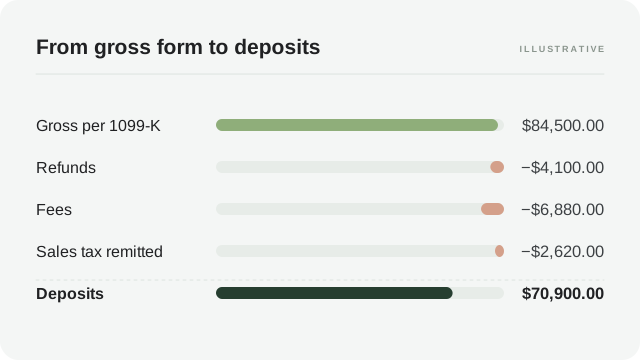
A fictional seller receives one 1099-K for $84,500.00. The books for the same channel show net deposits of $70,900.00. The bridge: the gross included $4,100.00 of refunds issued on those transactions, $6,880.00 of marketplace fees, and $2,620.00 of sales tax collected and remitted on the seller’s behalf. Gross minus those three equals the deposits exactly. Nothing is missing, nothing is double-counted, and the form is fully explained in four rows.
Illustrative figures. In practice each row comes from the channel’s own annual summaries; the habit of grouping payout lines by family all year is what makes the January bridge an afternoon instead of a week.
The January routine #
Forms arrive in the first months of the year, one per marketplace or processor that met the reporting threshold for your account. The routine that turns them from a scare into a formality:
- Collect every 1099-K you receive — from every marketplace and payment provider — plus the channel’s own annual activity summaries.
- For each form, build the bridge: gross on the form; then refunds, fees, tax collected and boundary adjustments from the channel’s records; ending at the deposits in your books.
- Check each bridge closes to the penny. A gap that survives the known categories is a question for the marketplace, asked early.
- Give your bookkeeper the forms together with the bridges, and let them confirm the tax treatment of the underlying income under your filing method.
Step 3 is worth defending. Most gaps are timing — a late-December order settled in January, counted in the gross but not yet in the year’s deposits — and the bridge can show that explicitly rather than leaving a reader to wonder. Timing differences do not need fixing; they need labelling.
TidyPayouts keeps every payout split into named lines all year, so the 1099-K bridge is a report you run, not a reconstruction you attempt.
Thresholds and coverage move #
Who receives a 1099-K depends on reporting thresholds — the transaction counts and dollar amounts that trigger a form — and those thresholds have been the subject of legislation and phase-ins more than once, with state-level rules adding their own variations on top. Any specific number quoted in an article, including this one, ages; the IRS pages this post cites carry the current federal position, and your marketplace’s tax documentation carries your account’s position. The practical advice is stable regardless of the threshold: assume a form may arrive once your selling is material, keep the payout-level records that make reconciliation trivial, and let the bookkeeper handle what the form means for the return.
One more scope note: the forms follow processors, not your ledger. A seller on three marketplaces may receive three forms with three different grosses, none of which sum to anything meaningful — each reconciles to its own channel’s activity, which is why the bridge is built per form, never in aggregate.
What the form does not change #
Everything else in these books keeps working exactly as before. Sales are recorded per your method — cash or accrual, per our cash-versus-accrual guide; fees stay in their fee accounts; refunds stay in theirs; sales tax stays out of income. The 1099-K adds no new accounts and no new transactions. What it adds is an external cross-check, and like every cross-check it rewards the books that were tidy before it arrived.
If a form arrives and your books cannot produce the bridge — because payouts were recorded as single net lines — the fix is the same one this blog always prescribes: split the payouts by line for the affected period, rebuild the family totals, and let the bridge close. It is slower the first time, and it is the last time, once the routine holds.
Multiple forms and one tax identity #
Sellers rarely receive exactly one form. Each marketplace and payment processor that reported for you issues its own, keyed to the tax identification on file — and a business that changed its entity, EIN or address mid-year can see forms split across identities, which complicates collection before reconciliation even starts. The January routine handles this by design: collect every form and every entity’s mail, reconcile each form against its own channel’s activity, and hand the bookkeeper the set. What you must never do is sum the forms and compare the total to your books — the sum is meaningless, because each form describes a different pipe, and some pipes may overlap.
If a form carries an identification number or entity you do not recognise, treat it as urgent rather than curious. It may be an old account, a successor platform’s paperwork, or — rarely — someone else’s transactions keyed to your identity. The marketplace’s tax support can trace it; the earlier the question, the smaller the January it spoils.
A bridge template you can reuse #
The bridge is a small table, and reusing the same shape every year makes gaps jump out. One row per known category, one column per form:
| Bridge row | Source | Example |
|---|---|---|
| Gross per form | The 1099-K itself | $84,500.00 |
| Refunds on those transactions | Channel’s annual refund summary | −$4,100.00 |
| Marketplace and processing fees | Sum of fee lines from settlements | −$6,880.00 |
| Tax collected and remitted | Channel’s tax report | −$2,620.00 |
| Boundary timing | Orders at year end settled after it | ±noted, not netted |
| Deposits in the books | Your clearing/bank records | $70,900.00 |
Illustrative figures. The example above closes exactly; in life, the boundary-timing row explains most small residuals and should be shown, not buried.
Want the arithmetic done for you? Open the 1099-K reconciliation tool →
The template’s discipline is the source column. Every row names the document that produced it, so a reviewer — your bookkeeper in March, an auditor in three years — can re-derive the bridge without you in the room. A bridge that closes and cannot be re-derived is only half a bridge; the attachment habit is what makes January’s work survive contact with anyone else.
Common questions #
Do I owe tax on the gross shown on the 1099-K?+
The gross is a reporting measure, not your taxable income. Taxable income comes from your books — sales net of refunds, less fees and costs, under your method. Confirm the return treatment with your accountant; the reconciliation bridge is what connects the form to the books they prepare.
What if I disagree with the amount on the form?+
Start with the marketplace’s own annual summary and your settlement records; most differences are the gross-versus-net categories above or a scope question (one account, one tax identification). If a genuine discrepancy remains, raise it with the issuer promptly and keep the correspondence with your records.
My marketplace did not send a form this year. Can I ignore any of this?+
The reporting obligation to file accurate returns exists independently of whether a form arrived; thresholds and issuer behaviour change. Keep the same records either way — the bridge you did not need this year is the one that keeps next year boring.
Sources and review date #
Reviewed October 26, 2026 against the IRS references below; thresholds and reporting rules change, so check current IRS guidance and your marketplace’s tax documents. Examples are fictional; this article is general information, not tax advice — confirm treatment with your accountant or tax adviser.