Tidy
In this article
- A clearing account holds the net of each payout from the moment you record the sale until the bank deposit arrives.
- A healthy clearing balance is zero, or roughly one payout in transit.
- A growing positive balance means sales without deposits, or sales counted twice; a negative balance means deposits without sales.
- One clearing account per channel makes the cause of an imbalance obvious.
What a clearing account is #
A clearing account is a temporary holding account. When a marketplace sells something, you earn revenue before any money reaches your bank, and when the payout arrives it is a net figure, after fees, refunds and holds. The clearing account sits between the two. The sales and costs are posted into it, the deposit is posted out of it, and what remains is the difference between what the marketplace says it owes you and what it has paid.
It is not a place to keep money. It is a control: because it should end at or near zero, any balance that lingers is an error or a timing item worth naming.
Why marketplace sellers need one #
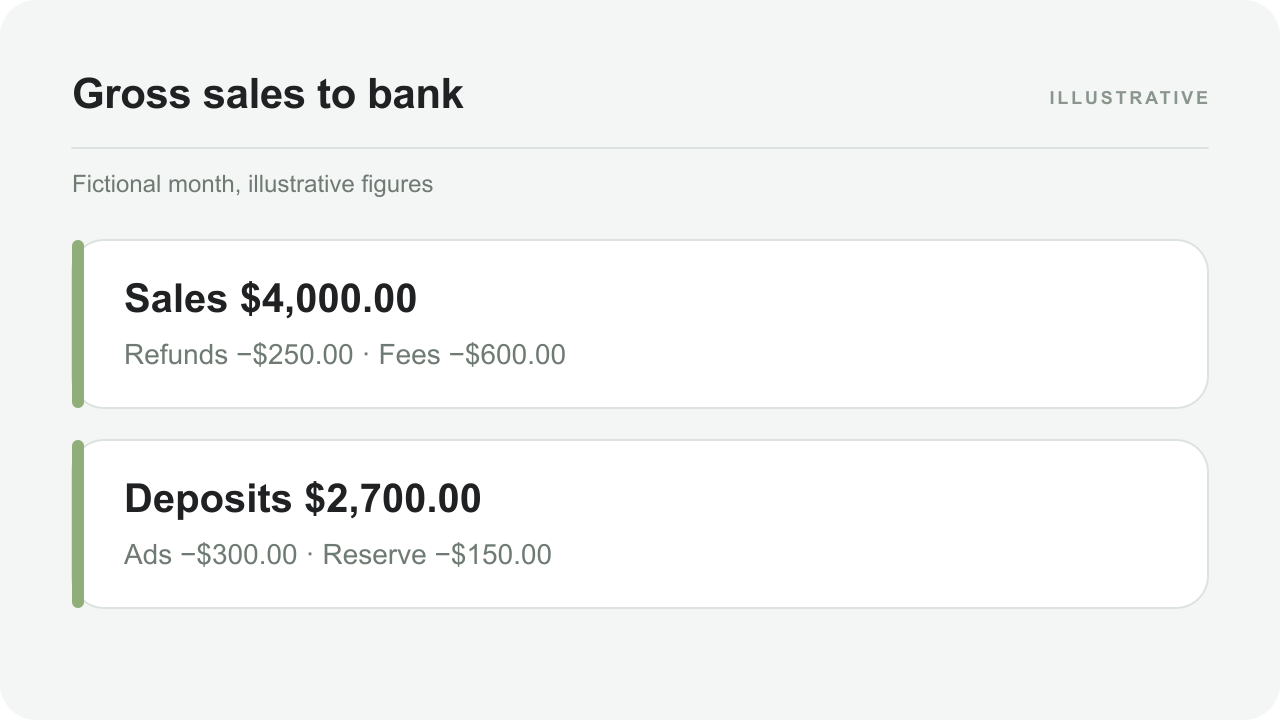
Two facts make marketplaces awkward for bookkeeping. First, the deposit is not the sales figure: it is net of fees, refunds, reserves and adjustments. Second, the deposit arrives days or weeks after the sale, and one deposit can cover many orders. Recording the deposit straight to income would understate sales by every fee and refund and would mix up periods. Recording the sales without a place to match the deposit leaves nothing to prove the books agree with the bank.
Our deposit versus sales guide shows how large that gap can be, and a clearing account is the structure that accounts for it.
How the money flows through it #
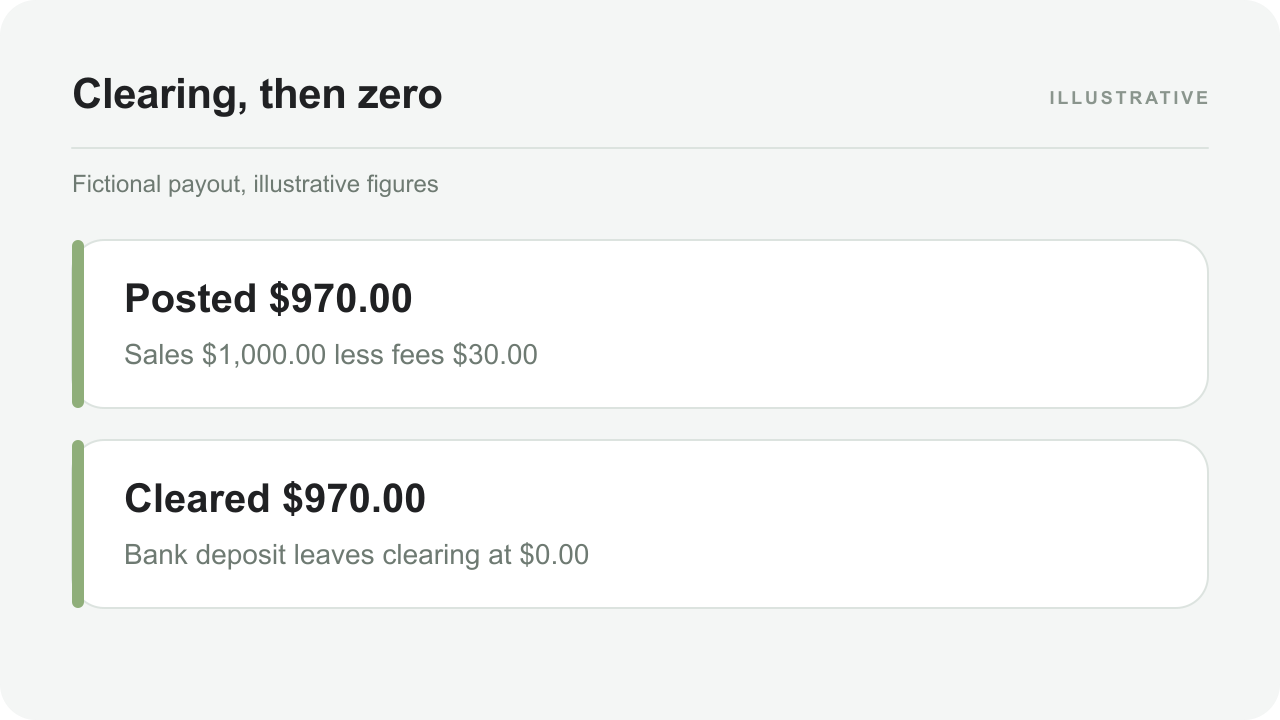
One fictional payout
A payout covers $1,000.00 of sales and $30.00 of fees. First, the sales entry debits clearing $970.00, debits fees $30.00 and credits sales $1,000.00. Later, the $970.00 bank deposit debits the bank and credits clearing $970.00. Clearing starts at zero, rises to $970.00 when the payout is recorded, and returns to zero when the deposit lands.
Illustrative figures.
Between those two events the clearing balance is a payout in transit: money the marketplace owes you that has not yet arrived. That is normal and expected at any moment in time. What is not normal is a balance that stays after the deposit has been matched.
Setting one up in QuickBooks Online #
- Create an account of the type Other current asset and name it clearly, for example “Amazon clearing”.
- Create one per channel, for example Amazon, Shopify, eBay, Etsy and Walmart, rather than one shared account. A channel-level balance points straight at the source of a problem.
- Point each channel’s payout entries at its own clearing account, and point the matching bank deposit at the same account.
- Tell your bank feed to match deposits to the clearing entries and not to categorize them as income.
- Add the account to your month-end checklist with a note of what balance is expected.
The chart of accounts generator includes a clearing account per channel, and the chart of accounts guide shows where they sit.
Reading the balance #
| Balance at month end | Usually means | What to do |
|---|---|---|
| Zero | Every payout recorded has been deposited and matched | Nothing; note it in the close file |
| About one payout, positive | A payout is in transit across the month end | Confirm it clears early next month |
| A large or growing positive balance | Sales recorded without matching deposits, or sales recorded twice | Trace one payout end to end; look for duplicate imports |
| A negative balance | A deposit recorded without its sales | Find the missing sales batch or the deposit booked as income elsewhere |
| A round positive amount | A reserve, advance or fixed adjustment | Move it to a reserve account with a note |
Our month-end close checklist puts this review in sequence, and the unmatched deposits guide covers the negative cases.
A two-payout example, including a reserve #
Two fictional payouts
Payout 1 covers $2,000.00 of sales, $300.00 of fees and a $100.00 reserve increase, so the deposit is $1,600.00. Payout 2 covers $1,500.00 of sales and $225.00 of fees with a $40.00 reserve release, so the deposit is $1,315.00. Clearing receives $1,600.00 and $1,315.00 from the payout entries and gives back the same two deposits, ending at zero. The reserve is not in clearing: the held $100.00 sits in a marketplace reserve account and falls to $60.00 after the $40.00 release.
Illustrative figures. Check: $2,000.00 − $300.00 − $100.00 = $1,600.00; $1,500.00 − $225.00 + $40.00 = $1,315.00.
Keeping the reserve out of clearing is deliberate. Held funds that will be released later are a different balance from a payout that is already on its way, and mixing them makes a normal hold look like a clearing error. Our reserve guide covers the roll-forward.
Clearing account versus a bank feed rule #
Some sellers skip the clearing account and use a bank rule to categorize each deposit. That works only if sales are recorded elsewhere at their full value and the deposit is matched to them, which is exactly what a clearing account formalizes. Without it, the two common failure modes are recording deposits as income, which understates sales by the fees and refunds, and recording both sales and deposits as income, which doubles revenue. A clearing account makes the correct treatment visible: sales go in, deposits go out, and the balance shows what is left.
One account or one per channel #
| Approach | Strength | Weakness |
|---|---|---|
| One clearing account for everything | Simple to set up | A balance cannot be traced to a channel; offsetting errors can hide |
| One per channel | A balance points at its source; easy to reconcile to each report | More accounts to review each month |
| One per channel and currency | Cleanest for sellers with foreign-currency payouts | Most accounts; worth it only with multiple currencies |
For most sellers with two or more channels, one per channel is the sweet spot.
Closing a period with a balance #
At month end, a balance equal to a payout in transit is fine, as long as you can name it: the channel, the payout ID and the expected deposit date. Write that in the close note, and confirm early next month that the deposit arrived and the balance cleared. Anything you cannot name should be investigated before the period is locked. If you must close with an unexplained balance, leave it visible and annotated; do not adjust it away.
A five-minute review #
- Open the clearing accounts and note each balance.
- For each non-zero balance, name the payout that explains it.
- Check that last month’s in-transit payouts have cleared.
- Look for round-number leftovers that suggest a reserve or advance.
- Record the result in the close note, even when it is “all zero”.
What goes into clearing and what stays out #
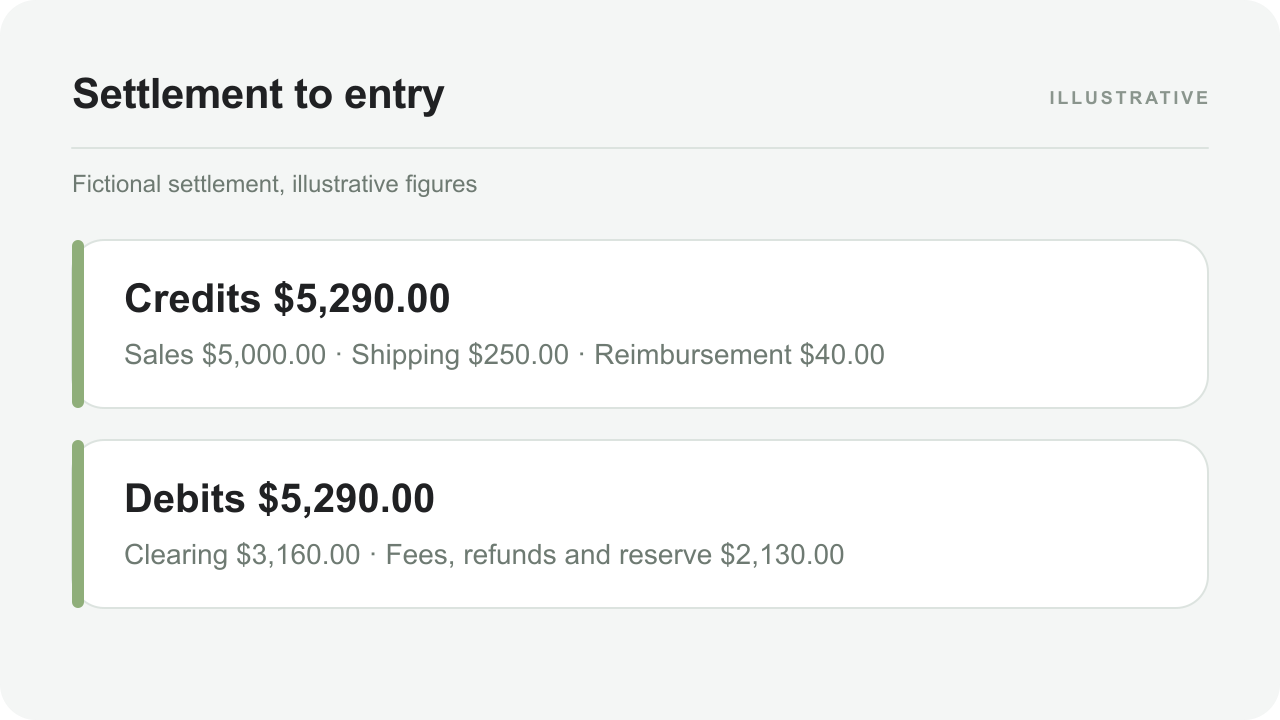
The rule is simple: clearing holds only what travels through the payout. If an item is deducted from the payout or added to it, it belongs in the settlement entry and therefore in clearing. If it is paid some other way, it does not.
| Goes through clearing | Stays outside clearing |
|---|---|
| Sales, shipping and promotions on the payout | Advertising billed to a card or invoiced separately |
| Refunds and fees deducted from the payout | Subscriptions and app fees paid by card |
| Reimbursements and fee credits on the payout | Inventory purchases and supplier bills |
| The bank deposit that settles the payout | Funds held in a reserve (a separate balance) |
Keeping card-billed costs out of clearing is what lets the balance reach zero: a payout can be matched to its deposit only if everything inside it came from the payout.
Mistakes that make it useless #
- Letting the bank feed categorize deposits as income, which bypasses clearing and counts sales twice.
- Using one clearing account for every channel, so a problem cannot be traced to its source.
- Clearing the balance with an adjusting entry to “make it zero” instead of finding the cause.
- Posting fees to clearing without posting the sales that produced them.
- Never reviewing it, so an error grows for months.
What the balance should equal at any moment #
A clearing account is not a mystery box; at any moment its balance should equal a computable number: the sales and shipping recorded but not yet paid, minus the fee and refund reductions recorded but not yet paid — summed over every settlement that has been booked and not yet deposited. If you book settlements the day they cut, that is “everything since the last deposit.” If you book weekly, it is a week’s worth. The formula turns “why is there $3,180 sitting in clearing?” from an investigation into an addition exercise: the unsettled settlements in your reports should sum to exactly that figure.
The same formula works in reverse as a detection tool. Pick any moment, sum the un-deposited settlements from the channel’s reports, and compare the total to the clearing balance. Equal: the account is healthy and your process is complete. Different: the gap is either a missed settlement entry, a deposit booked into the wrong account, or a fee posted outside clearing — and each of those is a one-line fix once named. Run the check at month end and again whenever the balance exceeds roughly two payout cycles’ worth of sales, which is the size at which problems stop being small.
Year-end: proving the clearing balance #
At year end the clearing balance becomes a line on the balance sheet that your tax preparer — and, if you ever apply for credit, a lender — will ask you to substantiate. The proof pack is three artifacts, and building it takes minutes if the account has been maintained: (1) the year’s settlement list with dates and amounts, (2) the bank’s list of deposits received, and (3) the reconciliation note showing which deposits cleared which settlements, with the residual sum equal to the December 31 balance.
Two year-end specifics worth knowing. First, the balance is a genuine asset — receivables from the marketplace — but a stale one is a red flag: any component older than the channel’s longest payout cycle should be explained in a note (a reserve release pending, a disputed refund, a currency hold). Second, if your preparer asks you to “zero out” clearing for tidiness, decline: sweeping a real receivable into income is exactly the double-count this account exists to prevent. The balance is supposed to exist. It is supposed to be explained.
Common questions #
Is a clearing account an asset or a liability?+
Usually an other current asset, because it represents money the marketplace owes you. If it goes negative, it behaves like a liability until the missing sales are recorded.
Do I need a clearing account if I use cash-basis books?+
It is still useful. Even on cash books it lets you post a payout’s parts and match the deposit without distorting income.
Should I clear the balance with a journal entry?+
Not to force it to zero. Find the cause first; use an adjusting entry only to record a real item such as a reserve, and annotate it.
How often should a clearing account be reviewed?+
At least monthly, as part of the close. Sellers with high volume benefit from a weekly look, because an error is much easier to trace when it is a few days old than when it is a quarter old.
Can I use the same clearing account for Amazon and Shopify?+
You can, but a balance then cannot be traced to a channel. Separate accounts cost a few extra lines in the monthly review and save much more time when something does not tie.
Sources and review date #
Written November 13, 2026 from general bookkeeping practice. Provider behaviour varies by account and changes over time, so confirm the details against your own statements and the help pages below. Examples are fictional; confirm account mappings and tax treatment with your bookkeeper.