Tidy
In this article
- The standard US rate for online seller transactions is 3.49% + 49¢ per transaction — a percentage plus a fixed component, so small orders pay disproportionately.
- Rate variants exist by payment method: QR-code transactions are 2.29% + 9¢, keyed-in cards carry different fixed fees — check the rate table per how the buyer actually paid.
- Chargebacks cost $20 each where seller protection doesn’t cover the case, and currency conversion adds a spread of roughly 3–4% over the base rate.
- PayPal fees are payment processing, not selling fees — in the books they belong on their own line, reconciled against the PayPal activity statement like any other account.
PayPal fees at a glance #
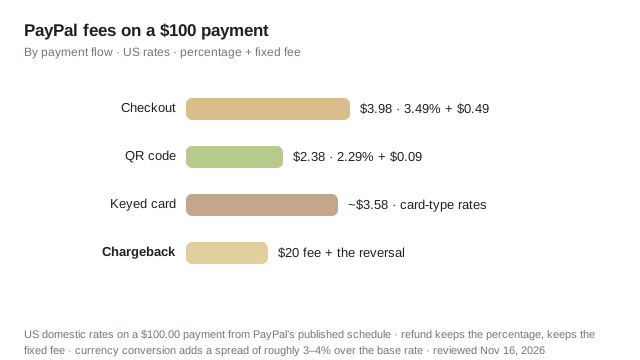
PayPal has no monthly fee and no listing fee: every cost is per transaction, priced as a percentage plus a fixed amount that depends on how the payment was taken. The 2026 US rates that matter to sellers:
| Transaction type | US rate | Example on $100 |
|---|---|---|
| Standard online checkout (goods & services) | 3.49% + $0.49 | $3.98 |
| QR-code transactions | 2.29% + $0.09 | $2.38 |
| Debit/card keyed in manually | 3.49% + $0.09 (varies by card type) | ~$3.58 |
| Invoices paid by card | Follows the payment method’s rate | varies |
| Chargeback (where protection doesn’t apply) | $20 per dispute | flat |
| Currency conversion | Spread of roughly 3–4% over base rate | varies |
US domestic rates reviewed November 16, 2026 against PayPal’s published merchant fee page below. PayPal reprices periodically and rates vary by country and merchant agreement — the official fees page is the authority; third-party calculators are convenience only.
Two structural facts before the details. PayPal charges the percentage on the total amount including shipping and sales tax where tax is on the invoice. And the fixed component is charged per transaction, so splitting one sale into multiple payments multiplies it.
The fixed-fee trap on small orders #
The 49-cent fixed fee looks trivial until it meets a small order. On a $100 sale it’s half a percent; on a $5 sale it’s 9.8% — the 3.49% plus nearly ten points of fixed fee. Sellers of low-priced items (trading cards, stickers, digital files) feel PayPal’s fixed fee more than its percentage, and the remedies are structural rather than negotiable: bundle orders so one payment covers several items, set minimum-order values, or move micro-transactions to QR-code rates (2.29% + 9¢) where the flow allows in-person or scanned payment.
The same arithmetic applies to refunds, with a twist worth knowing: PayPal’s standard behavior on refunds is to keep the fixed fee while returning the percentage portion — so a fully refunded $100 sale still costs the seller the 49¢ (and, under current terms, the percentage portion is returned). Small amounts, but they accumulate on high-return catalogs, and they belong on their own line in the books rather than vanishing into a net PayPal balance.
Which rate applies to which transaction #
PayPal’s schedule prices by payment method and flow, and the differences are big enough to matter: a $100 order taken by QR code costs $2.38; the same order through standard checkout costs $3.98 — a 40% difference in fee. Invoices billed to card-paying clients follow the card rate; friends-and-family personal transfers don’t carry seller fees at all but also carry no seller protection. The discipline: tag each PayPal transaction in the books with its flow (checkout, invoice, QR, keyed), because the rate reconciliation — comparing your statement’s effective rate per flow against the published table — is how billing errors and plan mismatches get caught.
International sales add the conversion spread: PayPal converts to your home currency at a rate containing a spread of roughly 3–4% over the base exchange rate, charged inside the conversion. Cross-border sellers should model that spread as a cost of the international sale — it can exceed the transaction fee itself. The multi-currency recording pattern is in our multi-currency payouts guide.
Disputes, chargebacks and currency spreads #
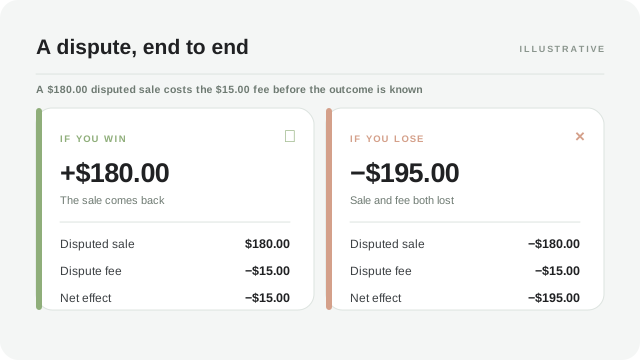
When a buyer escalates to a chargeback and seller protection doesn’t resolve it, PayPal charges a $20 dispute fee — in addition to the reversed transaction. The defenses are the same evidence set as every payment dispute in this series: delivery confirmation to the buyer’s stated address, matching order records, and responsive communication. The bookkeeping rule is the three-lines separation from our chargebacks guide: the reversed transaction, the $20 fee, and any eventual recovery each post separately.
Seller protection itself is worth reading once a year: transactions covered by PayPal’s seller protection program (eligible intangible or physical goods, delivered to the address on the transaction details) can have the chargeback fee waived and the reversal reversed — protection that hinges on shipping to the confirmed address and keeping the proof-of-delivery trail. The habit costs nothing at fulfillment time and saves $20-plus-revenue cases later.
PayPal versus Shopify Payments and marketplaces #
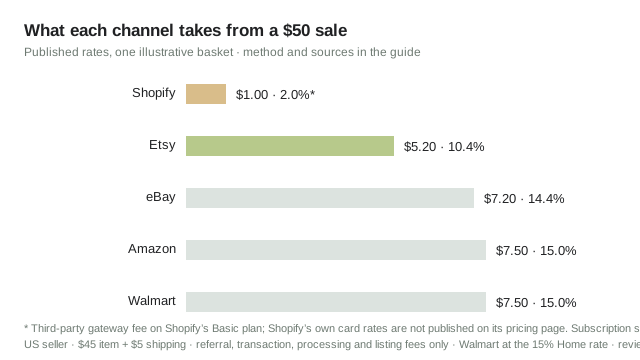
On a $100 online sale, PayPal’s standard $3.98 sits close to Shopify Payments’ $2.90 + 30¢ = $3.20 on the Basic plan, and well above QR-code rates. Against marketplaces, remember the direction of comparison: eBay and Etsy include payment processing inside their fee stacks (eBay inside the final value fee, Etsy as the 3% + $0.25 processing line), so a seller who adds PayPal to an already-fee’d marketplace order is double-paying the payment layer. PayPal earns its keep on direct channels — invoices, your own site, in-person QR — where no marketplace fee exists and the 3.49% is the only commission in sight. The channel-wide version of this comparison is the take rates guide.
How PayPal lands in your books #
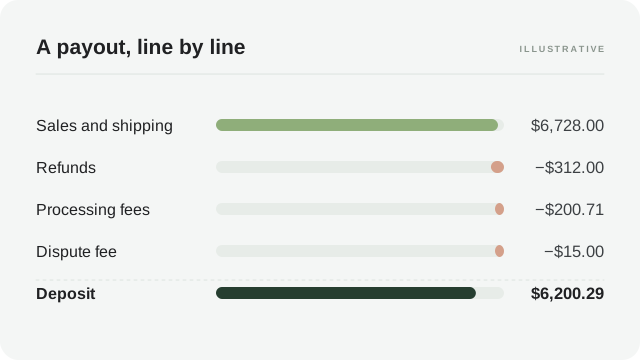
PayPal is a clearing account, not an expense line: sales flow in, fees and refunds deduct inside the balance, and transfers to your bank sweep it to zero. Treating the PayPal balance as an income figure double-counts sales; treating the whole transfer as revenue-in-minus-fees hides both. The structure: record each PayPal transaction’s sale, refund and fee on separate lines, hold the running balance in a PayPal clearing account, and reconcile monthly against the PayPal activity statement — the same routine this blog teaches for every marketplace settlement, applied to a payment account.
The fee lines themselves belong in a payment processing account, separate from marketplace selling fees — PayPal fees exist on direct and marketplace sales alike, and blending them makes both channels’ margins unreadable. Chargeback fees and currency-conversion spreads each get named lines too; the clearing account guide covers the account mechanics and the Shopify payout walkthrough covers the gateway-shaped version of the same reconciliation.
TidyPayouts keeps PayPal, marketplace fees and postage in separate lines — so every channel’s margin is real.
International fees beyond the conversion spread #
Cross-border PayPal transactions carry two extra layers. The international percentage on the transaction runs above the domestic rate (add roughly half a point to a point depending on the recipient country), and the fixed fee varies by recipient currency rather than the flat 49¢. Then conversion applies if payout currency differs — the 3–4% spread from the earlier section, charged inside the conversion. An international sale can therefore carry a transaction fee, a higher fixed fee and a conversion spread: three layers where the domestic sale had one. The books answer is the same one from the multi-currency guide — record in the transaction currency, book the spread on its own line, and never recompute an exchange rate the statement already states.
The PayPal balance as working capital #
PayPal money sits in the PayPal account until you transfer it — and some sellers leave a balance there deliberately, paying suppliers from it or timing transfers for rate reasons. The books treatment: the balance is an asset (a receivable from PayPal), reconciled monthly against the activity statement like any bank account, with transfers to the operating bank recorded as transfers rather than income. If a balance is left in a foreign currency, the year-end revaluation from the multi-currency guide applies to it too. The failure mode is the un-reconciled PayPal account: months of sales, fees, refunds, labels and transfers accumulating into one number nobody can explain — the digital equivalent of the drawer that “sort of balances.”
PayPal business loans and working capital #
PayPal extends working-capital loans and fixed-term business loans to eligible merchants, repaid as a share of daily PayPal sales plus a flat fee disclosed at offer. Two bookkeeping notes, because these arrive quietly. The advance is not income when it lands — it is a liability (or a merchant-cash arrangement whose accounting treatment your bookkeeper should set), and the repayments deduct from settlements before payouts, which makes them look like fees on the statement. Track the loan in its own liability account and the flat fee as interest/financing cost. And read the effective cost: flat-fee repayment on a fast-selling season is a high annualized rate dressed as a small number. The same modeling habit as the catch-up guide’s hire-it-out section applies — understand the total cost before the money arrives, not after.
Common questions #
What is PayPal’s standard seller fee in 2026?+
For standard online seller transactions in the US: 3.49% of the total plus a fixed 49¢ per transaction. Rates vary by payment method (QR-code payments run 2.29% + 9¢, keyed cards differ), by country, and by merchant agreement — PayPal’s merchant fees page is the authority for your account.
Why does PayPal cost so much on small orders?+
The fixed fee. On a $5 sale the 49¢ fixed component is nearly 10% by itself, before the 3.49%. Bundle small orders into single payments, set sensible minimums, or route in-person micro-payments through QR-code rates. The percentage is rarely the problem; the fixed fee is.
Does PayPal refund its fee when I refund a buyer?+
Under current standard terms, refunds return the percentage portion of the fee while the fixed component is retained. On high-return catalogs that residual adds up — track it on its own line rather than letting it vanish into the PayPal balance.
What does PayPal charge for chargebacks?+
A $20 dispute fee where seller protection doesn’t resolve the case — on top of the reversed transaction amount. Covered transactions under the seller protection program can have the fee waived and the reversal reversed, which is why shipping to the transaction’s confirmed address with tracked delivery matters so much.
How much does PayPal take for currency conversion?+
A conversion spread of roughly 3–4% over its base exchange rate, charged inside the conversion when a payment or balance is converted to your home currency. For international sellers this spread often exceeds the transaction fee — model it as a cost of the international sale and record it on its own line.
Is PayPal cheaper than Shopify Payments?+
On a $100 online order, PayPal’s standard $3.98 sits above Shopify Payments’ roughly $3.20 on the Basic plan — but PayPal often converts carts Shopify Payments declines, and offering both typically raises total checkout conversion more than the rate difference costs. The fee table is a input to the checkout decision, not the decision itself.
Do I still pay PayPal fees on eBay orders?+
On managed-payments eBay orders, no — eBay’s final value fee already includes payment processing, and PayPal isn’t charged. PayPal fees on eBay now apply mainly to off-platform or legacy flows. If you see PayPal fees on eBay sales in your books, that’s a reconciliation flag, not a schedule.
How should I record PayPal in QuickBooks?+
As a clearing account: sales, refunds and fees each on separate lines held in the PayPal balance, with bank transfers matching the balance to zero. Booking the bank transfer itself as income double-counts sales; blending fees into it hides them. The clearing-account walkthrough in our QuickBooks guide covers the setup.
Sources and review date #
Reviewed November 16, 2026 against PayPal’s published merchant fee page below (which limits automated access — verify rates while signed in to your own account) and current third-party fee references. Rates vary by country and merchant agreement; examples are illustrative.