Tidy
In this article
- A chargeback deducts the disputed amount when the dispute opens, plus a fee — before anyone decides who is right.
- Winning returns the money; it may or may not return the fee, depending on the provider and region.
- Keep three lines apart: the disputed amount, the dispute fee, and the original sale they all reference.
- Dispute activity is a payout-reconciliation signal too — a spike usually has an operational cause, not an accounting one.
The dispute arrives before the verdict #
A chargeback starts when a buyer asks their card issuer to reverse a charge. What matters for your books is the sequencing: the disputed amount is deducted from your payouts when the dispute opens, along with a dispute fee, long before any evidence is weighed. Shopify’s help describes the mechanics for its payments — including that winning the dispute returns the disputed amount, and that the fee may be refunded depending on your region — and every channel has its own flavour of the same pattern. The books need to survive both outcomes without rework.
The sequencing explains the classic reconciliation jolt: a payout smaller than its report suggests, with no refund to explain the gap. The gap is a dispute. It references an older order, it carries its own fee, and it will either reverse in a later payout or not — three facts your posting should preserve, not flatten.
Three lines that must stay separate #
| Line | What it is | Where it belongs |
|---|---|---|
| Disputed amount | The order value held back while the dispute runs | A dispute receivable/hold line until resolved |
| Dispute fee | The provider’s charge for handling the case | Dispute costs expense |
| Original sale | The order the dispute references | Exactly where it was first posted — untouched |
The original sale is the anchor. Reversing it on day one and re-booking it on a win is how books lose track of whether an order was ever paid.
Why a hold line rather than posting the loss immediately? Because the outcome is genuinely undecided. A receivable-style hold says: this money left our payouts, a decision is pending. If the dispute is won, the credit returns in a later payout and clears the hold — nothing else moves. If it is lost, the hold converts to the dispute’s final cost, and the fee that sat in expense all along finally has its story. Either way the original sale stays; the dispute is an event about payment, not about whether the customer bought.
One disputed order, both outcomes
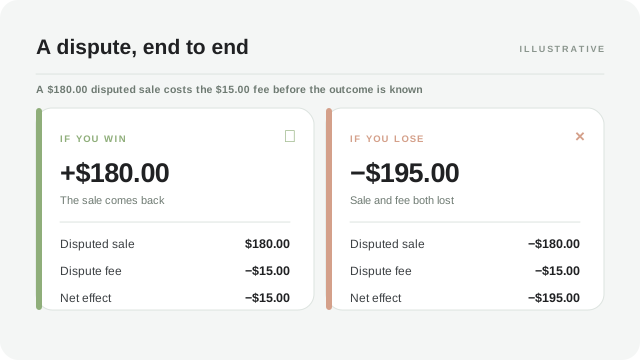
A fictional $180.00 order is disputed, and the provider charges a $15.00 fee. On opening: payouts show −$180.00 (hold) and −$15.00 (fee expense). If you win: a later payout shows +$180.00, the hold clears to zero, and the net cost of the episode is the $15.00 fee — possibly less, if the provider refunds it. If you lose: the hold is written off to dispute losses; the net cost is $195.00. Both outcomes reconcile to the bank, and both leave the original $180.00 sale exactly where it was.
Illustrative figures. Fee amounts and refundability vary by provider and region; the amounts your own payout lines carry are the ones to book.
Where disputes hide in channel payouts #
On Shopify Payments the pattern above appears directly in payouts. On marketplaces with their own buyer-protection flows, the same economics can appear as holds on funds, account-level reserves or claims deducted from settlements — the reserve mechanics in our Amazon reserves guide are the cousin of this pattern. The bookkeeping question is identical in every costume: which payout line is a payment dispute, which is a fee, and which is merely the platform holding funds pending some other process? Grouping settlement lines by family each month, as every reconciliation guide in this series insists, is what makes the answer a lookup instead of a guess.
TidyPayouts keeps dispute amounts, dispute fees and sales on separate lines, so a dispute changes your numbers without wrecking your story.
The cost of a dispute is more than the fee #
The obvious costs are the fee and, on a loss, the sale amount plus the goods you shipped. The quiet costs are operational: the time to assemble evidence, the possibility of a higher dispute rate if disputes cluster, and the refunds-in-kind a buyer expects after a bad experience. A dispute rate worth reacting to is usually telling you something earlier in the funnel — a product description that overpromises, shipping that arrives late, a billing descriptor customers do not recognise. That diagnosis is operational, not accounting; the books’ job is to surface the pattern honestly and early, which is exactly what a separate dispute line does on a monthly review.
Prevention basics are well-trodden and worth repeating once: clear descriptors, fast and documented customer support, tracking on every shipment, and the fraud-screening tools your channel provides. None of it is bookkeeping — all of it shows up in bookkeeping.
A monthly dispute check #
- List disputes opened, won and lost in the period, with amounts and fees.
- Match every open dispute to a hold on your books; investigate holds with no dispute and disputes with no hold.
- Confirm won disputes returned their amounts in a later payout — and note whether the fee came back.
- Review the dispute-rate trend by channel; investigate clusters before they become a pattern the provider notices first.
Four checks, a few minutes once the lines exist. The output is a dispute story you can tell on demand — which, when a provider or a buyer asks, is worth exactly what it costs.
Evidence, and what it can do #
Responding to a dispute is an operational craft with its own literature, and this article stays in its bookkeeping lane — but the lane borders a useful fact: the outcome determines which of the two worked-example paths your numbers take, so the books should make responding easier. They do, in one specific way: the dispute file practically assembles itself from your existing records. The order’s income line and date, the payout that carried it, the shipping record, the refund history, the customer conversation — each is a line you already maintain, each is the raw material of a response, and each is findable in minutes on books that keep order-level traceability.
What the books cannot do is win the dispute for you; evidence standards belong to the card networks and the provider’s process, and the provider’s own help is the guide worth following. The division of labour is clean: operations gathers and argues, bookkeeping keeps the trail, and the monthly dispute check from this article confirms that whatever was argued, the money moved the way the outcome said it should.
Disputes, inquiries and claims are not the same thing #
Channels use overlapping words for different mechanisms, and the differences matter at posting time. A card chargeback is the full pattern above: money deducted at opening, a fee, a verdict. A pre-dispute inquiry asks whether you can resolve things before it escalates — often no funds move yet, and the bookkeeping move is a note on the order, not a hold. A marketplace claim under buyer protection runs on the marketplace’s own program: funds may be held, deducted, or merely frozen, per that program’s rules, with timelines that differ from any card network’s.
Treating all three identically is how books end up with holds that never existed and deductions nobody can find. The grouping habit resolves the vocabulary too: group settlement lines by what actually happened to the money, not by what the row was called. A held amount, a taken amount, and a returned amount are three different facts, whatever the label; your dispute lines should carry the facts, with the channel’s case reference attached so its program’s paperwork can be joined to yours when the verdict arrives.
When a dispute is really a returns problem #
A dispute is often the last step of a service failure that started weeks earlier: a late delivery the buyer gave up waiting for, a product nothing like its photos, a return path that felt like a maze. The books will happily book the fee and move on; the better question the monthly check can ask is whether each dispute had a sibling refund or support ticket — most do. Where they do, the fix lives upstream in operations, and the dispute line is only the receipt.
This is why the dispute line earns its separation on the profit and loss rather than hiding inside refunds. Grouped with refunds, a disputes problem reads as mildly generous return policy; grouped alone, with counts and reasons beside it, it reads as the operational signal it is. Our returns guide covers the upstream half of that story; the dispute check here is its downstream shadow.
Common questions #
Should I reverse the sale when a dispute opens?+
No. Keep the sale and record the disputed amount as a hold; reverse nothing until the outcome. The dispute concerns payment, not the sale itself, and day-one reversals are how books lose the thread of whether an order was ever paid.
What happens to the dispute fee if I win?+
It depends on the provider and region — Shopify’s guidance notes the fee may be refunded depending on country. Check the later payout line: if the fee returned, post it as a recovery against your dispute-cost line; if not, the fee stands as the cost of the episode.
A marketplace deducted a claim that looks like a chargeback. Same treatment?+
In principle yes — a deducted amount pending resolution is a hold, and its fee is a cost — but marketplace claims follow their own programs and timelines. Keep them in channel-named dispute lines so the channel’s own reports reconcile against them cleanly.
Sources and review date #
Reviewed October 26, 2026 against the provider guidance below. Dispute programs, fees and refundability vary by channel and region; your own payout lines are the amounts to book. Examples are fictional.