Tidy
In this article
- A return is several events, not one: the refund, the fee treatment, the item’s journey back, and the restock-or-write-off decision.
- The refund often does not recover the original selling fees in full — a fully refunded order can still cost money.
- Money and goods move on different clocks: refund in one payout, item back on the shelf days later, each recorded when it happens.
- The unit’s cost follows the unit: restocked means inventory again; damaged means a write-off. Refunds never touch COGS lines by default.
A return is a process, not a row #
The books meet a return before the returned box does. The buyer’s refund is issued — sometimes before the item ships back, sometimes weeks after it arrives — the marketplace deducts the refund from a settlement, and the fees around the original order unwind by their own rules. Meanwhile the physical unit travels: back to a marketplace warehouse, to you, or occasionally straight to disposal, and its cost returns to inventory or becomes a write-off accordingly. Booking the return as a single negative row flattens a process with five distinguishable events, and the flattening is where return accounting goes wrong.
This guide follows one fictional return through those events. The channel specifics — who pays return shipping, whether fees come back, how restocking is handled — vary by marketplace and program; the structure of the events does not.
The money side of a return #
The refund itself is the simple part: a negative line in whichever settlement it lands, posted to the refunds line your books already maintain. The interesting rows are around it.
- Original fees. Selling and processing fees were charged when the order was; on refund, some portion may be credited back. How much varies by channel and fee type — payment processing fees in particular often keep a part of the original charge. The settlement’s own rows state what came back; book what they say, not what symmetry suggests.
- Return shipping. Whoever pays it — you, the buyer, or the marketplace under a program — it is a cost of the return and deserves its own visibility once it becomes material.
- Restocking fees. Where charged, they reduce the refund the buyer receives; the retained slice is typically a contra to the refund, not a new income line. Conventions vary — agree once with your bookkeeper.
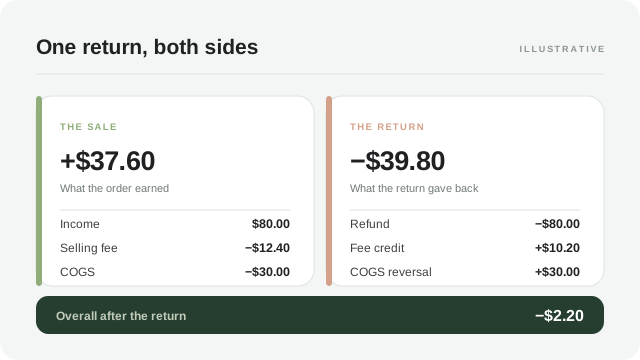
One $80 order, returned
A fictional $80.00 order: unit cost $30.00, selling fee $12.40. The buyer returns the item and receives a full refund; the channel credits $10.20 of the original fee; the unit arrives back in sellable condition. The sale: income $80.00, fee −$12.40, COGS −$30.00 — profit $37.60. The return: refund −$80.00, fee credit +$10.20, COGS reversal +$30.00 (the unit is inventory again) — effect −$39.80. Overall: −$2.20. The order earned nothing and cost the unrecovered fee residue: a perfectly handled return still has a price.
Illustrative figures. The fee credit here is invented for the example; the settlement’s rows carry the real one. The COGS reversal applies because the unit came back sellable — see below for the cases where it does not.
The goods side: restock or write off #
The unit’s journey decides where its cost goes. Back in sellable condition: its cost returns to inventory at the value it left with, ready to be expensed again as COGS when it sells next time — the reversal in the worked example. Damaged, incomplete or unsellable: the cost does not come back; it becomes a write-off, visible as its own line rather than absorbed silently. Still in transit at period end: it remains what it physically is — your inventory, temporarily unlocated — and the count reconciliations in our COGS guide are what keep unlocated inventory from quietly becoming lost inventory.
Channels with warehouse networks add a middle case: the unit returns to the marketplace’s warehouse, and its disposition — resellable, unfulfillable, disposed — arrives through their reports. Where the marketplace disposes of a unit, the write-off is real even though no box reached your door, and where it compensates you for that loss, our reimbursements guide covers the credit.
TidyPayouts posts refunds, fee credits and cost reversals as separate lines, so a returned product changes your numbers without muddying them.
Two clocks on every return #
The refund and the unit rarely move together. A fast channel refund hits a settlement in days; the box can take two weeks, and the restock a day after that. Under a cash view the books show the refund when it settles; the inventory side updates when the unit is accounted for; for a short window the two disagree — a refund with no unit back, a unit back with no refund. That disagreement is normal and needs labelling rather than forced symmetry: return-in-transit lines, or simply a monthly habit of pairing refunds to their returns’ outcomes, keep the window honest until it closes.
The timing that should not drift is attribution drift: refund rows landing in a different month from their original sales, with no reference connecting them. Channels vary in what references they provide; wherever a reference exists, carry it. A refund that cannot be tied to its order is a reconciliation suspicion, not a fact — the pairing habit in the monthly routine below is what turns suspicion into traceability.
What a return rate should be allowed to say #
Once returns are booked with their parts kept apart, the reports earn the right to answer management questions: return rate by product, margin damage by channel, fee residue as a real cost line. A product with a 20% return rate and heavy fee residue is priced wrong even when every individual order looked fine — and no single-number booking would ever reveal it. That visibility, not the bookkeeping mechanics, is the return on doing returns properly.
A monthly returns routine #
- Group refund lines from the month’s settlements; total by channel.
- Pair refunds to fee credits and note the residue — the unrecovered fee cost of returning.
- Pair refunds to return outcomes: restocked, written off, in transit. Chase pairs still open from earlier months.
- Post write-offs deliberately, with the report reference; never let inventory shrink by silence.
- Review the rate and the residue by product; flag anything whose trend changed.
Five steps that start with the settlement report you already reconcile. Returns never become fun; they become legible, which is most of what bookkeeping can promise about them.
Returnless refunds and keep-it items #
Sometimes the cheapest resolution is the refund without the box: the item is low-value, return shipping would exceed the product, or the channel’s program simply issues the refund and lets the buyer keep the goods. The money side books exactly as any refund — negative line in its settlement, fee residue noted. The goods side records nothing coming back: no restock, no COGS reversal, because no unit returned. The books then say something important that a single-row booking would hide — that the cost of this return is the entire unit, not a logistics fee — and the product’s margin history carries the full weight of that outcome.
Keep-it outcomes deserve one extra sentence in the notes: why the unit was not recovered. Patterns matter. A product that generates keep-it refunds regularly is a returns problem the margin report should be allowed to expose; scattered one-offs are the ordinary cost of trading. The monthly routine’s pairing step — refunds to outcomes — is where the distinction is recorded, and it costs one line per case.
What the books can and cannot see #
Return data has a reputation for catching abuse — serial refunders, wardrobing, promo stacking — and the books do carry traces of it: refund frequency by buyer, returns clustered on new releases, fee-residue patterns that spike with certain orders. But bookkeeping is a ledger, not an investigation, and its honest contribution is the same as everywhere else in this series: clean, grouped, comparable lines that make a pattern visible if someone chooses to look. Acting on abuse — limiting buyers, disputing claims, involving the channel — is operational and policy work with its own rules on each platform.
Keep the boundary deliberate. The monthly returns routine reports what happened; it does not accuse anyone of anything. The moment a pattern looks operational rather than random, hand it to the channel’s reporting tools and your own policies, with the books’ numbers as the supporting exhibit. That division keeps the ledger trustworthy — useful precisely because it never had a motive.
Common questions #
Should refunds reduce sales or sit as their own expense?+
Both conventions exist — our chart of accounts guide covers the choice. What matters is picking one, noting it, and applying it everywhere. A books-with-both approach is the one option that makes refund reporting meaningless.
The customer kept the item and still got refunded. What now?+
The money side books as any refund; the goods side records no return — no restock, no reversal. If the channel’s program makes that outcome reimbursable, the credit follows the reimbursements pattern: a recovery against the loss, not extra income.
Do I re-record COGS when a returned unit sells again?+
Yes — and that is the point of the reversal. The unit returned to inventory at cost, so its second sale carries COGS again. Skipping the reversal would let one unit’s cost fund two sales’ margins, which flatters nothing it touches.
Sources and review date #
Reviewed October 26, 2026 against the provider guidance below. Return programs, fee treatment and restocking conventions vary by channel; your own settlement rows and channel policies are authoritative. Examples are fictional; confirm treatment with your bookkeeper.