Tidy
In this article
- eBay automatically calculates, collects and remits US sales tax at checkout in every jurisdiction that requires it — sellers cannot opt out, pay no fee for the service, and have no tax table to maintain.
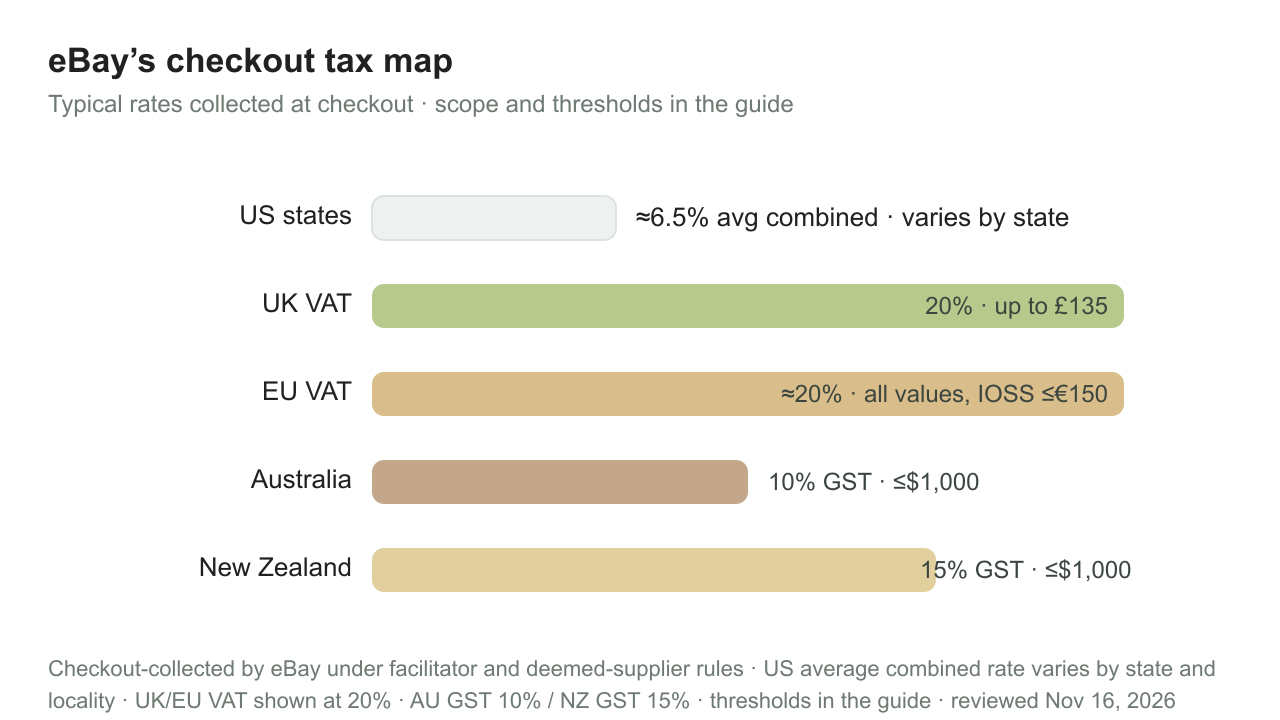
- eBay’s checkout tax reaches further than sales tax: 20% UK VAT on consignments up to £135, EU VAT on all values (eBay as deemed supplier under IOSS for consignments up to €150), and GST in Australia and New Zealand up to $1,000.
- Used items are taxed like new ones, and tax applies to the sale price plus shipping and handling where the jurisdiction taxes it — eBay computes the detail per order.
- What remains yours: nexus measured across all your channels (eBay orders count toward it), any non-facilitated sales you make, verification that the remittance matches the reports, and filings where registrations or informational duties exist.
What eBay collects for you now #
The US picture is settled. Under marketplace facilitator laws, eBay calculates, collects and remits sales tax at checkout on orders delivered into every jurisdiction that requires it — 46 US jurisdictions had laws in effect by July 2021, and with Missouri’s arrival on January 1, 2023 the coverage is complete: every state with a sales tax, plus DC. Sellers cannot opt out, pay nothing for the collection service, and take no action for these orders. The tax is the buyer’s money: it appears as its own line on the order and the settlement, and it is never your income.
The detail eBay computes per order is broader than sellers often assume. Tax applies to the sale price and — in jurisdictions that tax delivery — to shipping and handling charges; it applies equally to used and new items; and buyers claiming exemption must hold the state-issued certificates, which eBay’s checkout respects where the buyer’s account carries them. What you should not expect: tax on eBay’s own fees (those are eBay’s money, not part of your sale), or any seller-side obligation to calculate rates by hand.
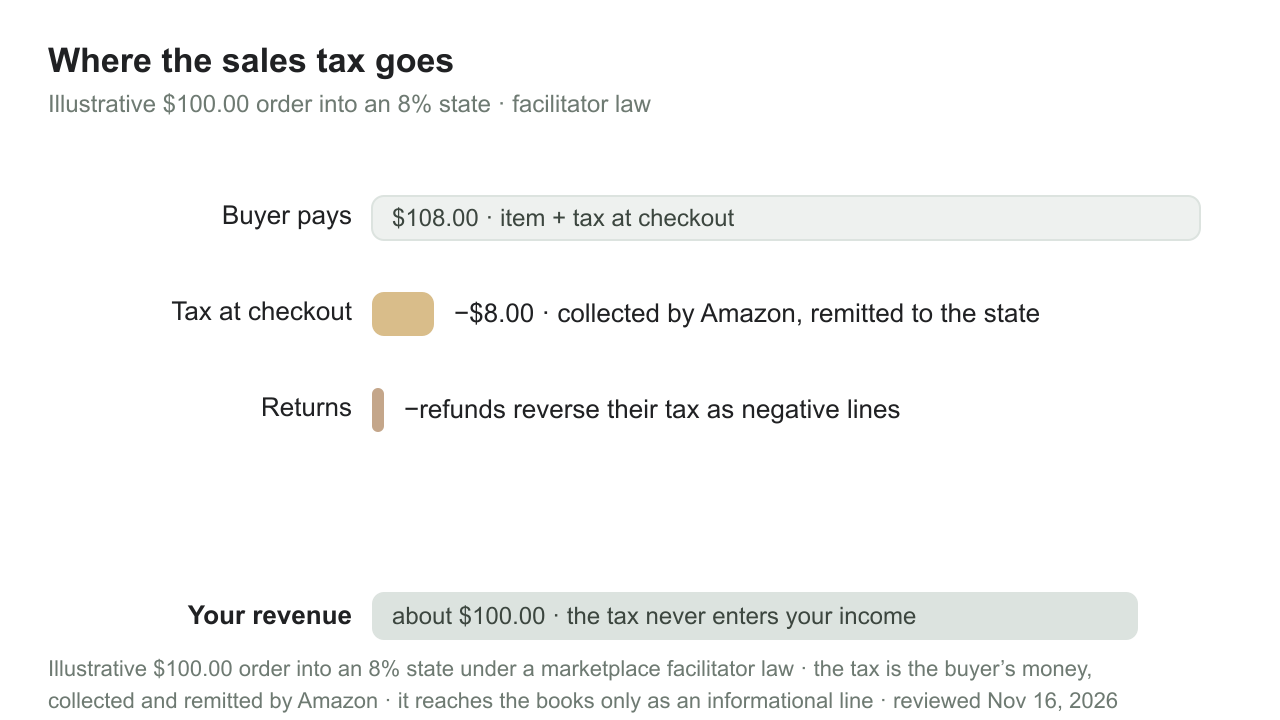
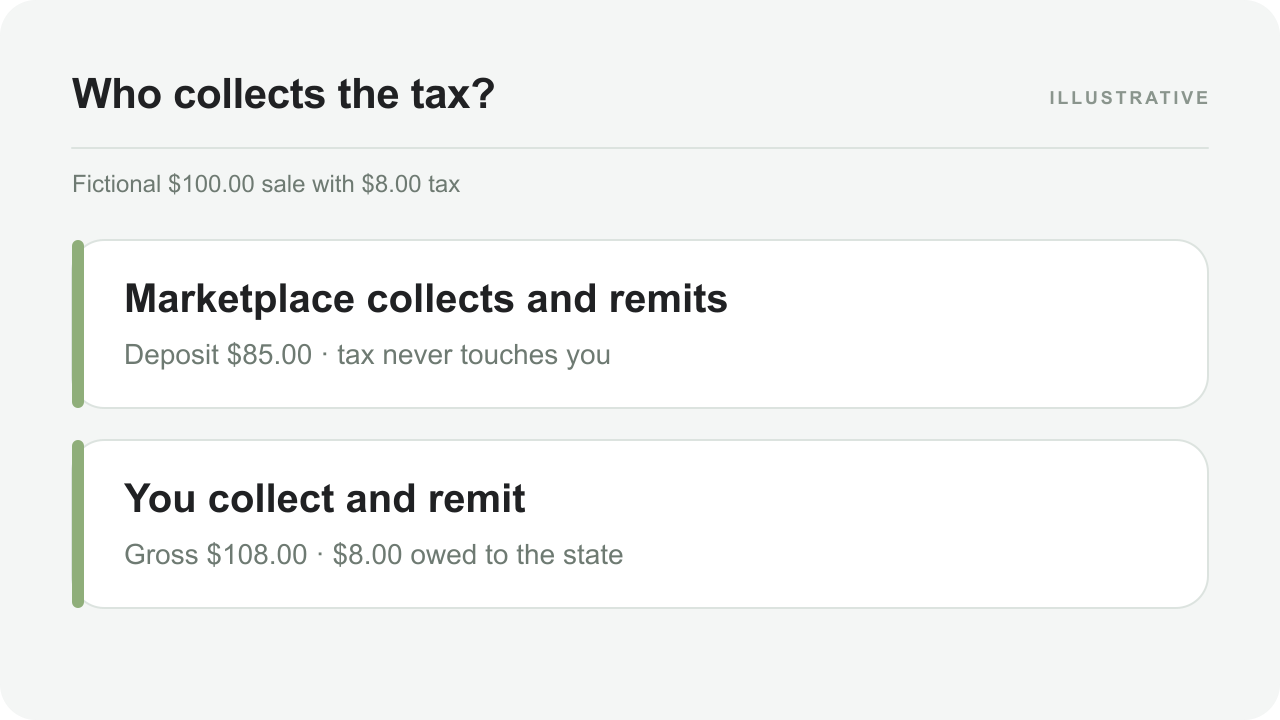
One boundary matters as much as the coverage. Facilitation attaches to eBay orders. The moment your business sells anywhere else — your own site, a marketplace without a facilitator law, in person, wholesale — those sales follow the ordinary nexus and collection rules, and eBay’s remittance covers none of them. The full treatment of that residual obligation is in our Amazon sales tax guide, whose nexus and filing sections apply to eBay sellers identically; this guide stays on what is eBay-specific.
Whatever happened to the sales tax table #
Guides from 2020 and earlier — including most that still rank for this topic — spend their middle sections on eBay’s sales tax table: the account-settings page where sellers entered per-state rates, ticked “also charge tax on S&H,” and then manually checked a box on every listing to apply the table. That machinery exists because, before facilitator laws, sellers were the collectors. With US facilitation now complete, the table is a legacy artifact for marketplace orders: eBay calculates the tax itself, the per-listing checkbox is obsolete for covered orders, and the 2020-era instructions to “maintain your tax table annually” describe work that no longer exists.
The honest replacement is smaller and different. Today’s US to-do list is: know your nexus (next-but-one section), handle any non-facilitated sales yourself, keep your listings’ item locations accurate so eBay’s calculations key off the right jurisdictions, and verify the paperwork (a later section). The tax table needs none of your attention unless eBay’s help pages ever direct you there for a specific order type — which, as of this writing, they do not for standard US marketplace sales.
International: where eBay’s tax machinery is busiest #
The US facilitator story is the quieter half. eBay’s checkout tax actually spans four more tax systems, and for cross-border sellers this is the half with real mechanics:
| Jurisdiction | What eBay collects at checkout | Scope |
|---|---|---|
| United States | Sales tax, computed per state and locality | All 45 sales-tax states + DC, all order values |
| United Kingdom | VAT at 20% | Consignments up to £135 imported from outside the UK |
| European Union | VAT at the destination country’s rate | All consignment values; eBay as deemed supplier under IOSS up to €150 |
| Australia | GST at 10% | Orders up to AUD $1,000 |
| New Zealand | GST at 15% | Orders up to NZD $1,000 |
Current as of November 2026 from eBay’s own tax pages (sources below). Above the thresholds, standard import treatment applies and the tax is collected at the border from the buyer — not through the checkout.
Three consequences worth internalizing. A UK buyer paying £120 for a £100 item under the £135 threshold is paying eBay-collected VAT, not a surprise fee — and so are you protected from double-charging: never add VAT manually to orders where eBay already collected it. The EU regime treats eBay as the deemed supplier for low-value consignments under the Import One-Stop-Shop, which is why EU orders of any value carry VAT at checkout — the July 2021 reform that post-dates most older guides entirely. And your obligation on all of this is mostly data quality: accurate item location, accurate category and customs information, and prices that leave room for the tax the buyer will see added. The remittance is eBay’s problem; the accuracy of what gets taxed is yours.
Nexus still accrues across everything you sell #
Facilitation does not turn nexus off. Economic nexus — the power a state gains over you at roughly $100,000 of sales or 200 transactions into the state per year, with outliers at $250,000 and $500,000 — is measured per state, per year, across your whole business: eBay orders, Amazon orders, your own site, all of it. An eBay-only seller may never need to act on those thresholds for marketplace orders, because facilitation covers them; the same seller who launches a Shopify store inherits thresholds their eBay volume has already spent most of the way toward.
The full threshold table, the Wayfair ruling behind it, the FBA-style inventory nuance, and the remediation path (voluntary disclosure agreements through the Multistate Tax Commission) are in our Amazon sales tax guide — none of it is Amazon-specific, and duplicating it here would serve no one. The eBay-specific version of the discipline: export your eBay by-state sales at least annually and add them to the same monitoring file as every other channel’s.
Where the tax shows in your eBay paperwork #
eBay gives you the tax trail at three levels, and the verification habit is to read all three once a month:
- The order. Every order’s detail page shows the sales tax (or VAT/GST) the buyer paid, separately from the item price and shipping. Spot-check exempt-looking orders here.
- The reports. Seller Hub’s order reports and downloads carry per-order tax columns; a by-state or by-country total takes one spreadsheet pivot. The refunds and fees reconciliation guide covers the report-reading routine.
- The settlement and invoice. Collected tax appears on settlements as its own lines — distinct from sales, fees and fee credits — and reverses on refunds the same way (negative tax lines, not silently vanished money).
The loop: monthly, total the tax lines, confirm they scale with taxable sales, and file the note with your books. When a state auditor, a tax preparer, or your own year-end reconciliation asks how much tax flowed through your eBay business, the answer is a report, not a reconstruction. This is the same discipline every guide in this series teaches about payouts; tax is simply one more line that deserves its own name.
Filing: what states still want from eBay sellers #
For a marketplace-only eBay seller, the filing burden is close to zero — and where it isn’t, the pattern matches the Amazon picture exactly: some states expect informational reporting of facilitator-collected sales (Missouri is the standing example), registrations you hold expect a return every period even at zero sales, and any non-facilitated sales into nexus states are yours to collect and remit on a schedule the state assigns by volume. Registration still belongs before collection wherever you are the collector. The complete filing walkthrough — frequencies, due-date habits, the compliance calendar, and what to do about past years — lives in the Amazon sales tax guide and applies unchanged here.
The one eBay-specific filing footnote: UK, EU, Australian and New Zealand sellers face their own VAT/GST registration regimes (and non-UK sellers making UK sales do too), which sit outside this US-focused guide — eBay’s seller-side tax pages cover the registration triggers per country, and the cross-border mechanics are worth a professional conversation before they’re worth a guess.
TidyPayouts splits every settlement into sales, refunds, fees and tax lines — facilitator tax stays out of your income and visible on its own.
The books treatment #
The rule is identical to the Amazon version and bears one-line repetition: checkout-collected tax is never your income and never your expense. It rides the settlement as its own line, reverses on refunds, and exits your books’ interest entirely — the P&L carries the tax-exclusive sales number your tax professional needs. Self-collected tax from non-facilitated channels lands in a sales tax payable liability and leaves when filed. The entry-level walkthrough with settlement line examples is in the facilitator bookkeeping guide; keep that account structure channel-agnostic so eBay, Amazon and your own site all post the same way.
Common questions #
Does eBay collect sales tax on all my US orders?+
Yes, on orders delivered into the 45 sales-tax states plus DC — eBay calculates the rate per order, adds it at checkout, and remits it to the state. Sellers cannot opt out, pay no collection fee, and take no action for these orders. Used items are taxed exactly like new ones.
Do I still need to set up eBay’s sales tax table?+
No — not for standard US marketplace orders. The per-state sales tax table predates facilitator laws, when sellers were the collectors; eBay now calculates tax itself and the per-listing “charge tax per the table” step is obsolete for covered orders. Check eBay’s current help pages if you ever sell an order type outside the covered flow.
Does eBay add sales tax to shipping?+
Where the delivering jurisdiction taxes shipping and handling, eBay includes it in the taxable base — the checkout computes this per order rather than by a flat seller setting. States differ on delivery charges, so two identical orders into different states can show different tax on the same shipping line.
What about UK, EU and Australian buyers — who collects their VAT and GST?+
eBay, at checkout: UK VAT at 20% on consignments up to £135, EU VAT at the destination rate on all values (eBay as deemed supplier under IOSS up to €150), Australian GST at 10% and New Zealand GST at 15% up to their $1,000 order thresholds. Above those thresholds, import treatment applies at the border. Never add these taxes manually on top of eBay’s collection.
Do I need a sales tax registration if eBay remits everything?+
For a marketplace-only eBay seller, most states require nothing for facilitator-covered sales — though a few expect informational reporting. Registration enters the picture when you sell through non-facilitated channels into states where your nexus (which your eBay volume counts toward) has crossed the threshold, and for your home state’s own rules. Map channels and volumes with a tax professional before assuming.
How do I see how much tax eBay collected on my sales?+
Three views, monthly: the order detail pages (tax per order), Seller Hub’s downloadable order reports (tax columns for pivoting by state or country), and the settlement lines where collected tax rides separately from sales and fees. Total them, sanity-check against taxable sales, and file the note with your books.
What happens to the tax when I refund a buyer?+
eBay reverses the tax along with the sale — it shows as a negative tax line on the affected reports and settlement rather than disappearing. Your filings and reconciliation should net reversals the same way they net refunds; the returns reconciliation guide covers the matching routine.
I used to maintain the sales tax table and charge tax myself. Did that all stop?+
For standard US marketplace orders, yes — facilitator laws made eBay the collector everywhere, and the old table-and-checkbox workflow is legacy. What didn’t stop: your obligations on non-facilitated channels, nexus monitoring across everything you sell, informational filings where states require them, and the paperwork review that confirms eBay’s remittance matches its reports.
Sources and review date #
Written November 16, 2026 against eBay’s published tax pages below; jurisdiction rules change, and the US thresholds and filing detail this guide links to rather than repeats live in our Amazon sales tax guide. Confirm your own situation with a tax professional before registering or filing anything.