Tidy
In this article
- Sales tax collected by a marketplace on your behalf is the marketplace’s to remit — it should not be booked as your revenue.
- Sales tax you collect yourself is a liability, not income, until you pay it to the state.
- Which case applies depends on the channel and the state; the settlement or payout report shows the tax lines.
- Reconcile tax lines separately every month, so the liability balance matches what you actually owe.
Two kinds of sales tax line #
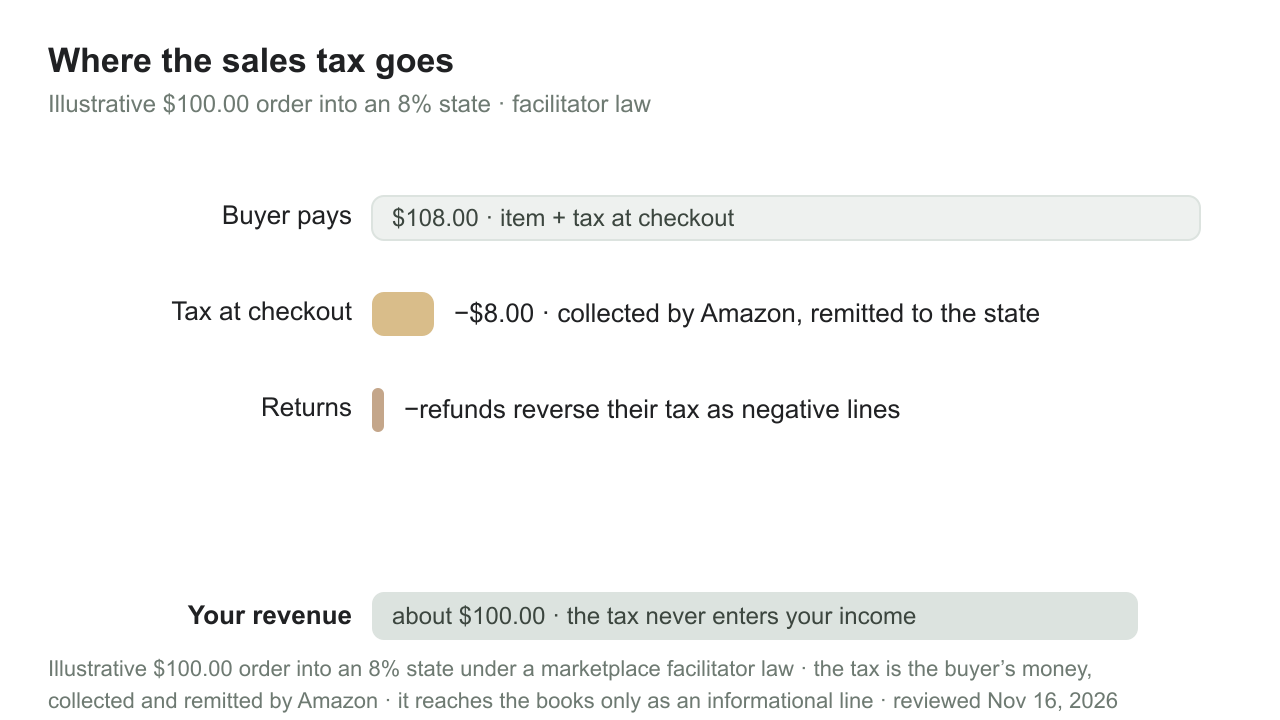
Marketplace sellers meet sales tax in two very different forms. In many places, marketplaces are required to calculate, collect and remit sales tax on orders placed through them — these are often called marketplace facilitator rules. On those orders the buyer pays tax to the marketplace, the marketplace sends it to the tax authority, and the tax never reaches your bank account. On orders from your own storefront, or in places where the marketplace does not collect, the tax is yours to collect and file.
Both cases show up in reports, which is what makes them easy to mix up. A tax column is not the same as tax you owe. Read the line description, not the amount.
| Case | Who remits | In your books |
|---|---|---|
| Marketplace collects and remits | The marketplace | Not income, not a liability — a memo or excluded line |
| You collect (own store, non-facilitated orders) | You | Sales tax payable until filed and paid |
The mistake that inflates revenue #
The common error is booking the buyer’s order total as income. If an order total includes $8.00 of tax that the marketplace sends to the state, then counting $108.00 as sales overstates revenue by $8.00, and the books will never reconcile to the deposit, because the deposit excludes it. Over a year this distorts gross receipts, margins and anything you compare to a Form 1099-K — see our 1099-K guide for how reporting totals differ from deposits.
A worked example #
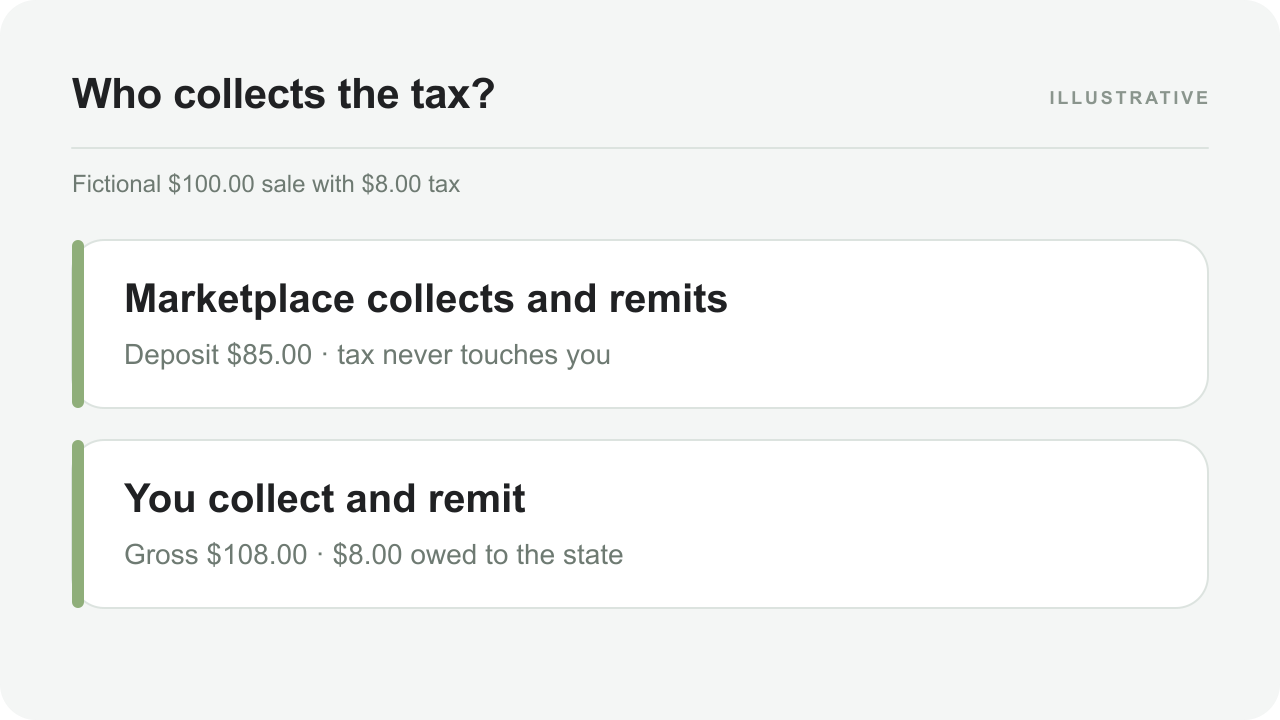
Same sale, two tax treatments
A fictional $100.00 item carries 8% tax, so the buyer pays $108.00. Marketplace collects: income is $100.00, fees are $15.00, and the deposit is $85.00. The $8.00 appears in the report but goes straight to the tax authority. You collect: a storefront takes $108.00, a $3.52 processing fee comes off, and the payout is $104.48. Income is $100.00, the fee is an expense, and $8.00 sits in sales tax payable until you file.
Illustrative figures. Rates, fees and rules vary by place, channel and time; use your own reports and a tax professional’s guidance.
Reconcile the tax lines every month #
Once a month, total the tax lines on each channel and sort them into the two cases. The collected-by-marketplace total should reconcile to the channel’s tax report and never touch income. The collected-by-you total should equal the movement in your sales tax payable account; after you file and pay, the balance should fall back toward zero. A payable balance that only ever grows means a payment was booked to expense — or never made. The chart of accounts generator includes a sales tax liability account built for this, and our chart of accounts guide shows where it sits.
Where this goes wrong in practice #
Three situations catch sellers out: orders shipped to states where the marketplace does not collect, refunds that return tax along with the price, and a business with sales tax registration obligations of its own regardless of marketplace activity. None of these is a bookkeeping rule so much as a reminder that the report only tells you what the channel did, not what you owe. Treat questions about registration and filing as tax advice, not bookkeeping, and take them to a qualified professional.
How marketplace facilitator rules came about #
For years, sellers owed sales tax mainly where they had a physical presence. In 2018 the U.S. Supreme Court’s decision in South Dakota v. Wayfair allowed states to require out-of-state sellers to collect tax based on economic activity. Most states with a sales tax then adopted marketplace facilitator laws, which place the collection and remittance duty on the platform that facilitates the sale instead of on each individual seller.
The details differ by state: what counts as a marketplace, which sales are covered, what thresholds apply, and what the seller still has to do. That variation is why this guide stays on the bookkeeping side. A state’s revenue department, or a tax professional, is the source for what you owe; the Streamlined Sales Tax Governing Board, linked below, is a useful starting index for participating states.
Finding the tax lines in your reports #
Every channel reports tax a little differently, and the labels are not consistent. Some reports show a tax amount on each order row. Others show it only in a summary, or show a line whose description says the tax was collected and remitted by the marketplace. A few show order totals that include tax and leave you to subtract it.
- Read the description, not just the amount; “tax” in a column heading can mean tax collected by you, tax collected for you, or tax refunded.
- Check whether the payout deposit includes or excludes the tax line. If your bank deposit equals sales minus fees and refunds with no tax, the marketplace is holding the tax.
- On your own storefront, find the tax the payment processor reports separately from the sale.
- Keep one saved report per channel per month that shows tax by order, so the monthly total can be traced to its source.
If you cannot tell which case an order falls under, do not guess in the books. Park the amount in a labelled clearing line with a note and resolve it from the channel’s tax report.
Booking tax the marketplace collects #
The cleanest treatment is to keep marketplace-collected tax out of your accounts altogether: record the sale at its pre-tax price, record fees and refunds as usual, and let the deposit tie to that figure. Many sellers prefer to see the tax for reconciliation, though. In that case, a bookkeeper can set up a pair of memo or clearing accounts, one for tax collected by the marketplace and one for tax remitted by it, that net to zero every period. If they do not net to zero, either a tax line was missed or a refund was recorded without its tax.
What you should not do is route that tax through income or through your own sales tax payable account. It was never yours, and it was never owed by you. Putting it in the payable account makes the liability look larger than it is and leaves you chasing a payment you were never going to make.
Refunds and tax #
A refund returns the buyer’s money, and usually the tax with it. On a marketplace-collected order, the marketplace adjusts its own remittance and nothing in your tax payable changes; your books should reduce the sale and the refund, and the tax pair, if you keep one, should reverse too. On an order you collected tax for, a refund reduces your payable balance by the tax returned.
A full refund on an order you collected tax for
A fictional order is $100.00 with 8% tax, so the buyer paid $108.00. The refund returns $108.00. In your books, sales fall by $100.00 and sales tax payable falls by $8.00. If the full $108.00 were booked as a reduction of sales, revenue would be understated by $8.00 and the payable balance would be $8.00 too high.
Illustrative figures. Refund and tax rules differ by channel and place.
A sales tax payable roll-forward #
For tax you collect yourself, a short roll-forward proves the liability the same way a reserve roll-forward proves held funds. One row per filing period, and the closing balance must equal the next row’s opening balance.
| Period | Opening | Collected | Refunded | Paid | Closing |
|---|---|---|---|---|---|
| Month 1 | $420.00 | $310.00 | −$24.00 | −$420.00 | $286.00 |
| Month 2 | $286.00 | $355.00 | −$18.00 | −$286.00 | $337.00 |
In Month 1, the payment settles the prior period’s opening balance, and the closing balance is what you collected and have not yet paid. If the closing balance ever exceeds roughly one filing period of collections, a payment is missing. If it goes negative, a refund or payment was booked to the wrong account. The Amazon sales tax summary spreadsheet includes a quarterly view built the same way.
Illustrative figures.
Own-store orders, exempt buyers and where you owe #
Marketplace rules cover marketplace orders. If you also sell through your own website, wholesale, or in person, those sales are outside the facilitator’s collection duty, and your obligations depend on where you have registered and where your sales exceed state thresholds. Wholesale or resale buyers may present an exemption or resale certificate, in which case tax is not charged on the sale; keep the certificate, because it is the evidence if the state asks why no tax was collected.
None of these is hard to record once the case is identified, but identifying the case is a tax question. Registration, thresholds and filing frequency belong with a tax professional or the state’s revenue department, not with the bookkeeper’s chart of accounts.
Tax, the 1099-K and your annual totals #
Payment reporting forms reflect payment amounts, not your accounting for them. The IRS describes the Form 1099-K as reporting gross payment transactions without subtracting fees or refunds, so the total on the form will not equal revenue in your books. Tax collected on your behalf, fees and refunds are some of the reconciling items. Our 1099-K guide walks through the bridge, and keeping the tax lines separate all year is what makes that bridge short.
Common questions #
Should marketplace-collected sales tax appear on my income statement?+
No. If the marketplace collects and remits it, it is not your revenue or your liability. Keep it out of income; if you want visibility, track it in a memo line that reconciles to the channel’s tax report.
What if my deposit looks smaller than the order total?+
Compare the order total with the report: the difference is usually fees, refunds, reserves and, where the marketplace collects it, tax. Itemize the gap rather than treating it as a lost sale.
Do I still need to file sales tax if the marketplace collects it?+
That depends on your own registrations and on sales outside the marketplace. It is a tax question, not a bookkeeping one, so confirm with a tax professional for your states.
How often should I reconcile sales tax payable?+
Match your filing frequency at a minimum, and monthly is better. A monthly roll-forward catches a missed payment or a mis-booked refund before it is a quarter old.
How do I book a refund on an order where the marketplace collected tax?+
Reduce sales and book the refund at the report amounts. Your own sales tax payable does not change, because the tax was never your liability; if you keep a memo pair for marketplace tax, reverse the tax there.
Sources and review date #
Reviewed November 13, 2026. Sales tax rules vary by state and change over time; confirm your obligations with the state revenue department or a tax professional. Examples are fictional.
Change log. November 13, 2026: Added background on marketplace facilitator rules, finding tax lines in reports, booking and refunds, a sales tax payable roll-forward and own-store orders, plus a Sources section.