Tidy
In this article
- The core stack on every US sale: $0.20 to list (4 months or until it sells), 6.5% transaction fee on item price plus shipping plus gift wrap, and 3% + $0.25 payment processing.
- Offsite Ads add 12% (shops over $10,000 sales per year — mandatory) or 15% (smaller shops — optional, can be switched off) on orders attributed to Etsy-placed ads within a 30-day window.
- US sellers pay no regulatory operating fee; sellers in the UK, France, Italy, Spain, India, Türkiye and Vietnam pay a small percentage that rises periodically (the UK reached 0.48% in June 2026).
- On a $50 attributed sale the fees total roughly $11.20 — about 22% — which is why Offsite Ads attribution is the single number Etsy sellers should watch.
Etsy fees at a glance #
Etsy prices like the opposite of Amazon: no subscription to buy into, but a stack of per-event charges that begins before anything sells. Every fee below applies to Etsy.com marketplace sales; sellers running a separate Pattern site or selling in person have different lines, which the sections on those costs touch on briefly.
| Fee | When it applies | Amount (US, 2026) |
|---|---|---|
| Listing fee | Per listing, on creation and on each auto-renewal | $0.20 per listing per 4-month term |
| Transaction fee | Every sale | 6.5% of item price + shipping + gift wrap |
| Payment processing | Every sale through Etsy Payments | 3% + $0.25 (US; varies by country) |
| Offsite Ads fee | Only on orders attributed to Etsy-placed external ads | 12% (mandatory at $10K+ sales/365 days) or 15% (optional below) |
| Regulatory operating fee | Sellers in certain countries only | US: none; UK 0.48%; varies elsewhere |
| Currency conversion | Payout converted to a different currency | 2.5% |
| Shipping labels | Optional — buy postage through Etsy | Carrier cost, charged to the payment account |
US rates reviewed November 16, 2026 against Etsy’s published fee pages below. Rates are periodic-change territory — Etsy has raised the transaction fee from 5% to 6.5% and nudged regulatory fees up more than once — so confirm the current numbers before you price.
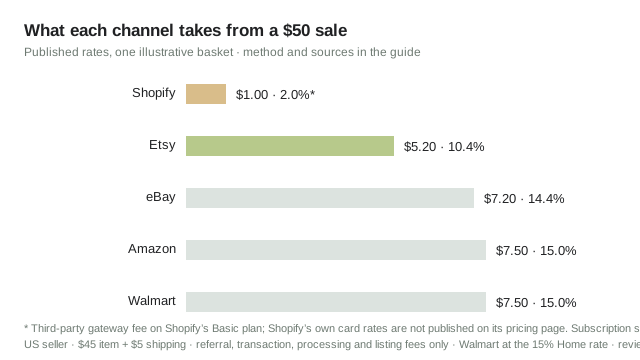
The comparison shoppers’ number: on a $50 sale with no Offsite Ads attribution, the fee stack is about $5.20 plus listing fees — an effective take near 10.5% once a steady listing rotation is included. With a 12% Offsite Ads attribution, the take jumps to roughly 22%. The whole guide exists to unpack that gap.
Listing fees and auto-renewals #
Each listing costs $0.20 and runs for four months or until it sells, whichever comes first. Three details do most of the damage. The fee is not refunded if the item doesn’t sell or if you delete the listing. Auto-renewal charges a fresh $0.20 every four months — a shop with 200 evergreen listings pays $40 every four months ($10/month of pure presence) whether anything sells or not. And a listing renewed by a sale — say a quantity-5 listing where one sells — bills a new $0.20 for the remaining four, which is why active multi-quantity listings produce small, steady listing-fee lines on every statement.
For the books, listing fees are billed to your Etsy payment account as they occur and are best tracked in their own line: they are a listing cost, not a selling fee, and their size relative to sales is the health metric of your catalog strategy (the promotions and discounts guide carries the same catalog-hygiene logic).
The 6.5% transaction fee #
The transaction fee is Etsy’s commission: 6.5% of the price you display — the item price, plus what you charge for shipping, plus gift wrap and personalization charges. Note what sits inside the base: shipping is fee’d, exactly as on eBay, so free-shipping pricing simply moves the 6.5% onto the item line. The fee is charged when the sale happens, including on orders paid through channels Etsy powers for you (Etsy app sales included).
On refunds, the transaction fee behavior matters for reconciliation: Etsy refunds the transaction fee when a full refund is issued in the same currency as the sale, and on partial refunds proportionally — but only within the first 180 days of the original transaction. A refund issued after 180 days keeps the fee charged, which is a real cost on late returns and one more reason the returns routine should watch aging orders.
Payment processing #
Every sale through Etsy Payments carries a processing fee: in the US, 3% of the total (item + shipping + tax) plus a flat $0.25. The percentage varies by seller country — from roughly 2% to 4% — while the flat component is roughly $0.25 in USD-equivalent markets; Etsy publishes the table per country. Unlike the transaction fee, the processing fee base includes sales tax.
Processing is where Etsy’s per-order floor behaves like eBay’s per-order fee from the eBay fees guide: on a $10 order, $0.30 + $0.25 is 5.5% of the sale before anything else. Small orders pay proportionally much more, and the flat fee is also why bundling two items into one order saves money — one processing charge instead of two.
Offsite Ads: the 12–15% fee that surprises sellers #
Offsite Ads is Etsy’s external advertising: Etsy places your listings on search engines and social platforms, and when a shopper clicks one of those ads and buys from your shop within 30 days, Etsy charges an Offsite Ads fee on the entire order — item plus shipping. The rate depends on your last 365 days of Etsy sales: shops under $10,000 pay 15% and can switch Offsite Ads off in settings; shops at or over $10,000 pay a discounted 12% and cannot opt out.
The fee is charged only on attributed orders — you never pay for impressions or clicks — and it stacks on top of the transaction and processing fees rather than replacing them. That stacking is the surprise: a seller budgeting 10% for Etsy fees who lands one Offsite Ads order at $200 has just paid $24 for the attribution plus the ordinary stack. The fee appears as its own line on your payment account, labeled by order, and — the reconciliation point — the same order that carries it also carries the ordinary fees.
The management habit: count your attributed orders monthly (Shop Manager → Marketing → Offsite Ads shows them), compute the Offsite Ads fee as a share of revenue, and decide deliberately whether the program earns its keep in your shop’s current state. Sellers under the threshold have the simplest lever in all of marketplace fees: a switch.
Regulatory operating fees and currency conversion #
Two lines apply depending on where and how you sell. The regulatory operating fee exists only for sellers located in certain countries — the UK, France, Italy, Spain, India, Türkiye, Vietnam among them — and is a small percentage of item price plus shipping that rises periodically: the UK’s reached 0.48% in June 2026. US-based sellers pay none, which is why most American guides (including this one) give it a paragraph rather than a table row. If you sell from a covered country, check Etsy’s current rate for your location — it changes more often than any other Etsy fee.
Currency conversion charges 2.5% when a payout must be converted — a buyer paid in a currency different from your listing currency, or your deposit currency differs from your payment account. The mechanics and the bookkeeping treatment match the multi-currency payouts guide: record the sale in the listing currency, record the conversion fee on its own line, and reconcile the deposit to the payment account statement rather than recomputing rates.
A worked order: from checkout to payout #
A $50 order, attributed to Offsite Ads — fictional
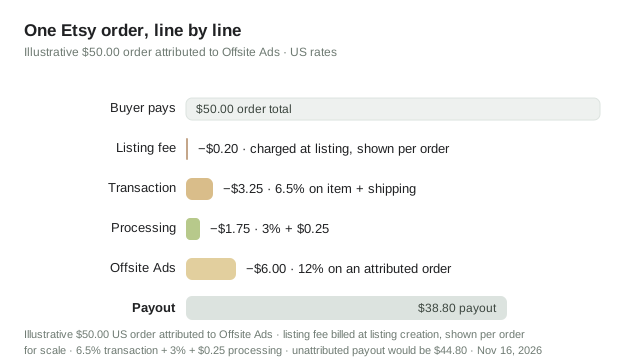
A $50.00 order (item $44 + $6 shipping, no gift wrap), attributed to an Offsite Ads placement, buyer pays no tax for simplicity. Transaction fee: 6.5% × $50 = $3.25. Processing: 3% × $50 + $0.25 = $1.75. Offsite Ads fee: 12% × $50 = $6.00. Listing fee: $0.20, charged at listing creation (amortized to pennies per sale, but billed up front). Total fees on the order: $11.20 — an effective take of 22.4%. The same order without Offsite Ads attribution: $5.20, about 10.4%.
Read the two rows of that comparison as the real decision: at 15% (shops under $10K), the attributed order pays $7.50 for the ad line alone, taking the effective take past 25%. Etsy sellers pricing from a 10% intuition are pricing from the no-ads world, and the payment account statement is where the difference shows up.
Illustrative computation on the November 2026 US schedule. Processing percentages vary by country; sales tax handling changes the processing base.
Effective take at different price points #
Using the US stack (6.5% + 3% + $0.25) with no shipping, no gift wrap, and ignoring amortized listing fees:
| Order total | Core fees | + Offsite Ads 12% | + Offsite Ads 15% | Effective take (core) |
|---|---|---|---|---|
| $10.00 | $1.30 | $2.50 | $2.80 | 13.0% |
| $25.00 | $2.00 | $4.00 | $4.75 | 8.0% |
| $50.00 | $3.75 | $6.75 | $8.25 | 7.5% |
| $100.00 | $6.25 | $14.25 | $17.50 | 6.3% |
| $500.00 | $27.50 | $72.50 | $92.50 | 5.5% |
Core = 6.5% transaction + 3% + $0.25 processing. The flat $0.25 is why small orders pay double-digit percentage takes before ads even enter. Amortized listing fees add roughly $0.05–$0.20 per sale for a steady shop.
The shape matches eBay’s: a fixed component that dominates small orders, plus percentages that shrink as price grows — with the Offsite Ads line acting as a multiplier of the whole thing when it fires. Against the other platforms, Etsy’s core stack is leaner than Amazon’s 15% referral at low prices but crosses it as prices rise, and Offsite Ads attribution can push a single order past any marketplace’s headline rate — the exact comparison the take rates guide runs across all five platforms.
Shipping labels and other costs #
Buying postage through Etsy charges the carrier cost to your payment account and books the shipment against the order — convenient, and discounted versus retail rates. The label cost is a shipping expense line in the books (not a fee), and the reconciliation treats it like any non-sale payment-account debit: on its own line, matched to the label purchase. Beyond labels, the paid add-ons are thin: Pattern (Etsy’s standalone website) has its own subscription if you use it, and Etsy ads within Etsy.com — Etsy’s on-site ads — are billed as a daily budget, separate from Offsite Ads, and belong in the same advertising account as any other channel’s spend per the advertising spend guide.
Where the fees land in your books #
Etsy’s payment account is the clearing account: money lands there when orders are fulfilled, fees deduct inside it, and a deposit sweeps it to your bank on your deposit schedule. The account structure that keeps it honest is the one this blog teaches everywhere — sales, discounts, refunds, each fee type and shipping labels on separate lines, with the payment account balance proving the sum. Offsite Ads fees deserve their own line inside advertising or as a named fee line — blending them into generic Etsy fees hides the number that decides whether the program stays on. The full entry-level walkthrough, including the reconciliation against Etsy’s CSV reports, is in our Etsy payout reconciliation guide.
Two Etsy-specific lines deserve their named accounts. Listing fees — recurring, catalog-wide, predictable — are a subscription-like listing cost worth separating so the catalog-cost trend is visible. And Offsite Ads fees are advertising: they exist only because an ad ran, they scale with attributed sales, and they belong next to your other ad spend (the advertising spend guide shows the account shape).
Keeping Etsy fees down #
- Make the Offsite Ads decision deliberately. Under $10K/year: the program is optional, and it only pays if attributed orders convert at margins that survive 15%. Watch a quarter of attributed orders before renewing the decision; over $10K it’s mandatory, so price with the 12% in mind on high-visibility listings.
- Bundle orders. The flat $0.25 processing fee is per order — one checkout with three items carries one processing fee. Combine shipping policies to make multi-item checkouts the easy path.
- Price shipping with the fee stack in mind. Shipping is inside the 6.5% base and the processing base — free-shipping pricing moves both onto the item line, which is fine, but the price must carry it.
- Audit auto-renewals quarterly. Two hundred auto-renewing listings cost $400/year in listing fees. Every listing that hasn’t sold in a year is a $0.60/yr subscription to invisibility — renew deliberately, not by default.
- Reconcile the payment account monthly. Etsy’s payment account statement lists every fee line by order; matching it to the books is how listing-fee creep and Offsite Ads surprises get caught in one cycle.
One honest caveat: the fees worth eliminating are the accidental ones — forgotten auto-renewals, Offsite Ads running unwatched, tax lines leaking into income. The 6.5% transaction fee is the cost of the marketplace and the audience; the game is making every dollar of it deliberate.
Common questions #
How much does Etsy take from a $50 sale?+
Without Offsite Ads: $3.75 (6.5% transaction + 3% processing) plus the $0.25 processing flat — about 8% before listing fees and sales tax handling. With a 12% Offsite Ads attribution: $9.75, about 19.5%. The Offsite Ads line is the swing, so it’s the line to watch.
Does Etsy charge fees on shipping?+
Yes. The 6.5% transaction fee applies to the item price plus what you charge for shipping plus gift wrap and personalization, and the processing fee percentage applies to the order total including shipping. Etsy is fee’d on shipping exactly like eBay.
What is the Etsy Offsite Ads fee and can I turn it off?+
Offsite Ads is Etsy advertising your listings on external platforms; the fee is 15% of the order for shops under $10,000 in trailing 365-day sales and 12% for shops at or above — charged only when an order is attributed within 30 days of an ad click. Under the threshold, it can be switched off in Shop Manager; at or above, participation is mandatory and priced as a volume discount.
Does Etsy refund fees when I refund a buyer?+
The transaction fee is refunded for full refunds issued within 180 days of the sale, and proportionally for partial refunds in the same window. The payment processing fee is not returned. After 180 days, the transaction fee stays charged — a real cost on late returns worth tracking in the returns routine.
Why is my Etsy payment account balance smaller than my sales?+
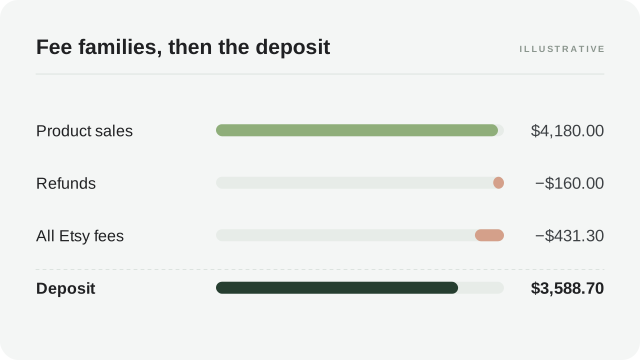
Because the payment account nets everything: sales minus refunds, transaction fees, processing fees, Offsite Ads fees, shipping labels you bought, and listing-fee charges. The statement lists each line by order; our Etsy payout reconciliation guide walks matching it to the books line by line.
Do US sellers pay the Etsy regulatory operating fee?+
No — the regulatory operating fee applies only to sellers located in certain countries (the UK, France, Italy, Spain, India, Türkiye, Vietnam and others), at small percentages that rise periodically. US sellers see none of it, which is why most US-facing fee guides omit it.
Does Etsy charge a monthly subscription?+
No. There is no shop subscription on the standard marketplace — the recurring costs are listing fees ($0.20 per 4 months per listing, including auto-renewals) and any optional services like a Pattern site subscription or Etsy’s on-site ads budget if you opt in.
Are Etsy fees tax deductible?+
Generally yes for a business: listing, transaction, processing, Offsite Ads and shipping-label fees are ordinary and necessary expenses of running the shop, deductible on the business return. Keep the payment account statements as support, and confirm allocations with your tax professional — our 1099-K guide explains how marketplace reporting interacts with the income side.
Sources and review date #
Reviewed November 16, 2026 against Etsy’s published fee and policy pages below. Etsy changes rates periodically — the transaction fee itself was raised from 5% to 6.5% in 2022, and regulatory fees have risen several times — so confirm the current schedule before pricing. Examples are fictional; tax questions deserve your tax professional.