Tidy
In this article
- Advertising is a marketing expense, not a selling fee — give it its own account so fees and ad spend can be compared honestly.
- Depending on the channel, ad spend may be deducted from payouts, charged to a card, or invoiced separately; the bank deposit alone will not show it.
- ACOS is ad spend divided by ad-attributed sales; ROAS is its inverse. Neither includes product cost, fees or returns.
- Reconcile ad charges to the channel’s advertising report, not to the payout total.
Advertising is not a selling fee #
Referral, final value and fulfillment fees are costs of making a sale. Advertising is a cost of finding the buyer. Blending them hides the most controllable number in your business: you cannot change a referral rate, but you can change a bid. Keep a separate marketing account, ideally with a subaccount per channel, and book every ad charge there. Our fee list shows which deductions are fees and which are advertising.
How ad spend reaches your books #
It depends on the channel and the program. Some ad charges are netted out of the payout or settlement; others are billed to a card or invoiced on their own schedule. That has a practical consequence: if you reconcile only to the bank deposit, spend billed separately never appears, and your margins look better than they are. Always find where each program charges you, then reconcile to the advertising report for the same period.
| How it is charged | Where you see it | Booking |
|---|---|---|
| Deducted from payout | A line on the payout or settlement | Marketing expense, as part of the payout posting |
| Billed to a card or invoiced | Card statement or invoice, not the payout | Marketing expense from the bill, matched to the ad report |
A worked example #
One fictional payout, ads included
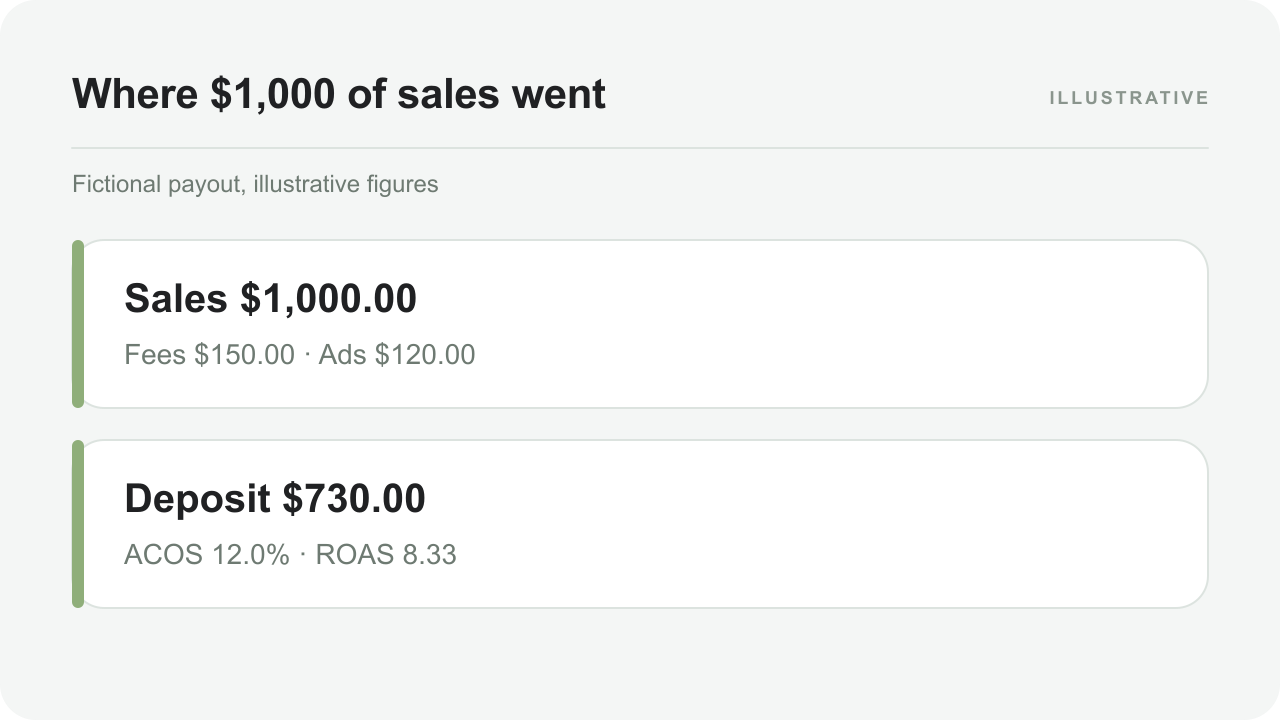
A fictional payout covers $1,000.00 of sales. Marketplace fees are $150.00 and advertising deducted from the payout is $120.00, so the deposit is $730.00. Booked correctly: income $1,000.00, selling fees $150.00, advertising $120.00, deposit $730.00. The advertising cost of sales (ACOS) is $120.00 ÷ $1,000.00 = 12.0%, and return on ad spend (ROAS) is $1,000.00 ÷ $120.00 = 8.33. In practice ACOS uses only ad-attributed sales, so your report’s denominator will usually be smaller than total sales.
Illustrative figures. Your program’s attribution window and reporting definitions determine the real ACOS and ROAS.
What ACOS and ROAS cannot tell you #
Both ratios stop at the ad. They ignore product cost, marketplace fees, shipping and returns. A 12% ACOS looks healthy until a 35% product cost, 15% fees and a return rate are layered on top. Use ACOS and ROAS to judge the ad, and use margin after all costs to judge the product — the ACOS and ROAS calculator and our COGS guide help with each half.
A monthly ad check #
- Total advertising by channel from each program’s own report.
- Match each total to payout deductions, card charges or invoices — one source per dollar.
- Look for charges in one period and credits in another, such as invoice corrections.
- Compare ad spend as a share of sales month over month, and investigate swings.
Set up the accounts before the first invoice #
Advertising is easiest to keep clean when the accounts exist before the first charge arrives. A workable structure is one parent expense account for marketing, with a subaccount for each place you advertise: one per marketplace program, plus one for off-marketplace ads such as search or social campaigns. If you want a single view across channels, tracking classes or locations can slice the same spend a second way without multiplying accounts.
Give each ad program its own vendor record too. Charges that arrive by card, invoice or payout deduction then land against a consistent name, which makes the monthly comparison to the program’s report a filter rather than a hunt. Our chart of accounts guide shows where these subaccounts sit next to fees and clearing, and the chart of accounts generator can produce the starting list.
Prepaid balances, credits and refunds #
Some programs let you load a balance in advance, apply promotional credits, or issue adjustments for invalid activity. Each behaves differently in the books, and each is easy to mishandle if the only record you look at is the bank.
- Prepaid funds. Money you add before it is spent is not yet an expense. Many bookkeepers carry it as a prepaid asset and move it to marketing expense as the program’s report shows it consumed. If the balance is small and turns over within the month, a simpler approach may be acceptable; ask your bookkeeper.
- Promotional credits. A credit reduces what you pay, not what you spent. Book the expense at the reported amount and the credit as a reduction of advertising in the period it is applied, so the net matches what left your account.
- Adjustments and refunds. A credit for invalid clicks or an invoice correction should reduce advertising expense when it posts. Do not net it against sales, and do not leave it as a stray deposit in the bank feed.
In every case, the rule is the same: expense follows the program’s report, cash follows the bank or card, and the difference lives in a named balance until it clears.
A worked example: ads charged two different ways #
One month, two channels
A fictional seller has $4,000.00 of sales on Channel A, with $1,600.00 attributed to ads. Channel A deducts $480.00 of advertising from its payouts. On Channel B the seller has $2,000.00 of sales, $500.00 attributed to ads, and a $250.00 advertising bill charged to a card. Total advertising is $730.00 on $6,000.00 of sales. Reconciling to the bank deposits alone would show only the $480.00 on Channel A and miss the $250.00 on Channel B, which is 34% of the month’s ad spend. ACOS is $480.00 ÷ $1,600.00 = 30.0% on Channel A and $250.00 ÷ $500.00 = 50.0% on Channel B. Spend as a share of all sales is 12.0% on Channel A ($480.00 ÷ $4,000.00) and 12.5% on Channel B ($250.00 ÷ $2,000.00).
Illustrative figures. Attribution windows and report definitions differ by program.
The point of the example is not the percentages; it is that two channels with nearly identical spend relative to total sales can have very different ACOS, and that only a per-channel, per-source reconciliation shows either.
ACOS versus ad spend as a share of all sales #
ACOS divides ad spend by sales the program attributes to the ad. Sellers also track total advertising cost of sales, often shortened to TACoS: ad spend divided by all sales, ad-driven or not. The two answer different questions. ACOS tells you whether a campaign is efficient on the sales it claims. The total-sales ratio tells you whether advertising is growing the business or just renting sales you might have made anyway.
Track both monthly, per channel. If ACOS is steady but the total-sales ratio rises, you are spending more to hold the same revenue. If the total-sales ratio falls while revenue grows, organic demand is carrying more of the load. Neither number replaces margin after product cost, fees and returns; the ACOS and ROAS calculator turns a per-unit margin into a break-even and a target.
Timing and cutoff for ad charges #
Clicks happen on one day and are billed on another. A campaign that runs through the end of the month may be invoiced or deducted in the next. On accrual books, expense belongs to the period the clicks occurred, so an unbilled amount at month-end is accrued from the program’s report. On cash books, it belongs to the period it was paid. Either is workable if applied consistently; mixing them is what produces a spike in one month and a hole in the next. Our cash versus accrual guide explains the choice, and the month-end close checklist shows where an ad accrual fits.
Mistakes that distort margins #
- Netting advertising against sales so revenue looks smaller and ad spend disappears from the marketing line.
- Booking ads as cost of goods sold, which mixes a marketing choice into product cost.
- Reconciling only to payouts, so card-billed or invoiced programs are never recorded.
- Recording a program’s deduction from the payout and then the same charge again when its invoice arrives.
- Combining marketplace ads with off-marketplace campaigns, which hides which channel the money is working in.
- Leaving credits and corrections as unexplained bank deposits instead of reducing expense.
Each of these is detectable the same way: total the program’s own report for the month and compare it with the sum of the entries tagged to that program.
A note on tax treatment #
Advertising is generally treated as an ordinary business expense, and the IRS discusses it in its guide to business expenses, listed below. How and when you deduct it depends on your accounting method and your circumstances, so this guide covers recording, not tax advice. Keep each program’s report and invoice with the month’s file, since they are the evidence behind the number.
Attribution versus billing: why the reports disagree #
Two documents describe the same advertising, and they almost never agree: the attribution report (which sales the platform credits to ads, using its attribution window and model) and the billing record (what was actually charged, on the invoice or settlement, in the period it was charged). A campaign attributed $900 of sales this month; the invoice charged $310 — or the reverse, when charges land in the month after the clicks. Neither document is wrong. Attribution answers “what did the ads cause?”; billing answers “what did we pay and when?”; and the books need the second while the marketing decisions need the first.
The reconciliation habit keeps both honest without merging them: book the billed amounts in the advertising expense account (the cash story), and keep the attributed revenue in the campaign reports (the effectiveness story), with a monthly note tying the two periods together. The disagreements worth escalating are the persistent ones — a billed total with no matching attributed sales (billing error, or a campaign that spent without converting), or attributed revenue that never turns into billed charges (attribution window games). eBay’s 2026 any-click change made exactly this divergence bigger for General campaigns, which is why the Promoted Listings guide now pairs every attribution number with a billed-charges number.
Feeding ad data into unit economics #
Advertising becomes a product decision when it is allocated to units. Channel-level totals answer “is advertising worth doing?”; per-SKU allocation answers “which products earn their advertising and which are subsidized by the catalog?” — and the second question is where the real money hides, because most catalogs contain a few SKUs whose ad-attributed sales are unprofitable after the ad rate, supported invisibly by the winners. The allocation method can be simple and still honest: for each SKU, take the ad fees the platform attributes to it (both marketplaces report attributed sales per item), divide by its attributed revenue to get its effective ad rate, and set that against the SKU’s contribution margin — the same ceiling logic the Promoted Listings guide teaches, applied per item instead of per store.
The bookkeeping enabler is the separation this guide started with: advertising in its own account, unmixed with selling fees, is the only line a per-SKU split can be built from. Sellers who blend ad spend into fees cannot run the allocation without reconstructing history; sellers who separated it run it monthly from reports. The output belongs next to the pricing conversation, not just the marketing one — a SKU whose required ad rate sits permanently above its margin ceiling has a pricing problem, a cost problem, or a listing problem, and the ledger can say which.
Common questions #
Should advertising go in cost of goods sold?+
Generally no. Cost of goods sold covers what you paid for the product and getting it to sellable condition. Advertising is a marketing expense; confirm treatment with your accountant.
My ad total is not in the payout. Is something missing?+
Not necessarily. Many programs bill separately from payouts. Check the program’s billing method and reconcile to its advertising or billing report.
What is a good ACOS?+
There is no universal number. It depends on your margin after product cost, fees and returns. The break-even ACOS is that margin — spend above it loses money on the ad-attributed sales.
Where do ads on Google or social media go compared with marketplace ads?+
Both are marketing expense, but give them separate subaccounts. Marketplace ads are often deducted from payouts, while off-marketplace ads are usually billed to a card, and mixing them hides where each dollar is working.
How do I record an advertising credit or refund?+
Reduce advertising expense in the period the credit posts, using the program’s report as the source. Do not book it as sales, and do not leave it as an unexplained deposit in the bank feed.
Sources and review date #
Reviewed November 13, 2026. Marketplace advertising programs, billing methods and reports change; use the current terms for your own account. Examples are fictional; confirm account mappings and tax treatment with your bookkeeper.
Change log. November 13, 2026: Added sections on account setup, prepaid balances and credits, a two-channel worked example, ACOS versus total ad spend share, timing, common mistakes and tax treatment, plus a Sources section.