Tidy
In this article
- The referral fee is identical under both methods — the decision lives entirely in fulfillment: FBA’s per-unit fees plus storage and returns lines versus your own postage and labor.
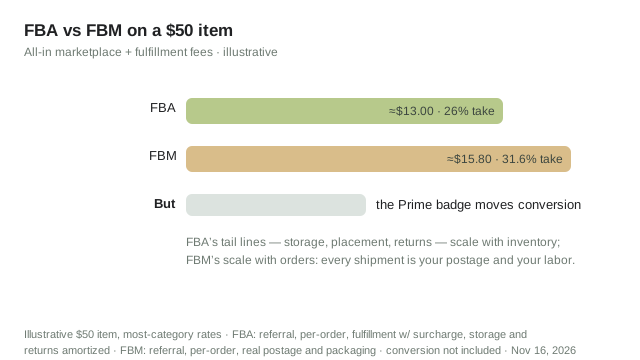
- On a typical $50 item the all-in fees land close: FBA around $13 with storage and returns amortized, FBM around $15–16 with real postage — which is why conversion, not fees, usually decides.
- FBA’s costs scale with inventory (storage, aged surcharges, placement) while FBM’s scale with orders (every shipment is your labor and postage) — different failure modes entirely.
- The Prime badge is FBA’s hidden revenue line: if it moves conversion enough, it pays for fees that look expensive in a static comparison — which is why the decision is per SKU and re-run quarterly.
What each method means #
Every Amazon sale carries the same referral fee — 15% in most categories, tiered elsewhere — regardless of who ships. The FBA-versus-FBM question is therefore about everything around that percentage: FBA (Fulfilled by Amazon) means your inventory lives in Amazon’s warehouses, Amazon packs and ships each order, fields buyer contacts, and takes per-unit fulfillment fees plus storage. FBM (Fulfilled by Merchant) means the listing lives on Amazon but your garage, your postage and your afternoon do the shipping — with Amazon’s Buy Shipping option available per order and Seller Fulfilled Prime as a harder-to-reach middle path.
The fee schedules for both methods are fully verified in our Amazon fees guide; this comparison costs the same item under each and then handles the parts no fee table captures — conversion, labor and tail fees. One scoping note: FBA storage applies only to inventory Amazon holds, FBM sellers pay no storage, and everything below uses the US schedule reviewed November 2026.
The lines, compared #
| Cost line | FBA | FBM |
|---|---|---|
| Referral fee | 15% most categories (identical) | 15% most categories (identical) |
| Per-order fee | $0.30/$0.40 (identical) | $0.30/$0.40 (identical) |
| Per-unit fulfillment | ~$3–$15+ by size/weight, +3.5% fuel surcharge | — |
| Postage | — | Your actual carrier cost, per order |
| Storage | $0.78/cu ft monthly, $2.40 Oct–Dec (standard) | — |
| Inbound placement | $0.14–$0.32 per small-standard unit | — |
| Returns processing | ~$1.65 per return (FBA) | Your labor + return postage policy |
| Refund administration | Up to $5/item, $10/order cap (FBA) | — |
| Labor | Amazon’s | Yours, per order |
| Prime badge | Yes | No (unless Seller Fulfilled Prime) |
FBA figures from Amazon’s 2026 schedule (the April fuel surcharge included in fulfillment rates), reviewed November 16, 2026 — full lines and the January 2027 announced increase in the Amazon fees guide. FBM postage is seller-specific by definition.
The same item, both ways #
A $50 kitchen item, costed twice — fictional
Referral and per-order fees are common to both: $7.50 + $0.40 = $7.90. The methods diverge from there.
FBA: fulfillment fee about $4.50 for a large-standard unit (fuel surcharge included), plus storage amortized across the units’ dwell time (~$0.30 each in the off-Q4 months), inbound placement (~$0.30), and returns/refund lines amortized by an expected 4% return rate (~$0.35). All-in fees: about $13.00 — a 26% take on the item before COGS. No packing labor, Prime badge on the listing.
FBM: actual postage for the same parcel, $7.50 with a commercial rate, plus $0.40 of packaging, plus the packing labor — call it ten minutes, $2.50 at even a modest internal hourly value. All-in: about $18.30 — a 37% take, if you value your time at all. No storage risk, no placement fees, full control of the packing slip.
The static math favors FBA on this item — but only before conversion. If the Prime badge sells the FBA listing 40% faster than the FBM one, the per-unit fee disadvantage can vanish entirely: the FBA column’s monthly profit is units × margin, and units is where the badge earns its keep.
Illustrative figures on the November 2026 schedule. Postage, storage dwell time, return rates and conversion deltas are all item-specific — the working version of this table uses your own numbers, per SKU.
FBA’s tail: the fees beyond fulfillment #
The per-unit fulfillment fee is the headline, but FBA’s real cost structure lives in the lines around it. Storage bills monthly on everything in the warehouse — and triples in Q4 — so slow movers rent shelf space at the worst possible rate; the 181-day aged-inventory surcharge punishes them further. Inbound placement charges per unit to distribute your shipments, unless you pay for fuller truckloads. Returns processing (~$1.65) and refund administration (up to $5/item) attach themselves to every unhappily ended sale. None of these exist in FBM — which is why honest comparisons amortize them per unit, as the worked example does, instead of pretending the fulfillment fee is the whole FBA cost.
The counterweight is operational: FBA’s tail fees are inventory-management problems — aged stock, oversized dwell, poor sizing data. A seller with clean inventory turns and accurate dimensions pays a fraction of the tail that a slow-moving catalog pays. The fees are real but they respond to how the inventory is run, which is why the Amazon fees guide treats storage and aged surcharges as their own section.
FBM’s tail: postage, time and Buy Shipping #
FBM’s headline cost is postage, and its real cost is everything postage doesn’t include. Buy Shipping (Amazon’s per-order label service) delivers Amazon-negotiated rates and automatic delivery confirmation — often the cheapest correct option for small parcels — but oversized items, remote zones and dimensional-weight traps make self-arranged freight the norm on bigger items. Every order is also your labor: pick, pack, label, drop off, and answer the buyer’s where-is-it message. And handling-time requirements mean the deadline risk is yours — late shipments hit account health, which on FBM has no surcharge but real visibility consequences.
The seller-fulfilled middle path exists: Seller Fulfilled Prime grants the Prime badge to FBM sellers who meet Amazon’s trial and performance requirements — worth investigating for items where FBA storage hurts but Prime conversion matters. It is demanding by design, so treat it as a separate project rather than a toggle.
Where each method wins #
- FBA wins: small, light, fast-moving items where fulfillment is cheap relative to price and the Prime badge moves conversion; high-velocity SKUs where storage turns over quickly; catalogs you want to scale without scaling a packing bench.
- FBM wins: oversized and heavy items (FBA fulfillment fees climb steeply with size tier), slow movers and one-offs (no storage rent on the unsold), fragile or white-glove goods, and products where you control the brand experience end to end.
- The hybrid wins most: FBA for the SKUs where velocity and Prime pay the fees, FBM for the long tail and the bulky — most established catalogs are a mix, and the mix should be re-drawn per SKU as fees and velocities move. The fee guide’s effective-take table is the starting point for each SKU’s arithmetic.
The quarterly per-SKU check #
The comparison goes stale the way every Amazon comparison does: fulfillment rates rise (the April 2026 surcharge, the announced January 2027 increase), storage reprices for Q4, postage rates move, and conversion shifts with the season. The quarterly version is mechanical per SKU: take last quarter’s actuals — units sold, fulfillment fees, storage, returns — compute the all-in fee per unit, do the same for the FBM counterfactual (real postage from Buy Shipping history), and compare against the conversion difference the two listings showed. Any SKU whose FBA fees exceed the FBM counterfactual by more than its conversion advantage earns a move. That whole loop is a report-and-spreadsheet exercise — and it is exactly the per-SKU advertising-allocation habit from the advertising guide, pointed at fulfillment instead.
What the two methods do to your books #
Both methods settle the same way — Amazon nets the fees and remits the balance — but the fee lines differ, and the account structure should show it. FBA settlements carry fulfillment, storage, placement, returns and refund-admin lines that belong in their own fee accounts (so the tail is measurable); FBM settlements carry only the referral stack, with your postage appearing on the carrier or Buy Shipping statements as its own expense — never blended into Amazon fees, because postage is a fulfillment cost that eBay and Etsy orders carry too. The settlement-entry walkthrough for the FBA line types is in the settlement booking guide, and the account separation is the chart of accounts pattern throughout.
Inventory moves differ too: FBA inventory is your asset sitting in someone else’s warehouse (reconciliation against Amazon’s inventory ledger monthly), while FBM stock sits where you can count it — the COGS guide covers both and the drift checks that keep them honest.
TidyPayouts splits FBA and FBM settlements into their own fee lines and matches every deposit — so the per-SKU comparison runs on real numbers.
Common questions #
Is FBA or FBM cheaper overall?+
For small, fast-moving items, FBA usually comes out cheaper on all-in fees because Amazon’s fulfillment rate beats retail postage and there is no packing labor to value. For oversized, slow-moving or fragile items, FBM wins — FBA fulfillment fees climb steeply with size tier and storage punishes dwell. The honest answer is per SKU, and it changes when rates change.
Do I pay the same referral fee either way?+
Yes — the referral fee is a percentage of the sale and does not care who ships. The per-order fee is identical too. Every difference in the comparison lives in fulfillment, storage, returns and labor, not in Amazon’s commission.
Does the Prime badge really make that much difference?+
It is the largest variable in the comparison and the hardest to measure — conversion lift varies by category and price point, and Amazon’s buy-box and search placement favor Prime offers. The practical test is empirical: run both methods on the same SKU for a quarter and compare units sold, not just fees. If FBA’s extra fees are smaller than the extra contribution from higher velocity, the badge has paid for itself.
What is Seller Fulfilled Prime?+
A program that grants the Prime badge to merchant-fulfilled listings whose seller meets Amazon’s trial-period, shipping-performance and automation requirements. It lets FBM sellers keep control of inventory and packing while offering Prime delivery — a real option for bulky or slow-turning items, but an operational commitment rather than a setting.
Which FBA fees do sellers most often forget to include in comparisons?+
Storage (especially the Q4 rate and the aged-inventory surcharge), inbound placement, returns processing and refund administration. Comparisons that use only the fulfillment fee flatter FBA by a couple of dollars per unit — the tail lines are exactly the ones the fees guide breaks out.
Can I mix FBA and FBM?+
Yes, per SKU — most mature catalogs run a hybrid. One SKU cannot normally offer both methods on the same offer simultaneously, but the catalog-level mix is standard practice, and the quarterly per-SKU check (fulfillment fees versus the FBM counterfactual, against conversion) is what moves items between the columns.
How do FBA fees appear in my books differently from FBM costs?+
FBA fees are netted out of settlements line by line — fulfillment, storage, placement, returns and refund admin each visible on the settlement report. FBM costs never touch the Amazon settlement: postage hits your carrier account and packing supplies your supplier invoices. The chart of accounts keeps Amazon fulfillment fees, storage and FBM postage in separate lines so each method’s true cost is readable.
What changes should I re-run the comparison after?+
Amazon fee changes (April 2026 added a fuel surcharge; January 2027 brings an announced average increase of about $0.19 per unit), Q4 storage repricing, postage rate updates, and any shift in a SKU’s return rate or velocity. The tracker in our fee changes post logs the schedule moves; your settlements log the actuals.
Sources and review date #
Written November 16, 2026 against Amazon’s published fee schedule and Seller Central guidance below — the same verified lines carried in our Amazon fees guide. FBM postage and labor are seller-specific and shown as illustrative. Rates change; confirm the current schedule before making fulfillment decisions.