Tidy
In this article
- The referral fee is the headline: 15% in most categories (with a $0.30 minimum per item), on the sale price including shipping — $7.50 on our standard $50 basket.
- The Professional plan is $39.99 per month; the Individual plan charges $0.99 per item sold instead, breaking even at roughly 40 items a month.
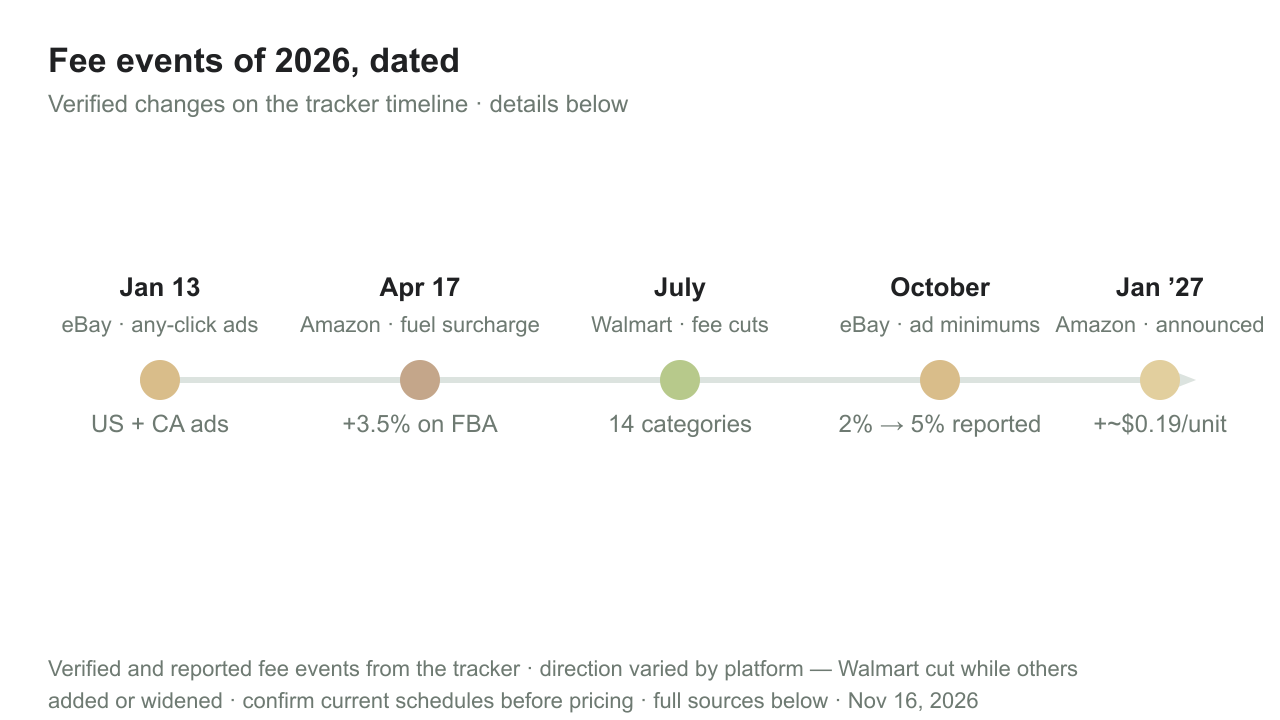
- FBA adds fulfillment ($3–$15+ per unit by size and weight), monthly storage ($0.78 per cubic foot off-peak, $2.40 October–December for standard size), inbound placement, removal and return fees — plus a 3.5% fuel and logistics surcharge on FBA fulfillment fees since April 2026.
- Referral, FBA and storage fees net inside the settlement; the subscription and some charges arrive on the monthly invoice. Amazon announced average fulfillment fee increases of about $0.19 per unit starting January 2027.
Amazon fees at a glance #
Amazon sells access to demand, and its fee schedule prices three things separately: the right to sell (the plan), the sale itself (the referral fee), and — if you hand fulfillment over — the physical work (FBA). Everything else is a surcharge on those three.
| Fee | When it applies | Typical amount (US) |
|---|---|---|
| Selling plan | Always, or per sale | $39.99/month (Professional) or $0.99 per item sold (Individual) |
| Referral fee | Every sale | 15% in most categories; ranges from roughly 3% to 45%; $0.30 minimum per item in most categories |
| Closing fee | Media categories only | $1.80 per item |
| FBA fulfillment fee | Per unit shipped by FBA | Roughly $3–$15+ per unit by size and weight tier |
| FBA monthly storage | Per cubic foot, monthly | Standard size: $0.78 January–September, $2.40 October–December; oversize lower off-peak |
| Aged inventory surcharge | Inventory stored past 181 days | Escalating per-cubic-foot charges the longer units sit |
| Inbound placement | Sending inventory into FBA | Roughly $0.14–$0.32 per small standard unit, depending on the shipment plan; low-inventory listings can be exempt |
| Removal / disposal | Having units returned or destroyed | Roughly $1 per unit for standard sizes, charged when processed (since March 2026) |
| Returns processing | Returned units in high-return categories | About $1.65 per unit for small standard, more for larger sizes |
| Refund administration | Refunded orders | Amazon retains up to $5 per refunded item, capped at $10 per order |
| Fuel and logistics surcharge | On FBA fulfillment fees, US and Canada | 3.5%, effective April 17, 2026 |
US figures reviewed November 13, 2026 against Amazon’s public pricing page, its FBA pages and Seller Central fee schedules. Amazon revises its fee schedule regularly — the next round of FBA fulfillment increases was announced for January 2027 — so confirm current figures on Amazon’s own pages and in the Revenue Calculator before pricing decisions.
The selling plan: $39.99 or $0.99 an item #
Every seller picks one of two plans. The Professional plan costs $39.99 per month and unlocks unlimited selling, bulk tools, advertising access and the gated categories. The Individual plan has no monthly fee and charges $0.99 per item sold instead.
The crossover is simple division: $39.99 ÷ $0.99 ≈ 41 items. Below roughly 40 sales a month the Individual plan is cheaper; above it, Professional wins — and once you want advertising, FBA at volume, or categories that require Professional, the decision makes itself. The plan fee is charged to your card or netted per Amazon’s billing rules rather than appearing as a settlement line, which is one more reason a bank deposit is not a revenue statement.
Referral fees: the percentage on every sale #
The referral fee is Amazon’s commission — a percentage of the total sale price, including shipping — and it is the single largest fee most sellers pay. Most categories sit at 15%, but the schedule tiers by category and by price, and the tiers move often enough that copying a fee table from an old blog post (including this one) is a mistake.
| Category | Referral fee |
|---|---|
| Most categories (Home & Kitchen, Toys, Sports, Office, Media…) | 15% |
| Consumer Electronics, Computers, Video game consoles | 8% |
| Clothing | 5% up to $15; 10% $15–$20; 17% above $20 |
| Beauty & Health / Baby (item over $10) | 15% (8% on items of $10 or less) |
| Grocery & Gourmet | 8% up to $15; 15% above |
| Furniture | 15% up to $200; 10% above |
| Jewelry | 20% up to $250; 5% above |
| Watches | 16% up to $1,500; 3% above |
| Electronics Accessories | 15% up to $100; 8% above |
| Amazon Device Accessories | 45% |
| Gift Cards | 20% |
| Fine Art | 20% to $100, stepping down to 5% above $5,000 |
| Everything else (the default row) | 15% |
Selected rows from Amazon’s public referral fee table, reviewed November 13, 2026; the full table has more categories and per-tier thresholds. The fee applies to the total sale price including shipping and, in most categories, gift-wrap; the exact rate for a product is always shown in Seller Central and in the Revenue Calculator.
Two structural notes. High-ticket categories step down — a $2,000 watch pays 16% on the first $1,500 and 3% on the rest, roughly 10.75% overall — so percentage comparisons between cheap and expensive catalogues mislead. And the base is the total price: a $50 item with $10 shipping pays referral on $60, the same “fee on money you collect but don’t keep” pattern as eBay’s and distinct from Shopify, where the processing fee applies to whatever the card was charged.
Minimum referral and closing fees #
Two small fee rules bite at the edges of a catalogue. The minimum referral fee is $0.30 per item in most categories (Fine Art carries a $1.00 minimum; some categories, like gift cards, have none) — so a $1.50 knick-knack at 15% owes its $0.23 fee rounded up to $0.30, an effective 20% take. Pricing below roughly $2 in a 15% category means the minimum is doing the pricing, not your margin.
The $1.80 closing fee applies only to media categories — books, music, video, software and games — and stacks on top of the 15% referral. Media sellers pay it on every shipped unit; it is the reason a $12 used book nets noticeably less than the referral math alone suggests. LMB-era guides that cite a $1.00 minimum referral fee are out of date: Amazon moved the standard minimum to $0.30.
FBA fulfillment fees #
Hand a unit to Fulfillment by Amazon and Amazon picks, packs, ships and handles service for a per-unit fee set by size tier and weight: roughly $3–$15+ per unit across the standard and oversize tiers, with the smallest standard units at the low end and heavy oversize at the top. The tier boundaries are dimensional as well as weight-based, so packaging that pushes a product over a boundary raises its fee for the life of the listing — one of the highest-leverage cost decisions a product engineer makes.
Fulfillment fees net inside the settlement alongside the referral fee. Layered on top since April 17, 2026, is a 3.5% fuel and logistics surcharge on FBA fulfillment fees in the US and Canada — small per unit, but it applies to every unit, and it is the kind of line a spreadsheet built last year will not have. And change keeps coming: Amazon has announced average FBA fulfillment increases of about $0.19 per unit starting January 15, 2027, with small standard items priced $10–$50 rising by about $0.40. Treat every published FBA figure — including the ones in this post — as a snapshot with a stated date.
Storage and aged-inventory surcharges #
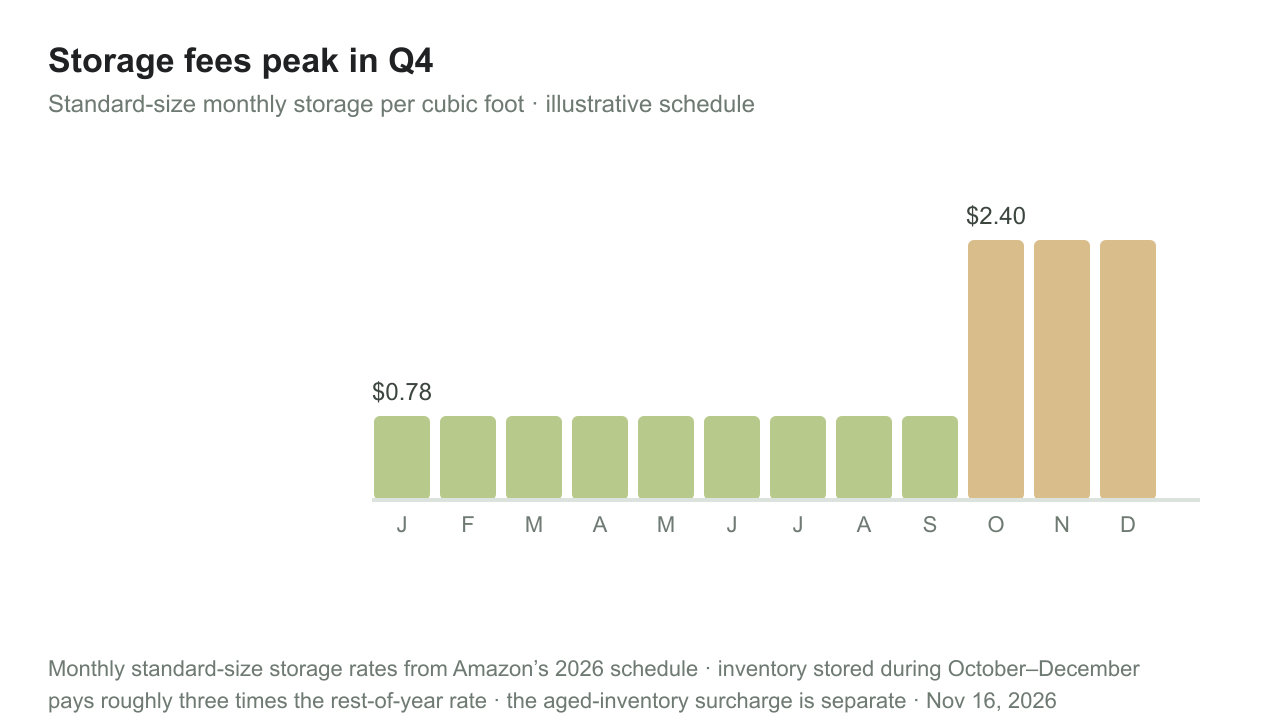
FBA storage is charged monthly per cubic foot of daily-average volume. For standard-size items the rates are $0.78 per cubic foot from January through September and $2.40 from October through December — the fourth quarter roughly triples the carrying cost right when holiday stock is at its peak. Oversize rates are lower off-peak. Ten cubic feet of slow-moving inventory carried through the fourth quarter costs about $72 in storage alone.
On top of monthly storage sits the aged inventory surcharge: units stored beyond 181 days accrue escalating per-cubic-foot charges that rise sharply at the one-year mark. The surcharge exists to price warehouse dwell time, and it converts “slow month” into a visible expense line — which is exactly why it deserves its own accounting category rather than being blended into generic FBA fees. Our FBA reimbursements guide covers the other half of the inventory story: units Amazon loses or damages and credits back.
Inbound placement, removal and disposal #
Getting inventory into FBA is itself priced. The inbound placement service fee charges per unit sent in — roughly $0.14–$0.32 for small standard units, scaling with size and with how you distribute shipments; Amazon-optimized single-destination plans pay more per unit than merchant-split shipments, and low-inventory listings can be exempt. The fee rewards sellers who plan shipments rather than defaulting through it.
On the way out, removal and disposal fees apply per unit — about $1 for small standard units, charged when the unit is processed (a mechanic Amazon moved to in March 2026). Liquidation returns a small recovery instead. These fees matter most as the exit cost of the aged-inventory story above: a stuck SKU pays storage for months, then roughly a dollar per unit to leave. Booking the trio together — storage, surcharge, removal — as one “slow inventory cost” line makes the real price of a stocking mistake visible.
Return and refund fees #
Returns carry two distinct fees depending on who fulfills. FBA returns processing charges per returned unit in higher-return categories — about $1.65 for small standard units, more for larger sizes — reflecting Amazon’s cost of receiving and grading the item. For seller-fulfilled refunds, the refund administration fee lets Amazon retain up to $5 per refunded item, capped at $10 per order — in effect Amazon keeping a slice of the referral fee it already charged when the sale was made.
Both fees interact with the fee-credit patterns marketplace sellers know from eBay, with one difference worth internalizing: Amazon’s refunds generally return the referral fee (via the refund itself netting against the sale) while these administration and processing fees stay charged. The recording consequence — refunds, withheld fees and reimbursements as separate lines — is in our Amazon deposit versus sales guide.
Advertising and costs outside the fee schedule #
Sponsored Products and the rest of Amazon Ads run on cost-per-click, budgeted by you, and land on a separate billing rhythm rather than the settlement — they are frequently the largest line after referral and fulfillment for competitive categories, and they belong in their own advertising account, not blended into “Amazon fees.” Our advertising spend guide covers the structure. Beyond ads, the practical extras — A+ content, premium account tools, third-party software, partnered-carrier shipping on merchant-fulfilled orders — each bill on their own schedule, which is why a seller’s true Amazon cost is the settlement bridge plus the invoice stack, not a single percentage.
Three worked examples #
All fictional, US, Professional plan, using the rates reviewed above.
Example 1: a $50 FBA sale
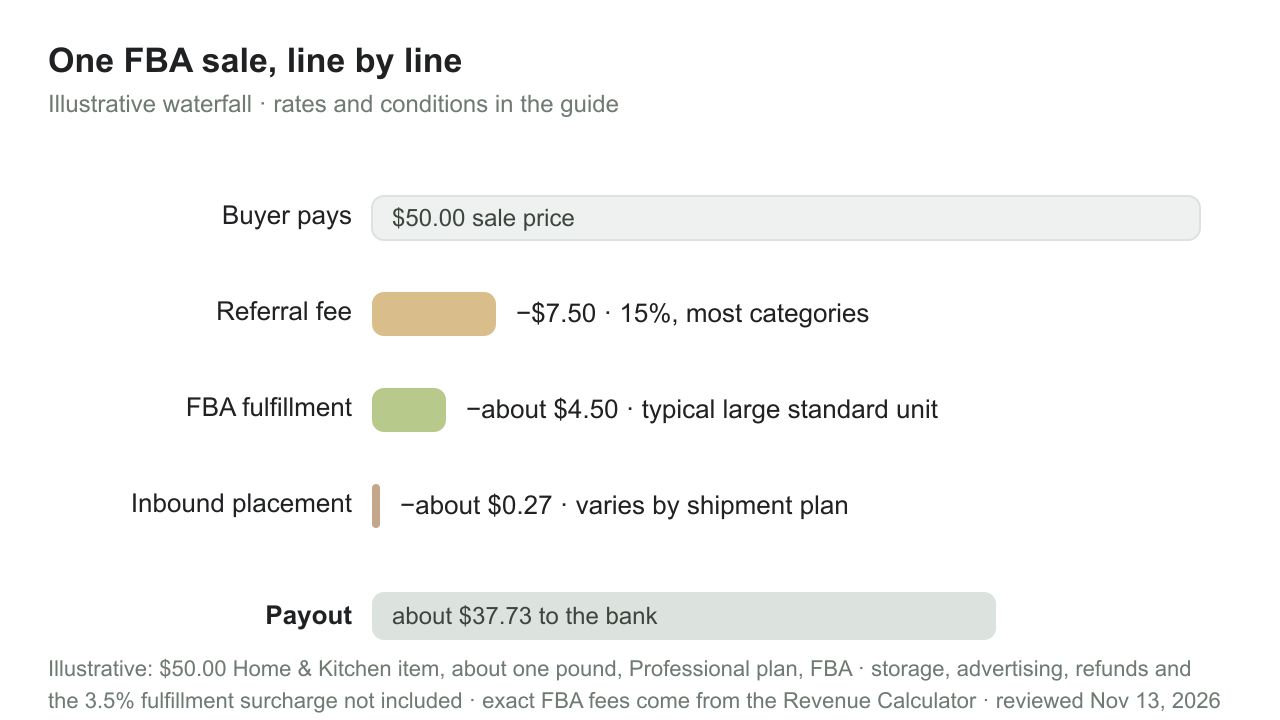
A $50 Home & Kitchen item at 15% referral owes $7.50. A typical large standard FBA unit runs about $4.50 in fulfillment (before the 3.5% surcharge, about $0.16 here), and inbound placement adds roughly $0.27. Payout before storage, ads and returns: about $37.73 — an effective take near 24.5%. Multiply that shape across a catalogue before believing any “Amazon takes 15%” summary.
Example 2: the plan breakeven
A seller moving 30 items a month on the Individual plan pays $29.70 in per-item fees; the Professional plan at $39.99 looks worse until item 41. But add advertising access, gated categories or FBA volume and the comparison stops being about the per-item fee — the plan choice is a capability decision once volumes approach the crossover.
Example 3: the slow SKU
Ten cubic feet of unsold seasonal stock arrives in September: off-peak storage at $0.78 is $7.80 for the month, October–December storage at $2.40 is $24.00 per month, the units pass 181 days in March and the aged surcharge starts stacking, and in May the seller pays about $1 per unit to remove them. The product never sold, and the fee lines tell that story precisely — if they are recorded as their own lines rather than netted into “Amazon fees.”
Amazon’s take versus other channels #
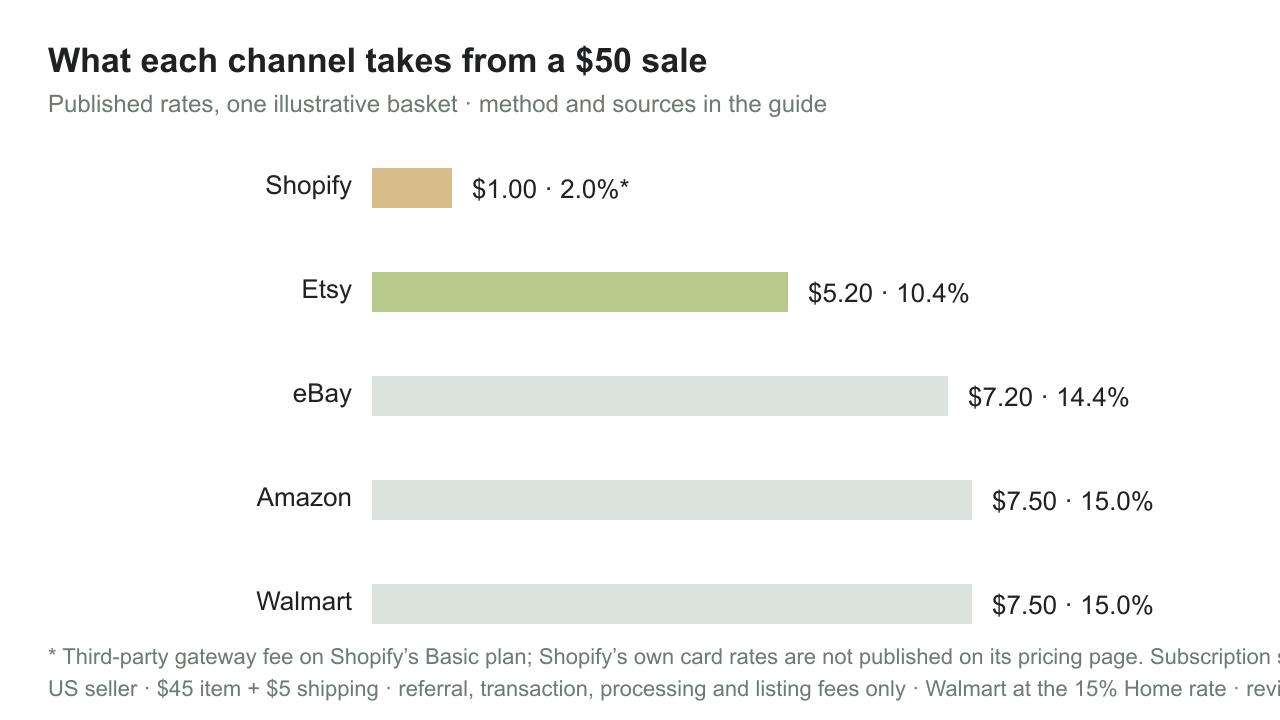
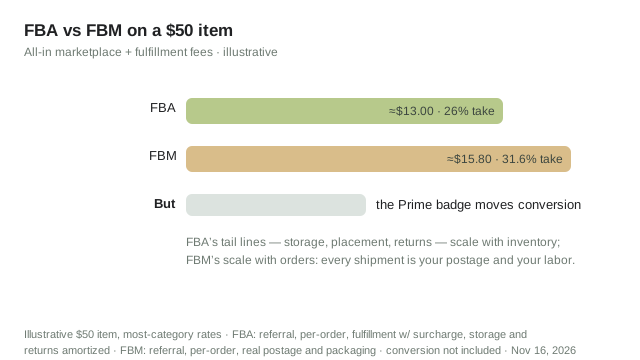
On our $50 basket, Amazon’s referral cut alone is $7.50 — 15% — against eBay’s $7.20, Etsy’s $5.20 and Shopify’s $1.00 gateway-only figure. Before FBA, Amazon and eBay look similar; after FBA, Amazon’s effective take climbs past 20% for typical parcel-sized goods. What the fee buys is the same argument as always: demand, trust and fulfillment infrastructure that no other channel matches at volume. The comparison worth running is per-SKU with your own real numbers in Amazon’s Revenue Calculator beside each channel’s calculator — and it should be re-run whenever Amazon announces a fee round, as it did for 2027.
Where each fee lands in your payouts and books #
Amazon’s settlement is the densest in ecommerce accounting: referral fees, FBA fulfillment, storage, placement, returns processing, refunds, reimbursements and advertising deductions can all appear inside one settlement, alongside reserves that hold funds back entirely — the pattern our reserve balance guide untangles. The settlement report lists each fee type on its own row; the deposit is the net.
The books structure that keeps this auditable: sales (Amazon is the marketplace facilitator for most US sales tax, so the tax slice is not your income — see the facilitator tax guide), then fees by type — referral, FBA fulfillment, storage, placement, returns, advertising — each mapped to its own expense account, then refunds and reimbursements on their own lines, and the monthly invoice (plan fee, some services) as a separate entry rather than a settlement adjustment. Blending the fee types into one number is what makes a fee increase like January 2027’s invisible until margins have already moved. The account mapping lives in our chart of accounts guide, the deposit bridge in the deposit versus sales guide, and the monthly routine in the month-end checklist.
TidyPayouts splits Amazon settlements into sales, fees by type, refunds, reimbursements and reserves — matched to the bank before anything posts.
Keeping Amazon fees down #
- Run the Revenue Calculator on every SKU before pricing — fulfillment tier, referral rate and placement interact, and the calculator is the only source that has your product’s real dimensions.
- Engineer packaging down a size tier where possible; fulfillment fees step at dimensional boundaries, and one inch of box can be a dollar per unit forever.
- Plan shipments deliberately. Inbound placement fees reward sellers who distribute intentionally; low-inventory listings can dodge the fee entirely.
- Kill slow SKUs before the surcharges stack. Storage at $2.40 per cubic foot in Q4 plus the aged surcharge plus removal is the full cost of indecision — price it into markdown decisions.
- Watch the return rate in flagged categories, where the per-unit returns processing fee applies; listing accuracy and packaging are cheaper than returns.
- Re-fee every January. Amazon announces fee changes in advance — 2027’s increases are already published — and a pricing sheet that survives a fee round unchanged is a pricing sheet losing margin silently.
- Keep advertising in its own account and measure it per SKU; ads are discretionary spend that behaves nothing like referral fees, and blending them hides both.
Common questions #
What percentage does Amazon take per sale?+
The referral fee is 15% in most categories — $7.50 on a $50 sale — with a schedule that runs from roughly 3% (high-ticket watches and jewelry tiers) to 45% (Amazon device accessories), and a $0.30 minimum per item in most categories. The fee applies to the total sale price including shipping.
How much is an Amazon seller account?+
$39.99 per month on the Professional plan, or nothing monthly on the Individual plan, which charges $0.99 per item sold. The plans break even at about 41 items a month; advertising access and gated categories effectively decide it for most growing stores.
How much does FBA cost per unit?+
Roughly $3–$15+ per unit depending on size and weight tier, plus a 3.5% fuel and logistics surcharge on those fees since April 2026, inbound placement of roughly $0.14–$0.32 per small standard unit, storage per cubic foot ($0.78 off-peak, $2.40 in October–December for standard size), and return fees in high-return categories. Amazon’s Revenue Calculator prices your exact SKU.
Why is my Amazon payout smaller than sales minus referral fees?+
Because referral is only one line: FBA fulfillment, storage, placement, returns processing, refunds and reimbursements all net inside the settlement, reserves can hold funds back entirely, and the plan plus advertising bill separately. The deposit-versus-sales bridge in our Amazon guide reconciles it line by line.
What is the 3.5% surcharge on my FBA fees?+
A fuel and logistics surcharge Amazon applied to US and Canada FBA fulfillment fees effective April 17, 2026. It is percentage-based on the fulfillment fee, so it scales with unit size — and it is a separate line, which is why it can surprise a spreadsheet built before April.
Does Amazon charge for returns and refunds?+
Yes, on both sides: FBA charges a returns processing fee per returned unit in higher-return categories (about $1.65 for small standard), and for refunded orders Amazon retains an administration fee of up to $5 per item, capped at $10 per order. The referral fee itself is generally reversed through the refund.
Are Amazon fees changing?+
Constantly, and with notice. The current published round raises FBA fulfillment fees by about $0.19 per unit on average starting January 15, 2027, with small standard items priced $10–$50 rising about $0.40. Amazon announces fee changes ahead of effective dates — build a January fee review into the calendar.
Are Amazon seller fees tax deductible?+
Referral, FBA, storage and plan fees are generally ordinary and necessary business expenses for sellers operating as a business, typically deducted as commissions, fulfillment or platform fees. Deductibility follows your tax situation — confirm treatment with your tax professional and keep the settlement reports and invoices as support.
Sources and review date #
Reviewed November 13, 2026 against Amazon’s published pages below. Amazon revises its fee schedule regularly and announces changes in advance — confirm current figures in Seller Central and the Revenue Calculator before pricing decisions. Worked examples are fictional.
Change log. November 13, 2026: Page title and summary shortened for search results; the guidance is unchanged.