Tidy
In this article
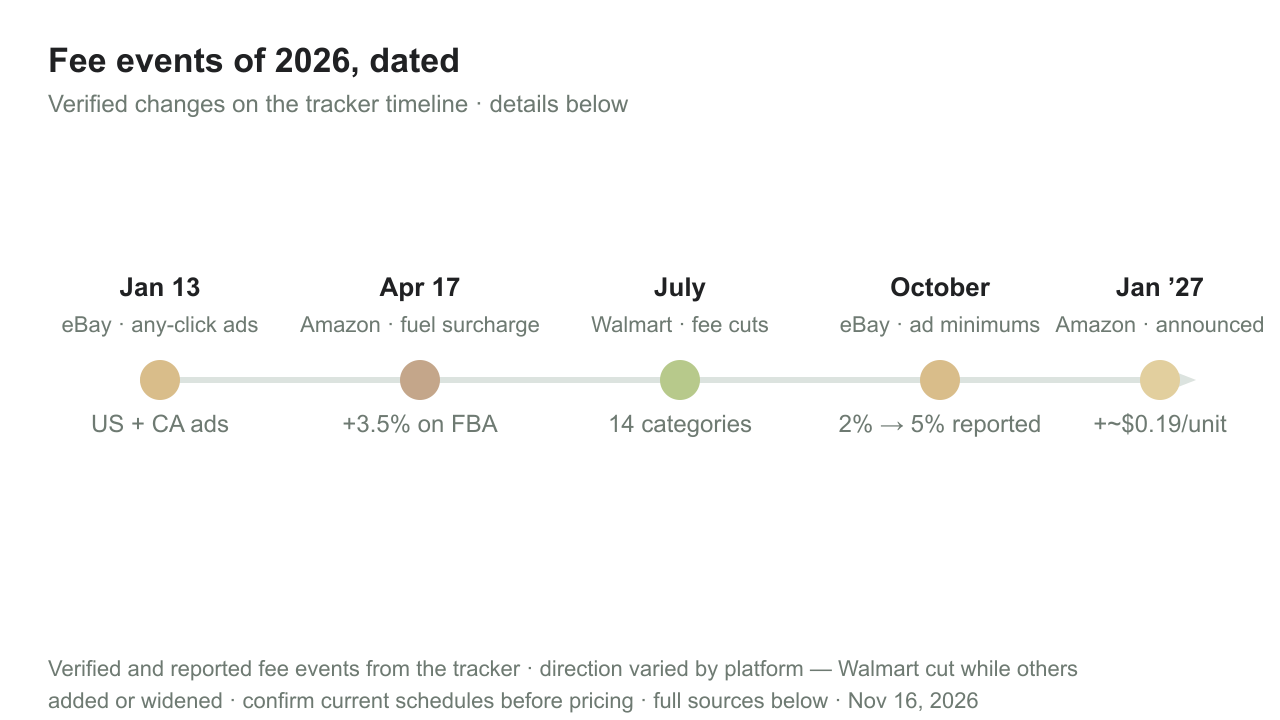
- 2026 was an active fee year: eBay widened ad attribution and reportedly raised minimum ad rates, Amazon added a fuel surcharge and announced a 2027 fulfillment increase, and Walmart cut fees in fourteen categories.
- Direction varied — Walmart's cuts were seller-friendly, eBay's attribution widened the fee net, Amazon's changes were cost additions. "Fees went up everywhere" is not what happened.
- Every entry below is dated and sourced; rates move again, so treat the official schedules as authority and this tracker as the change log.
- The bookkeeping consequence is uniform: when a schedule changes, your effective fee rate moves with no seller action — which is exactly why fees live in their own reconciled accounts.
What this tracker is, and how to use it #
This page is a change log, not a fee schedule. The full current rates live in our per-platform guides and in the platforms' own schedules; what this tracker adds is the dimension schedules can't show — what changed, when, and for whom. Every entry carries a date, a source, and a note on who is affected, so you can tell the difference between "my fees moved" and "the schedule moved for everyone."
We re-verify the entries against the platforms' own announcements and help pages each time we touch this page, and we add new entries as they land. The review date at the bottom of this page is the timestamp of the last full pass. If you price against a fee table, check its review date before you trust it — including ours.
The 2026 timeline at a glance #
| Date | Platform | What changed | Direction |
|---|---|---|---|
| January 13, 2026 | eBay | General (cost-per-sale) ad attribution widened to any-click in the US and Canada | Fee scope widened |
| April 17, 2026 | Amazon | Fuel and logistics surcharge added to FBA fulfillment rates | Cost added |
| July 2026 | Walmart | Referral fees cut in roughly fourteen categories | Cut |
| October 2026 | eBay | General ad-rate minimums reported up from 2% to 5% for some accounts | Reported increase |
| January 15, 2027 | Amazon | Announced fulfillment fee increase (average ~$0.19/unit) | Announced |
Each row links to its detail section below, with sources. The timeline covers fee and fee-mechanics changes only — policy and account-health changes are out of scope.
January: eBay moves to any-click attribution #
Effective January 13, 2026, for items on ebay.com, ebay.ca and cafr.ebay.ca (mirroring the UK, EU and Australia during 2025): General cost-per-sale campaigns now attribute a sale when any buyer purchases a promoted item within 30 days of any click on one of your ads — the buyer no longer needs to be the clicker, provided the item was promoted at both the click and the sale. The change replaced the previous direct-and-halo attribution model, and it widened the set of sales that pay an ad fee: a buyer who clicks an ad, leaves, and later buys the item organically is now attributed.
Who it hits: any seller running General Promoted Listings campaigns on established listings with strong organic traffic — the sales most likely to be re-billed are the ones you already had. Who it barely touches: sellers not running ads, and new listings where most attributed sales are genuinely incremental. The working response is measurement, not panic: track attributed sales against total sales (the lift ratio), and run a pause test before renewing campaigns. Our Promoted Listings guide carries the full mechanics and the defense playbook.
April: Amazon's fuel and logistics surcharge #
Effective April 17, 2026: a fuel and logistics surcharge of 3.5% on FBA fulfillment fees took effect on US inbound and outbound fulfillment. Amazon frames it as pass-through of transportation costs; for the seller it is simply a 3.5% increase in per-unit fulfillment cost — roughly $0.16 on a $4.50 fulfillment fee — that compounds with every unit shipped.
Who it hits: every FBA seller, on every fulfillment fee line. The compounding matters at the margin: a SKU priced against last year's fulfillment cost is now 3.5% worse on that line before any other change. The remedy is mechanical — refresh your per-unit fulfillment cost, re-run the margin ceiling on thin SKUs (the method is in our Amazon fees guide), and let the settlement reconciliation confirm the surcharge is actually 3.5% and not more. And it stacks with what comes next: Amazon has announced a further average fulfillment increase of about $0.19 per unit for January 15, 2027.
July: Walmart cuts referral fees in 14 categories #
Mid-2026: Walmart cut referral fees in roughly fourteen categories as part of a seller-focused pricing update — one of the few fee moves of the year in the seller's favor. The cuts landed on top of Walmart's existing tiered schedule (6%–20% by category, 15% the most common rate), which makes the affected categories meaningfully cheaper to serve on Walmart than the equivalent Amazon category in several cases — the comparison our take rates guide and category guide carry.
Who it hits, positively: sellers in the cut categories pricing across Walmart and other channels — the cut is a margin gift if your price list already assumed the old rate. The discipline that captures it: recompute the category's effective take after the change, and reprice where the old assumption was baked into prices. Fee cuts are rarer than fee adds; they are also where stale pricing bleeds the most.
October: reported eBay ad-rate minimum increases #
October 2026, reported by sellers: General campaign ad-rate minimums jumped from 2% to 5% for some accounts, including fixed-rate campaigns. The reports are account-specific and eBay has not published a blanket policy change, so we label this reported rather than confirmed: the number to trust is the minimum eBay shows in your own Seller Hub campaign flow.
Who it hits: low-rate General advertisers — sellers running 2–3% campaigns for a gentle visibility lift. A 5% floor more than doubles the fee on each attributed sale for those campaigns, and after January's any-click widening the fee reaches further too. The response is the break-even formula from the Promoted Listings guide: if 5% clears your margin ceiling, keep running; if not, the campaign that "barely paid" at 2% is now a loss at 5%. Also worth re-checking: dynamic-rate campaigns whose caps were set when the floor was lower.
Ahead: the announced January 2027 Amazon increase #
Amazon has announced an average FBA fulfillment fee increase of roughly $0.19 per unit effective January 15, 2027. It is announced, not in effect — this entry exists so the January increase is a planned event rather than a settlement surprise. The arithmetic to do before it lands: per SKU, add ~$0.19 to your current per-unit fulfillment cost, re-run contribution margin, and decide which SKUs reprice in January versus which absorb it. Sellers who do this in November price calmly; sellers who don't discover it in the first settlement of the year.
How to catch the next change yourself #
Platforms announce most fee changes, but through different doors: Amazon posts in Seller Central announcements and news pages, eBay in Seller Hub announcements and community posts, Walmart in Marketplace announcements and its learn portal, Shopify in changelogs. The vendor-neutral aggregation is weaker than any seller wishes, which is why a personal routine beats hoping. Ours, and the one we recommend: a quarterly fee-schedule reconciliation — pull your last quarter's settlements, compute your effective fee rate by bucket, and compare it to the schedule you priced against. When they diverge, something changed, and the settlement detail tells you what. The fee-to-revenue ratio is that comparison compressed into one number per channel per month.
The reconciliation also catches the changes nobody announces: category re-assignments that move an item onto a different rate line, surcharges that apply to some shipments and not others, and weight-based corrections. Announced changes are the minority of what your settlements reveal.
What a fee change does to your books #
A schedule change requires no entry in your books — the same fee accounts simply carry different amounts from the effective date. What it does require is a note: the month the change took effect, recorded in your close note, so that next year's "why did fees jump in April?" has a written answer. The structure this blog teaches everywhere — fees by type on their own reconciled accounts, the clearing account per channel, the month-end close comparing effective rates to schedules — is precisely the structure that makes a fee change visible in one monthly cycle instead of one tax season.
And when a change matters enough to reprice, the sequence is the one our take rates guide teaches: recompute the per-unit take with the new schedule, re-run the margin floor, then move prices where the floor breaks. Fee changes are why that recomputation is quarterly, not annual.
TidyPayouts reconciles every settlement's fees to their own lines — so a schedule change shows up as a rate move, not a mystery.
Common questions #
Which marketplaces changed fees in 2026?+
All the major ones moved something: eBay widened Promoted Listings attribution and (reportedly) raised some ad-rate minimums; Amazon added a fuel and logistics surcharge and announced a 2027 fulfillment increase; Walmart cut referral fees in about fourteen categories. The direction differed by platform — see the timeline above for dates and sources.
How often do marketplaces change their fee schedules?+
Every year, in every direction. Annual FBA adjustments are a fixed Amazon fixture, eBay reprices advertising mechanics more often than that, and Walmart repriced mid-2026. The only safe assumption is that the schedule you priced against is a snapshot, which is why a quarterly reconciliation against your own settlements is the durable defense.
Do I need to change anything in my books when a fee changes?+
No new entries — the same fee accounts carry different amounts from the effective date. Add one line to your close note recording the change and its effective date, and reprice where the margin math now breaks. The reconciliation does the rest.
Where do platforms announce fee changes?+
Inside seller platforms mostly: Amazon in Seller Central announcements, eBay in Seller Hub and community announcements, Walmart in Marketplace announcements, Shopify in its changelog. Email notices arrive too but land in the same folder as everything else competing for your attention — the quarterly reconciliation is what actually catches them.
Can I get old fees back if a change hurt me?+
Schedule changes apply to everyone and are not disputable. What is disputable: fee errors — miscalculated surcharges, wrong-category commissions, weight-based fee mistakes. Those are dispute paths, not schedule complaints, and the settlement-level reconciliation is how you tell them apart.
Does this tracker cover every marketplace?+
It tracks the four platforms this site covers in depth — Amazon, eBay, Walmart and Shopify — plus notable mechanics changes on Etsy where they interact with fees. Regional sites of the same platforms (ebay.co.uk, amazon.de and so on) run their own schedules we don't track here.
How current is this page?+
The review date at the bottom of this page is the timestamp of the last full pass over every entry, checked against the platforms' own announcements and help pages. Entries keep their original effective dates so the history stays intact as new ones are added.
What should I do first when a fee change lands?+
Recompute your per-unit take for the affected category with the new rate, re-run the margin floor, and reprice the SKUs whose floor now breaks — in that order. Then add the change and its effective date to your close note. The pricing first, the bookkeeping note second, and neither without the reconciliation that confirmed the change was real.
Sources and review date #
Last full review November 16, 2026. Every entry was verified against the platforms' announcements and help pages or, where platforms have not confirmed a change, against multiple independent seller-ecosystem reports (labeled "reported" above). Fee schedules move — confirm current rates on the official pages before making pricing decisions. The next full pass is scheduled for the quarter after the January 2027 Amazon increase takes effect.