Tidy
In this article
- Walmart’s category system is two layers: a top-level category for browse and search, and a product type beneath it that defines which attributes your listing must carry.
- The category sets your referral fee — Walmart’s schedule runs from 6% to 20% by category, with 15% the most common rate, and tiers that step both down and up at price thresholds.
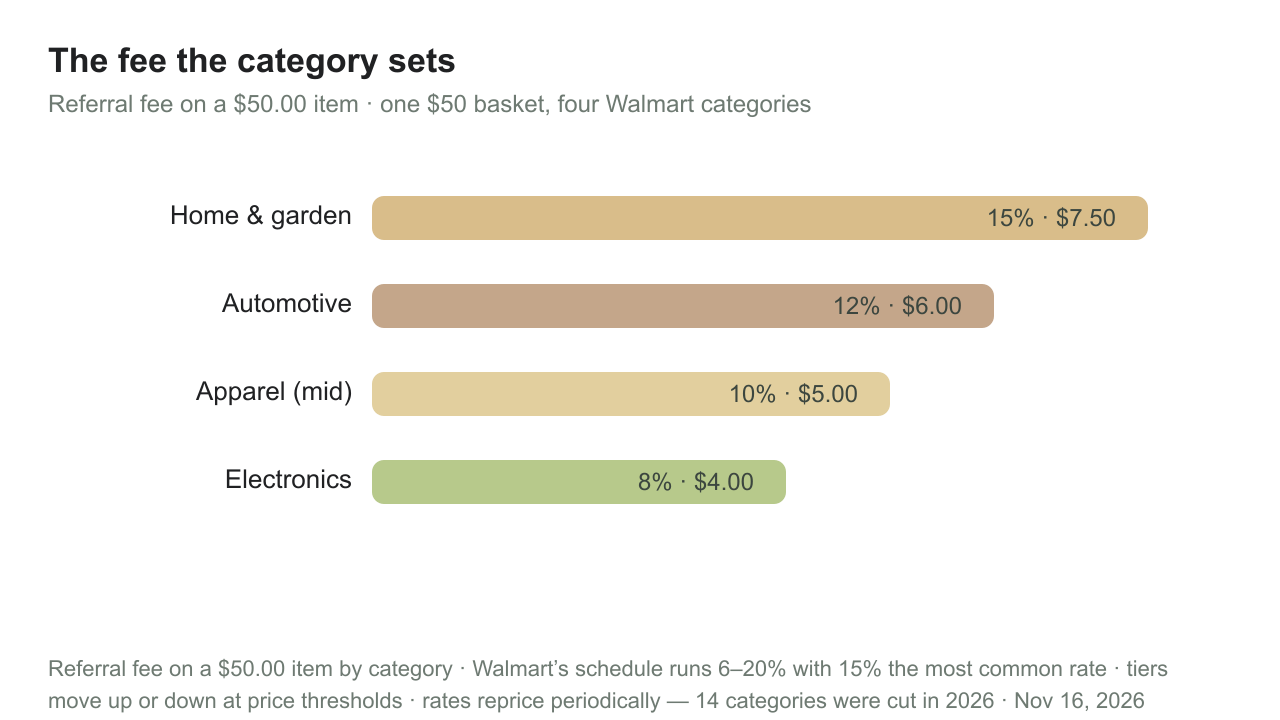
- Electronics at 8% and Home, Kitchen & Garden at 15% can mean a $3.50 difference on the same $50 item; the fee difference is real margin, chosen one dropdown at a time.
- Mis-categorization costs in three currencies: wrong commission, suppressed or demoted listings, and attribute mismatches that hollow out listing quality.
What a product category is on Walmart #
Walmart’s catalog taxonomy is a two-layer system, and sellers who conflate the layers create their own listing problems. The top layer is the category — the browse-and-search bucket a shopper navigates by (Apparel, Electronics, Home, Health, and so on). Beneath it sits the product type: a precise slot in Walmart’s taxonomy (a standing desk, a Cast-Style Griddle, a convertible car seat) that defines the attributes your listing is expected to carry — dimensions, materials, certifications, variant structures, the fields that power Walmart’s filters and comparison widgets.
Three things follow from that design. First, category choice is a fee decision: the referral fee schedule is per category, so the dropdown sets your margin before a single unit sells. Second, it is a visibility decision: browse nodes and search facets hang off the category and product type, so the wrong slot makes a correct listing invisible to the shoppers who were looking for it. Third, it is a data contract: Walmart maintains the taxonomy — the product types, their required and optional attributes, and the includes/excludes definitions that say what belongs where — and updates it over time, which is why the authoritative tree lives in Seller Center and Walmart’s published categorization guidance rather than in any blog post, this one included.
The widely-reproduced 2020-era taxonomy lists (with their “Animal,” “Carriers & Accessories” and similar buckets) capture the flavor of that guidance but should not be trusted as current structure; Walmart has reorganized and renamed since. The categories that matter for fees are the ones on the referral schedule, and those we can pin precisely.
The fee the category sets: referral fees #
Walmart Marketplace has no monthly subscription and no listing fee — the commission is the schedule. Referral fees run from about 6% to 20% depending on category, with 15% the most common rate across general merchandise. The lines worth knowing (all per the official schedule; rates are the seller’s responsibility to confirm at listing time):
| Category | Referral fee |
|---|---|
| Consumer electronics; major appliances | 8% |
| Automotive & powersports | 12% |
| Apparel & accessories | Tiered — 5% on the lowest price band, stepping to 10% and then 15% as item price rises |
| Home, kitchen, décor & garden (general merchandise) | 15% |
| Grocery | 8% on lower-priced items, 15% above the threshold |
| Baby products | 8% on lower-priced items, 15% above the threshold |
| Everything else (most general categories) | Commonly 15%; some niches 6–12% |
Condensed from Walmart’s published referral fee schedule, November 2026. Rates are percentage of the sale, several categories tier at price thresholds in both directions, and Walmart reprices categories periodically — verify the current line for your exact category before pricing. The authoritative table lives on Walmart’s Marketplace pricing page and its referral fee schedule guide.
Three structural notes. Tiers cut both ways: some categories step down as items get pricier (Walmart’s version of Amazon’s step-down tails), while others — grocery and baby are the standard examples — step up once an item crosses a price band, the marketplace assuming a pricier item is a different kind of sale. Rates move: Walmart repriced its schedule in 2026, cutting referral fees in roughly fourteen categories as part of a seller-focused update — another reason the year-old table in a blog post (anyone’s) is a liability. And incentives exist: Walmart has offered new-seller programs discounting base referral fees on the first tranche of GMV; check the Marketplace announcements rather than assuming yesterday’s promo still runs.
Choosing the category: three consequences #
On a $50 item, the fee spread between Walmart categories is the difference between a $4.00 commission and a $7.50 one — 8% versus 15% of the sale. That gap is why category selection on Walmart is a pricing decision, not clerical work:
- The commission follows the category, so two functionally identical listings can carry materially different margins. Where an item genuinely straddles two categories, the fee table is a legitimate input — the 8%-electronics classification is earned by the product’s nature, not chosen by preference; Walmart’s categorization definitions exist precisely so sellers cannot fee-shop their way into the wrong bucket.
- The visibility follows the category. Browse nodes, filters and facets are built from category and product type. A griddle listed under “Collectibles” does not appear when a shopper filters Cookware — and Walmart’s search leans on the structured attributes the product type requires.
- The data contract follows the product type. Each product type demands its attributes; listing against the wrong type leaves required fields empty, which suppresses listing quality scores and, eventually, the listing itself.
The correct technique is boring and effective: in Seller Center, search for the most specific product type that matches the item, take the category it lands in, and read that product type’s required attributes before writing the listing. Working bottom-up from the specific type beats working top-down from a guess.
The includes-and-excludes traps #
Walmart’s categorization guidance has long defined its product types with “includes” and “excludes” lines, and the boundaries are not always where a reasonable person would draw them. The classic examples the guidance itself uses: smart watches belong in Electronics, not Watches (fitness trackers likewise); sports nutrition products sit in Food & Beverage unless they carry FDA supplement labeling, which moves them to Medicine & Supplements; paint belongs in Building Supply, not general home décor; and portable HVAC units land in Home rather than the Plumbing & HVAC product types. The specific lines evolve with the taxonomy — treat the current categorization guide as the source and these as proof that intuition is not a categorization strategy.
The trap has a fee edge too. Category definitions and fee schedules are different documents with different boundaries: an item whose correct taxonomy slot is “Food & Beverage” pays that category’s tiered rate, and the item one shelf over in “Medicine & Supplements” pays its own. When a category assignment changes, the commission changes with it — which is why re-categorization shows up in your settlements as a fee-rate change with no seller action.
Mis-categorization and how to fix it #
Mis-categorization shows up as three distinct costs. Fees: the wrong category charges the wrong rate — either bleeding margin on a high-rate category or borrowing an unearned low rate that Walmart’s catalog processes will eventually catch. Visibility: the wrong browse node means the right shoppers never filter their way to you, and Walmart’s listing-quality scoring penalizes incomplete or mismatched attributes. Compliance: certain categories carry approval or restricted-status requirements, and listing into one without them is a policy problem, not a paperwork one.
The fix is a Seller Center edit: change the item’s product type, repopulate the attributes the new type demands, and let Walmart re-validate. Plan for the fee change to appear from the item’s next sale onward — prior settlements are not re-rated — and for a listing-quality dip during the transition if attribute coverage has to be rebuilt. Bulk catalog sellers should re-audit category assignments whenever Walmart publishes a taxonomy update; migrated items sometimes land in a more generic product type than they deserve, and generic slots pay generic rates.
Where the category fee lands in your settlement #
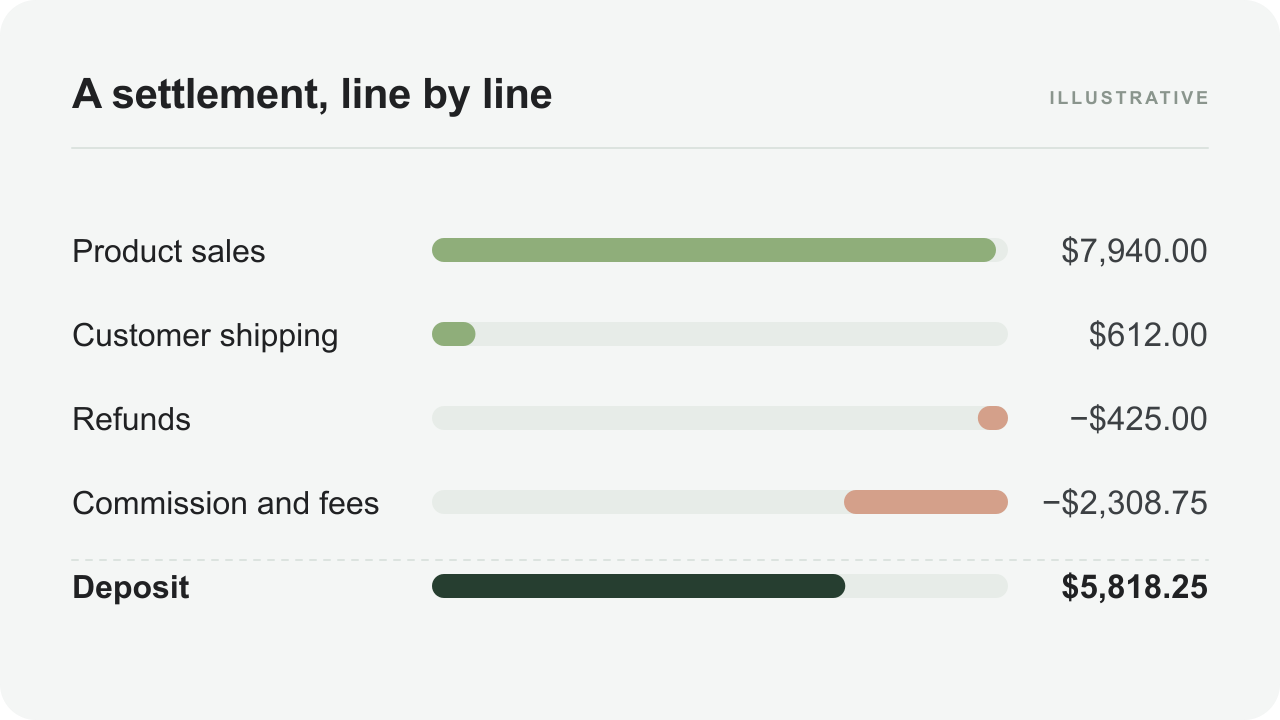
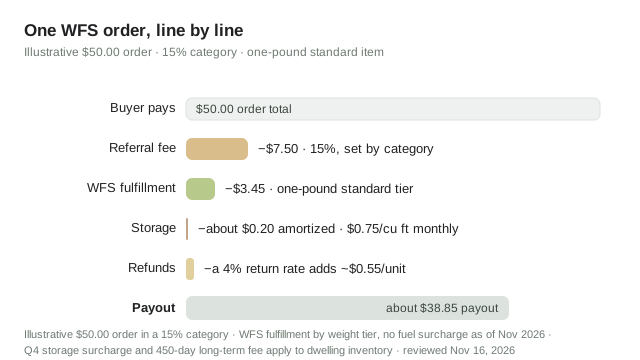
Walmart pays out on its own cycle, net of the commission the category set, plus any fulfillment (WFS) and advertising charges — and, since facilitator laws completed their US rollout in 2023, with sales tax lines that are Walmart’s remittance, not your income. Our Walmart settlement guide walks the document line by line; the category-specific habit is simple: keep commission in its own account rather than a blended “marketplace fees” bucket, because Walmart’s commission line is the one number that should reconcile against the referral schedule — and reconciling it catches both fee-schedule surprises and category drift. The facilitator tax lines follow the pattern described in the facilitator guide.
For a multi-category catalog, the books can go one step further and split selling fees by category — home-goods commissions in one account, electronics in another — which makes the margin table by category fall out of the P&L directly. That is over-engineering until volume justifies it; what is never justified is blending Walmart’s commission with your Amazon referral fees and eBay final value fees into one “fees” figure. The clearing account structure keeps the channels apart.
TidyPayouts splits every Walmart settlement into sales, refunds, fees and tax lines — category commissions stay visible and reconcilable to the schedule.
The books treatment #
Nothing about Walmart categories changes the bookkeeping pattern this site teaches — sales, refunds, fees and tax on separate lines, matched to the bank — but the category dimension earns one habit: when the commission account is reconciled monthly against the referral schedule, mis-categorization becomes a bookkeeping discovery instead of a quarter-end surprise. A settlement whose effective commission rate drifts from the schedule is either a fee-table change (check Walmart’s announcements), a category migration (check Seller Center), or an item sold through the wrong type (fix the listing). All three are findable in minutes from a clean ledger and invisible in a blended one. That reconciliation discipline is the settlement guide’s routine with the category column added.
Common questions #
How much does Walmart charge per category?+
Referral fees run from about 6% to 20% of the sale depending on category, with 15% the most common rate for general merchandise. Electronics and major appliances sit at 8%, automotive at 12%, and several categories tier at price thresholds — apparel steps up from 5%, grocery and baby step up from 8%. Walmart’s official schedule is the authority; reprice against it periodically.
Is selling on Walmart cheaper than Amazon?+
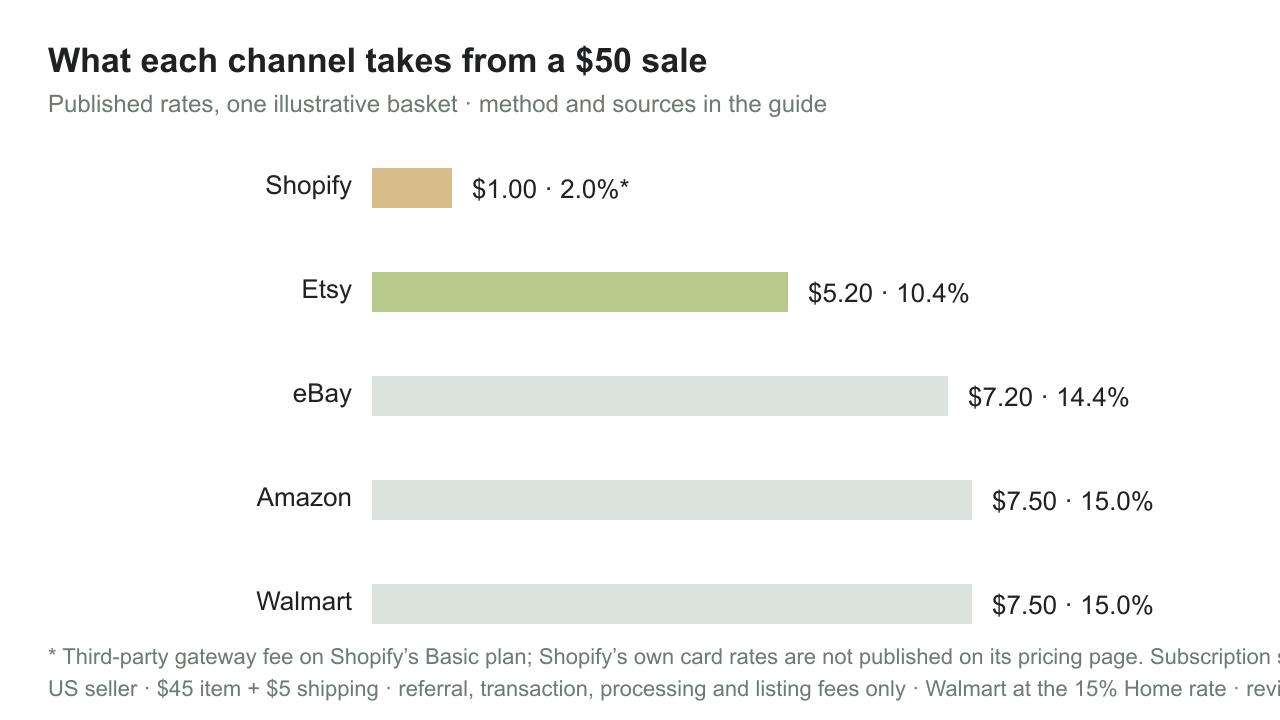
Category by category it often is, and structurally it always is at low volume: Walmart has no monthly selling plan to Amazon’s $39.99, and several categories price below Amazon’s 15% default (electronics at 8% versus Amazon’s 8% is a tie, but Walmart’s tiered apparel beats Amazon’s at low prices). Our take rates comparison puts the same $50 basket through both schedules — the marketplace fees land close; the differences are in the long tail of categories and incentives.
What category should I list my product in?+
The one Walmart’s own taxonomy assigns: search Seller Center for the most specific matching product type and take the category it lives in. Working bottom-up from the product type beats guessing a top-level category, because the product type also defines the attributes your listing must carry.
Can I change my product’s category after listing?+
Yes — edit the item’s product type in Seller Center and repopulate the attributes the new type requires. The referral fee follows from the item’s next sale onward; prior settlements are not re-rated. Expect a listing-quality revalidation during the change, and re-audit the whole catalog when Walmart publishes taxonomy updates, because migrated items sometimes land in more generic product types than they deserve.
Why did my Walmart referral fee change?+
Three usual answers: Walmart repriced the schedule (it cut fees in roughly fourteen categories in 2026), a price-band tier engaged (several categories step up or down at thresholds like $15), or the item’s category or product type changed. Your settlements show the effective rate — reconciling it against the schedule catches all three within a month.
Does the Walmart referral fee apply to shipping and tax?+
The schedule defines the fee on the sale proceeds Walmart records — the safe assumption for planning is that delivery charges the buyer pays are inside the base and marketplace-collected tax is not. The exact definition lives in your seller agreement and the official schedule; confirm rather than assume, because it changes the arithmetic on every order.
Are there Walmart fee discounts for new sellers?+
Walmart has run new-seller programs discounting base referral fees on the first tranche of gross merchandise value — reported structures have stepped 20%, 30% and 40% off across GMV bands. Promos come and go; check Marketplace announcements for what is currently on offer rather than relying on this paragraph.
How do Walmart categories affect search visibility?+
Directly. Browse nodes, filter facets and comparison widgets are all built from the category and product type, and the structured attributes the product type requires are what Walmart’s ranking reads for relevance. A listing in the wrong category is complete data in the wrong drawer — present, but not findable by the shopper whose filter it should have appeared under.
Sources and review date #
Written November 16, 2026 against Walmart’s published pricing and schedule pages below and seller-ecosystem coverage of the 2026 fee changes. Walmart’s taxonomy and fee schedule are maintained in Seller Center and change over time — the authoritative category tree and the current referral table are always Walmart’s own pages. Examples are fictional; category assignments with fee consequences deserve a check against the current categorization guidance.