Tidy
In this article
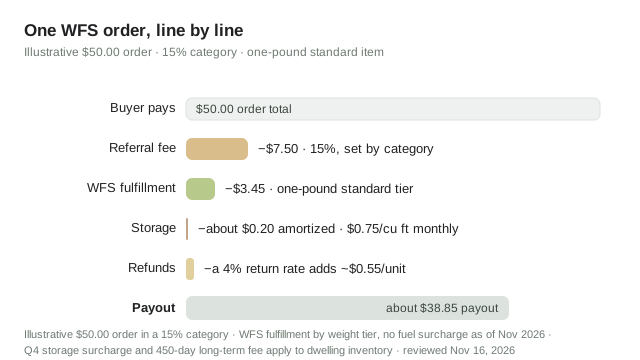
- WFS fulfillment starts around $3.45 per unit for a one-pound standard item, with rates stepping up by weight and size tier — and no fuel surcharge line as of November 2026.
- Monthly storage runs $0.75 per cubic foot outside Q4; inventory dwelling past 30 days in October–December pays a surcharge, and items stored 450+ days hit a $7.50/cu ft long-term fee.
- New sellers get real money off: promotional programs have included 50% off storage and 25% off fulfillment, and the current New-Seller Savings offer runs through January 31, 2027.
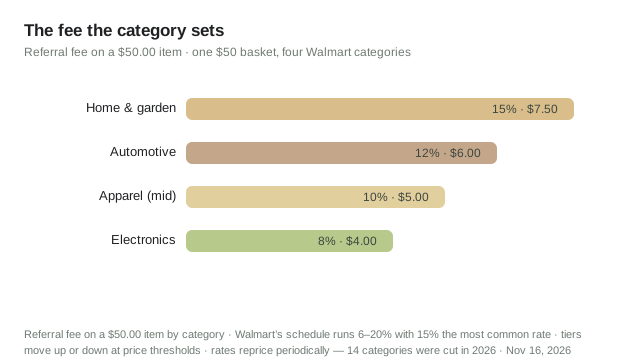
- The referral fee (6–20% by category, 15% common) is separate from WFS and unchanged by the fulfillment choice — the WFS decision is purely fulfillment economics.
WFS fees at a glance #
Walmart Fulfillment Services is opt-in per SKU: you keep the same listing, the same category referral fee (6–20%, 15% most common), and WFS adds the fulfillment and storage stack on top. There is no WFS subscription and no monthly minimum — the costs are per-unit fulfillment, per-cubic-foot storage, and surcharges for aged inventory.
| Fee | When it applies | Amount (US, 2026) |
|---|---|---|
| WFS fulfillment fee | Per unit shipped to a customer | From about $3.45 (one-pound standard); steps up by weight and size tier |
| Monthly storage | Per cubic foot held in WFS | $0.75/cu ft (January–September) |
| Q4 storage surcharge | October–December, inventory held over 30 days | Additional ~$1.50/cu ft |
| Long-term storage | Items stored 450+ days | $7.50/cu ft |
| Removal / disposal | Per unit returned to you or destroyed | Per-unit rates by size; promos have waived these |
| Inbound receiving | Shipments into WFS | No separate receiving fee in the standard structure |
| Referral fee (not WFS) | Every sale, on either fulfillment path | 6–20% by category — unchanged by WFS |
US rates reviewed November 16, 2026 against Walmart’s published WFS fee guide below. WFS rates and promos change — confirm the current table in Seller Center before deciding on inventory placement.
Fulfillment fees by size tier #
The fulfillment fee is quoted per unit and driven by weight band and size tier. A one-pound standard item starts around $3.45; heavier standard tiers step up from there, and oversized items carry their own schedule. Two things make the WFS number readable: it already bundles pick, pack, shipping and customer service for the order, and — unlike FBA as of 2026 — there has been no separate fuel-surcharge line stacked on top. Walmart’s own comparisons lean on exactly that point, so verify it holds when you quote.
The practical read is the same as every fulfillment decision in this series: measure your median shipped parcel (weight, dimensions), find its tier in the current table, and compare against your true self-fulfillment cost — carrier postage at commercial rates plus packaging plus labor. WFS wins when its per-unit number beats that sum, and loses when your postage is cheap, your items are bulky, or your velocity is too low to justify inbound shipments.
Storage, Q4 surcharges and long-term fees #
Storage bills monthly per cubic foot: $0.75 outside the fourth quarter. In October–December, inventory that has been in WFS for more than 30 days pays an additional surcharge of about $1.50 per cubic foot — roughly tripling the holding cost exactly when gift-season inventory sits. Items that dwell 450+ days pay a long-term fee of $7.50 per cubic foot, which is Walmart telling you to clean house.
The management pattern is the one from FBA, compressed: track your inventory dwell time monthly, keep Q4 inbound lean (stock what the forecast supports, not what the truck conveniently carries), and treat any SKU approaching long-term territory as a decision point — promo, clearance, or removal — before the fee lands. The COGS guide covers how dwell costs belong in your unit economics.
Removals and disposals #
Pulling inventory back out of WFS, or having it destroyed, carries per-unit rates that step by size tier. These are the fees most sellers never price until they owe them — and the recent promotions have waived removal fees entirely for qualifying sellers, which is worth checking before paying one. In the books: removals are a fulfillment cost (or a cost of reclaiming inventory), disposals are a write-off paired with the dead-stock write-off, and neither is a selling fee. Removals also matter for the books’ inventory ledger: units removed re-enter your own warehouse inventory at their recorded WFS cost, and the transfer should be documented on both sides — Walmart’s removal order and your receiving record — so the quantity doesn’t vanish from either ledger.
New-seller discounts and promos #
Walmart runs aggressive onboarding offers, and they are genuinely material: recent and current programs have included 50% off WFS storage and 25% off fulfillment for new WFS sellers, and the New-Seller Savings offer running through January 31, 2027 advertises credits worth up to $2,000 (10% off fulfillment fees until the credit cap is reached) plus full removal-fee waivers for qualifying sellers. Two habits when a promo applies: model the post-promo economics too, so the SKU still works at full rates; and note the promo credits in your books on their own line, so margin analysis during the promo period doesn’t mistake subsidized months for the steady state.
WFS versus FBA in five lines #
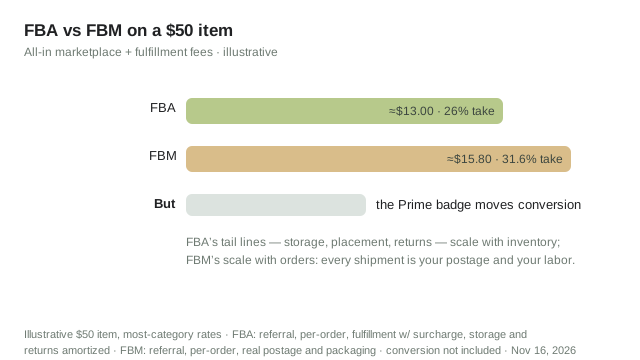
- Fulfillment: WFS from ~$3.45 vs FBA from ~$3.83 for a comparable one-pound unit (2026, FBA including its fuel surcharge) — close, with item-specific tiers deciding.
- Storage: WFS $0.75/cu ft vs FBA $0.78/cu ft off-season — near-identical; both triple in Q4.
- Tail fees: FBA’s list is longer (inbound placement, returns processing, refund administration, aged surcharges); WFS’s is shorter but includes the long-term storage cliff.
- Reach: FBA ships into Prime’s conversion engine; WFS delivers the Walmart Fulfillment badge and Walmart’s audience. Conversion differences usually dwarf fee differences.
- Decision method: identical — per SKU, with your own weights and velocities, recomputed quarterly. The worked example in our FBA vs FBM guide is the template; swap the FBA column for WFS rates.
Where WFS fees land in your books #
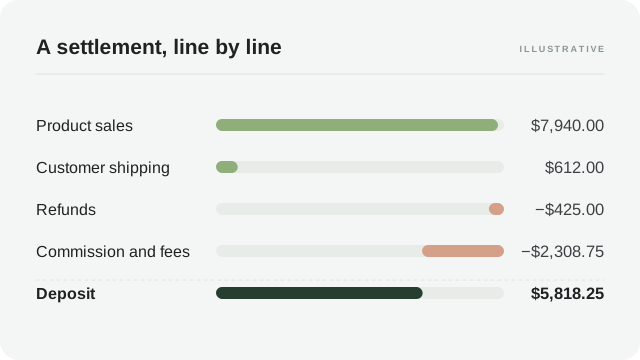
WFS fees are netted out of your Walmart settlement alongside the category commission — the settlement walkthrough in our Walmart settlement guide shows the line. The chart-of-accounts habit that matters: keep WFS fulfillment and storage in their own fee accounts, separate from the commission line, so the fulfillment decision (this guide) and the category decision (the categories guide) can each be evaluated against its own number. Storage at period end is an inventory-cost question — the COGS guide covers where holding costs belong — and promo credits post on their own line so subsidized months read as subsidized.
TidyPayouts splits every Walmart settlement — commission, WFS, storage, tax — into reviewable lines matched to the bank.
A Q4 storage worked example #
One pallet of slow movers through Q4 — fictional
Say 20 cubic feet of a slow-moving SKU sits in WFS from October 1 through January 15. October: the first 30 days bill at $0.75/cu ft ($15.00); the remainder of October, November and December bill with the ~$1.50 Q4 surcharge ($2.25/cu ft × 20 × 3 months ≈ $135.00); January bills back at $0.75 ($15.00) — and if the units cross 450 days, the $7.50 long-term fee replaces everything. Total holding cost: roughly $165 on inventory that retail value puts at maybe $600. A 27% holding cost per quarter is the number that turns “let it ride another quarter” into a removal-or-clearance decision.
Illustrative arithmetic from the published storage structure; exact surcharge application depends on Walmart’s current storage-policy page. The point is the ratio, not the decimal.
When WFS is not the fit #
WFS earns its keep on standard-size items with steady velocity. It is the wrong tool for oversized goods (tier rates climb steeply and storage cubes balloon), one-off and vintage items with unpredictable sell-through (the storage clock runs whether or not anything sells), and products where you control a better packing experience than a marketplace box. It is also worth remembering that Walmart still sells FBM on its marketplace happily — WFS is a lever, not a membership. The decision test is the one from the FBA vs FBM guide with the WFS column swapped in: fulfillment plus amortized storage versus your true postage-plus-labor, per SKU, recomputed quarterly.
Getting inventory into WFS #
The costs before the first sale are logistics, not fees: WFS inbound shipments follow Walmart’s routing — create the shipment in Seller Center, box and label to spec, and ship to the assigned fulfillment center. WFS accepts cases and individual boxes, with prep requirements for specific categories (apparel poly-bagged, hazmat flagged, expiration-dated goods labeled) that mirror marketplace expectations. Two practical notes: inbound shipments have no separate receiving fee in the standard structure — the costs are your freight to the center and your packing labor — and shipment accuracy is free money: a carton that arrives unannounced or mislabeled generates the same investigation-and-deduction cycle that marketplace shipments do. Build the inbound checklist once; every future replenishment inherits it.
Common questions #
How much does WFS cost per unit?+
Fulfillment starts around $3.45 per unit for a one-pound standard item and steps up with weight and size tier — the per-unit rate bundles pick, pack, shipping and customer service. Your median shipped parcel’s tier is the number to price against.
Is WFS cheaper than FBA?+
On the headline fulfillment rates, often marginally — Walmart’s one-pound rate undercuts FBA’s comparable 2026 rate including its fuel surcharge. But item-specific tiers, your storage dwell time, and the conversion difference between Walmart and Amazon audiences decide the real answer. Run the same SKU through both schedules with your own numbers.
Does WFS charge a monthly fee?+
No subscription and no monthly minimum — WFS charges per-unit fulfillment and per-cubic-foot storage, plus surcharges for aged inventory and per-unit removals or disposals. The referral fee on your sales is separate from WFS and applies regardless of fulfillment method.
What is the WFS storage surcharge in Q4?+
During October–December, inventory held in WFS for more than 30 days pays an additional surcharge of roughly $1.50 per cubic foot on top of the base $0.75 monthly rate. Plan Q4 inbound lean and move aged units before the surcharge window. Items stored 450+ days pay a separate long-term fee of $7.50 per cubic foot.
Are there WFS discounts for new sellers?+
Yes — Walmart has run New-Seller Savings programs with storage and fulfillment discounts (recently 50% off storage and 25% off fulfillment) and, for the offer running through January 31, 2027, fulfillment credits worth up to $2,000 plus removal-fee waivers for qualifying sellers. Check the current offer page, and model post-promo economics before committing inventory.
Does the WFS decision change my referral fee?+
No. The category referral fee (6–20%, 15% most common) applies identically whether Walmart fulfills the order or you do. WFS is purely a fulfillment-economics decision layered on top of the commission schedule.
How do WFS fees appear in my books?+
Netted out of your Walmart settlement, where they should be booked to their own fulfillment and storage fee accounts — separate from the category commission. The settlement walkthrough in our Walmart guide shows the lines; period-end storage belongs in the inventory-cost conversation with your bookkeeper.
Can I use WFS for items I also sell on other channels?+
WFS has supported multi-channel fulfillment, letting WFS ship your non-Walmart orders — which turns WFS inventory into shared working capital, but check the current multi-channel fulfillment rates and support scope before routing other channels through it. Keep those fulfillment charges in their own books lines so each channel’s cost stays readable.
Sources and review date #
Reviewed November 16, 2026 against Walmart’s published WFS fee guide and Marketplace pages below. WFS rates and promotions change — confirm the current table in Seller Center before committing inventory. Examples are illustrative.