Tidy
In this article
- Promoted Listings now run on two strategies: General (cost-per-sale — you set an ad rate from 2% of the sale, charged only when a promoted item sells) and Priority (cost-per-click with keywords and budgets).
- Since January 13, 2026, US and Canada attribution is “any-click”: any buyer purchasing any of your promoted items within 30 days of any ad click counts as an attributed sale — a wider fee net than the old direct-sale model.
- The decision is one formula: maximum sensible ad rate = your margin ÷ price, minus your target profit. If eBay’s suggested rate exceeds that ceiling, the answer is no.
- Ad fees are always incremental to the 13.6% final value fee and the per-order fee — the full selling stack applies to attributed sales too.
What Promoted Listings are today #
Promoted Listings are eBay’s first-party ads: your listing appears in search results with a “Sponsored”-style marker, above or among the organic results. The mechanism that decides whether they are worth it has two very different flavors:
- General strategy (cost-per-sale). You set an ad rate — a percentage of the sale, from 2% upward — and pay it only when a promoted item sells to a buyer whose purchase follows a click on one of your ads within the attribution window. Dynamic rates can move your rate with the market: you set a cap and a modifier around eBay’s suggested rate, which is recalculated from buyer demand and competition. Eligibility requires Above Standard or Top Rated seller level and, in most categories, fixed-price listings.
- Priority strategy (cost-per-click). You bid on keywords, set daily budgets, and pay per click whether or not anything sells. Priority placements are the ones eBay puts in the top search slots, and a listing can run one General campaign and Priority campaigns at the same time.
Everything below works for both, but the math section is written for General — cost-per-sale — because that is where most sellers live, and where the “worth it” question is genuinely answerable with arithmetic.
What changed for 2026 #
Three developments make older advice (including our own previous mentions) stale:
- The attribution net widened. Effective January 13, 2026, General campaigns in the US and Canada moved to an “any-click” attribution model — mirroring changes eBay already rolled out in the UK, EU and Australia during 2025. A sale counts as ad-attributed when any buyer purchases a promoted item within 30 days of any click on one of your ads — the purchaser no longer has to be the clicker. A buyer who clicked your ad, left, and came back organically a week later to buy is now an attributed sale. The fee scope expanded; several seller communities have called exactly that out.
- Minimum rates moved. Sellers have reported General ad-rate minimums jumping from 2% to 5% for some accounts in late 2026. Rate floors vary by account and category, so read the number eBay shows you in Seller Hub rather than assuming the historical 2%.
- Priority got the top slot. The pay-per-click strategy’s placements include the premium positions General ads don’t reach — a meaningful change if your category is crowded enough to need the very top of page one.
None of this makes Promoted Listings bad. It makes them priced — and pricing is what the rest of this guide is for.
The cost stack: where the ad fee lands #
The ad fee is calculated as a percentage of the total amount of the sale — the same fee base as the final value fee, shipping and sales tax included. It is charged on top of the full selling stack: on a 13.6% category sale, a 5% ad rate means you pay 18.6% plus the per-order fee plus, on the invoice, the ad fee rides with your other non-transaction charges rather than the payout. Our eBay fees guide walks that stack line by line.
The stacking matters because ads are usually evaluated in isolation. A seller hears “I’ll pay 5% only when it sells” and hears cheap. On a thin-margin item, 5% of revenue can be a quarter of the profit. The next section is the antidote.
The math that decides it: the break-even ad rate #
One formula answers “worth it?” for every item you sell:
Maximum sensible ad rate = (price − cost of goods − fulfillment − platform fees − target profit) ÷ price
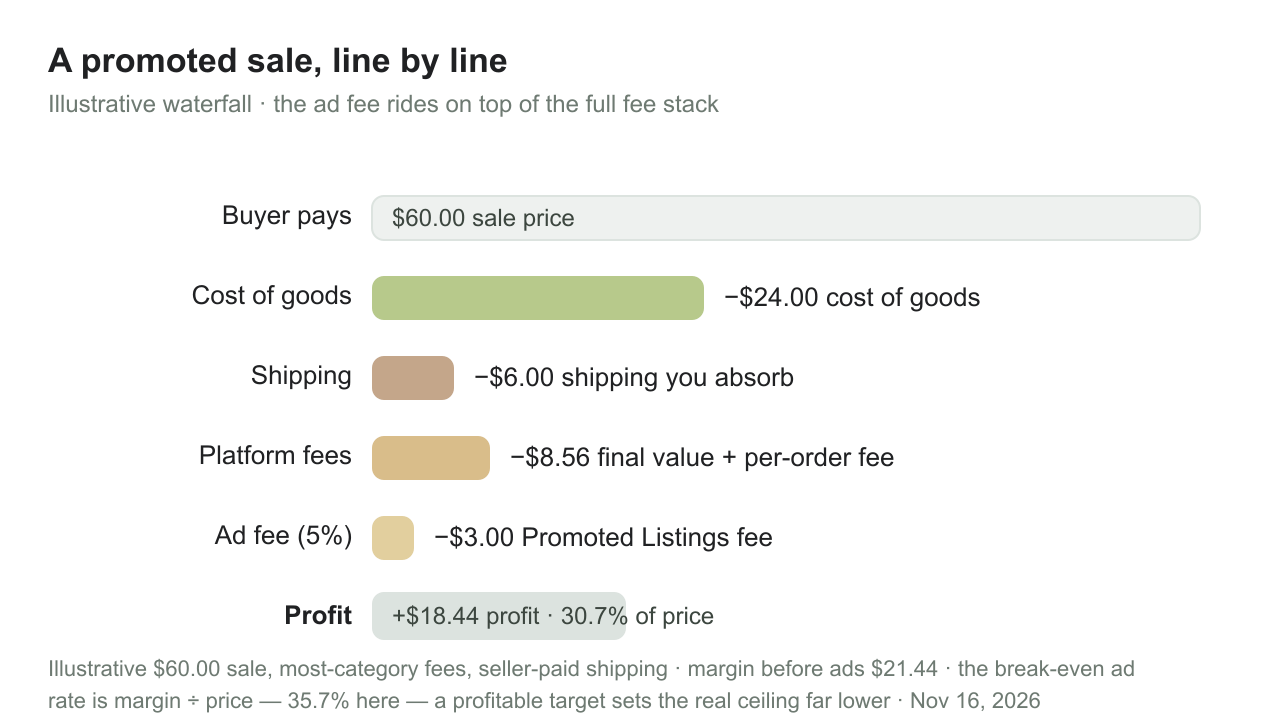
The $60 gadget, advertised — fictional
A $60 kitchen gadget. Cost of goods $24, you absorb $6 of shipping, and platform fees are $8.56 (13.6% final value fee + $0.40 per-order fee). Margin before advertising: $21.44 — 35.7% of price. That 35.7% is the absolute break-even ad rate: at it, you keep nothing.
With a target profit of $10 per unit, the sensible ceiling is ($21.44 − $10.00) ÷ $60 = 19% — but the honest ceiling is lower still, because the ad fee is charged on the total amount of the sale (shipping and tax included), not just the item price, and attribution — next section — bills sales you might have gotten anyway. At eBay’s typical suggested rates around 5–12% for competitive categories, this item nets $10–$18 per advertised sale: worthwhile if the sale is incremental, expensive if it was coming anyway.
Illustrative figures on the November 2026 most-category schedule. Your category, store level, shipping choice and cost base move every number — run the formula per item, not per store.
Two habits fall out of the formula. Compute the ceiling per item — a $400 lens with $180 of margin and a $12 gadget with $3 of margin have wildly different answers even in the same category. And treat eBay’s suggested ad rate as a market price for visibility, not a recommendation: if the suggested rate sits above your ceiling, the market is telling you this category’s attention costs more than your item earns — list it, don’t promote it.
Attribution: what counts as an ad sale now #
The January 2026 any-click change rewrote the most important rule. The mechanics now: an attributed sale is any purchase of a promoted item, by any buyer, within 30 days of any click on one of your ads — provided the item was promoted both at the click time and at the sale time. The old direct-and-halo model, which mostly tied fees to the clicker’s own purchase, is gone for US and Canada.
The consequence deserves its own sentence: organic sales can be billed as ad sales. A buyer who clicks your ad, browses away, and re-finds your listing through ordinary search next week is attributed. On a listing with strong organic traffic, a rising share of “attributed” sales may be sales you already owned. That does not make the fee wrong — visibility plausibly helped — but it makes naive ad math wrong: attributed sales ≠ additional sales.
Three defenses, in order of rigor:
- The pause test. Pause the campaign for two weeks and compare total sales rate. The truest measure of incrementality, available to everyone.
- The lift ratio. Attributed sales ÷ total sales of promoted items. A ratio near 1.0 says almost every sale is being billed as ad-driven — on an established listing, that is a signal the attribution net, not the ads, is doing the work.
- The fee-to-revenue ratio. Total ad fees ÷ total revenue of promoted items, tracked monthly against your ceiling from the formula above. When the ratio drifts up after an attribution change with no traffic change, your effective ad rate rose — respond by cutting the ad rate, not by hoping.
General versus Priority in practice #
| General (cost-per-sale) | Priority (cost-per-click) | |
|---|---|---|
| You pay | An ad rate on the total amount of the sale, only when a promoted item sells to an attributed buyer | Per click, keyword-bought, against a daily budget |
| Risk | Low per sale — but attribution bills sales you may have had anyway | Real — clicks without conversions cost cash |
| Control | Ad rate, dynamic rates (cap + modifier around eBay’s suggested rate) | Keywords, negative keywords, bids, budgets, placement targeting |
| Placement | In-results “sponsored” positions among organic results | Includes premium top-of-search slots |
| Best for | Established listings with healthy margins that need a visibility lift | New listings that need data fast, competitive keywords, precise targeting |
Strategy mechanics as of November 2026 from eBay’s advertising help pages; campaign options and rate floors vary by account and category.
The common play is General for the catalog and Priority surgically: keywords for the items with proven conversion, budgets you can afford to lose, and negative keywords pruned monthly. Running Priority on thin margins is the one configuration this guide flatly warns against — cost-per-click with unproven conversion is how ad spend becomes pure loss.
A decision framework #
In order, for each listing you are tempted to promote:
- Compute the ceiling. Margin ÷ price minus target profit. No ceiling above the category’s suggested rate? Don’t promote — fix cost or price first.
- Check the organic rank. Page-one organic with steady sales: ads mostly re-bill your existing demand under any-click attribution — skip. Pages two to four with good conversion when visited: the prime Promoted Listings case.
- Check the competition. Search your own title. Hundreds of near-identical listings is where visibility is bought; a handful is where it isn’t needed.
- Check conversion readiness. Weak photos, thin descriptions, or a feedback score that gives buyers pause will waste any ad click. Listing quality precedes advertising — the ad only buys the visit, the listing closes it.
- Start below the suggested rate and earn upward. Set the ad rate at or under your ceiling, run two weeks, and require measured lift — the pause test — before raising anything. eBay’s suggested rate is the market’s asking price, not your budget.
The framework’s honest summary: Promoted Listings are worth it when three things are simultaneously true — margin that clears the rate, a listing that converts, and demand that ads can genuinely add to. Any one missing and the fee is either unaffordable, wasted, or merely renamed.
The monthly optimization loop #
Advertising drifts without a loop, and 2026’s attribution change makes drift expensive. Monthly, per campaign:
- Pull attributed sales and ad fees from the Promoted Listings summary and the monthly invoice (where ad fees are billed — separate from the payout, unlike the final value fee).
- Compute the fee-to-revenue ratio against your ceiling. Ratio above ceiling: cut the ad rate or pause the worst items.
- Compute the lift ratio (attributed ÷ total sales). Near 1.0 on an established listing? Run the pause test before renewing the campaign for another month.
- Prune. Priority: negative keywords, paused keywords, budgets down on clicks that don’t convert. General: the bottom-quartile items by measured lift leave the campaign.
- Re-run the ceiling formula when costs or prices change — last quarter’s sensible 8% is this quarter’s loss if COGS rose.
Bookkeeping note: ad fees belong in their own advertising expense account, not in selling fees — the distinction is what makes campaign-level return on ad spend calculable at all. Our marketplace advertising spend guide covers the account structure, and the refunds and fees reconciliation guide covers matching the invoice lines.
TidyPayouts splits every payout and invoice line by type — advertising stays separate from selling fees, so campaign math is real math.
Common questions #
Are eBay Promoted Listings worth it in 2026?+
When three things hold at once: your margin clears the ad rate with room for target profit, the listing converts well, and the sales are genuinely incremental. The January 2026 any-click attribution widened the fee net to include sales you might have had anyway, so the bar is higher than it used to be — run the ceiling formula and the pause test rather than trusting the attributed-sales count.
How much do eBay Promoted Listings cost?+
General campaigns charge an ad rate — from 2% of the sale upward, with reports of 5% minimums for some accounts in late 2026 — on attributed sales only, calculated on the total amount of the sale. Priority campaigns are cost-per-click with keyword bids and daily budgets. Both sit on top of the normal final value fee and per-order fee.
What did the any-click attribution change do?+
Effective January 13, 2026 in the US and Canada (mirroring the UK, EU and Australia in 2025), a sale is ad-attributed when any buyer purchases a promoted item within 30 days of any click on one of your ads — the buyer no longer has to be the clicker, and the sale doesn’t have to be the advertised item’s own checkout journey. The fee scope widened; measure incrementality, not just attributed sales.
Do Promoted Listings fees apply to shipping and sales tax?+
Yes — the ad fee is calculated on the total amount of the sale, the same base as the final value fee, shipping and sales tax included. On top of that, attributed sales pay the full selling stack: the ad fee is incremental, never a substitute.
What ad rate should I set?+
Start from the formula: margin minus target profit, divided by price — that ceiling per item. Set the rate at or below it, under eBay’s suggested rate, and raise only after two weeks of measured lift. If the suggested rate exceeds your ceiling, the category’s attention costs more than your item earns; don’t promote it.
Can auctions use Promoted Listings?+
The General cost-per-sale strategy applies to fixed-price listings in most categories; auction-style listings have been largely outside it. Check eBay’s current eligibility table for your format before planning a campaign around auctions — and note that Below Standard sellers cannot promote at all, while Above Standard and Top Rated can.
Why am I paying ad fees on sales I don’t remember advertising?+
Almost certainly the any-click attribution: any purchase of a promoted item within 30 days of any ad click counts, and the item must have been promoted at both the click and the sale. Check the attributed-sales report against your total sales — a lift ratio near 1.0 on an established listing means attribution, not advertising, may be doing the billing.
Do attributed sales still pay the final value fee?+
Yes. The ad fee is entirely incremental: attributed sales pay the ad rate plus the final value fee plus the per-order fee, exactly like any other sale. That stacking is why the ceiling formula starts from margin after platform fees, not before.
Sources and review date #
Written November 16, 2026 against eBay’s advertising help pages and the coverage below; the January 2026 attribution change and reported minimum-rate movements make older Promoted Listings advice — including ours from earlier in 2026 — worth re-checking. Campaign options and rate floors vary by account and category. Examples are fictional; the fee figures ride on the schedule verified in our eBay fees guide.
- eBay: General campaign strategy (cost-per-sale)
- eBay: Priority campaign strategy (cost-per-click)
- eBay: suggested ad rates
- eBay: Promoted Listings overview
- eBay seller announcement: 2026 Promoted Listings updates
- Value Added Resource: the any-click attribution change, explained
- Value Added Resource: reported General ad-rate minimum jumps
- eBay Developer: Promoted Listings overview