Tidy
In this article
- A discount shrinks the sale; a gift card sale postpones it. The two are opposites, and booking either as the other distorts revenue in a different direction.
- Record discounts as a reduction of income, with the convention agreed once — not as a marketing expense buried where trends hide.
- A sold gift card is a liability: you have been paid for a product you have not delivered. Redemption is when income happens.
- Promotions interact with payouts — some channels charge for coupons or financing — so promo costs deserve their own named lines.
Three kinds of money you didn’t receive #
Promotions make revenue harder to read, because not receiving money means different things in different cases. A coupon on an order shrinks the sale — value never existed for you. A gift card sale brings cash in but delivers nothing yet — value exists but is owed. Store credit issued after a return keeps value circulating without new money at all. Three behaviours, three bookkeeping treatments, and one common failure: treating them all as “discounts” or, worse, netting them into a single revenue line where none of them can be questioned again.
Discounts shrink the sale #
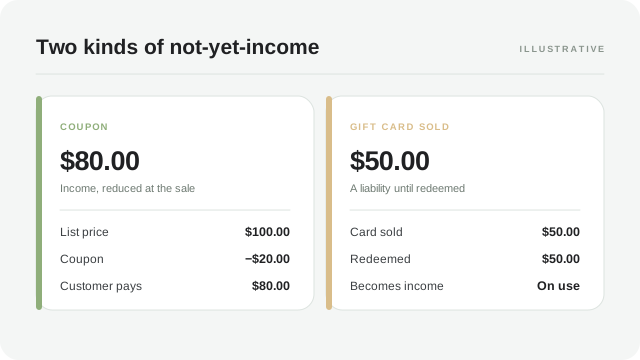
When a $100.00 product sells for $80.00 with a coupon, revenue from that order is $80.00. The books record the reduction as a discount — either netted in the sales line or kept as its own contra line beside it — rather than as an expense. The reasoning is practical, not pedantic: an expense line for discounts implies an operating cost you might cut, sitting in the same mental drawer as advertising, when it is actually the difference between list price and what the market paid you. Keep the discount visible as its own line and two reports stay honest: revenue at realisable prices, and a promotion line whose size you can judge against what it earned you.
Fees, meanwhile, charge on what the customer actually paid, and the payout reflects that. On a channel that charges its fee after coupons, the fee line follows the discounted amount — check your channel’s behaviour once, expect it consistently afterwards, and let the payout report settle any surprise.
| Promotion | What the money is doing | Books |
|---|---|---|
| Coupon / sale price | Value never received | Discount line (contra to sales) |
| Gift card sold | Cash received, product owed | Liability on sale; income on redemption |
| Store credit issued | No new money; value owed | Liability; income when redeemed |
| Channel-funded coupon | Channel pays part; you may still be charged its slice | Follow the payout rows; keep the cost visible |
Channel promotions vary: some marketplaces part-fund coupons, some charge fees for financing or offers, and programs change. Your settlement rows carry the amounts to book; the table carries the shape.
Gift cards are a liability until they are income #
Sell a $50.00 gift card and the books owe an answer to “what did we sell?” The honest one: a promise. The cash arrived; the product or service has not left the building. So gift card sales sit in a liability — value held on behalf of customers — and only when a card is redeemed does the income event happen. Shopify’s help describes creating and selling gift cards and how balances are redeemed; the accounting underneath is the same on any platform that offers stored value.
One gift card, two entries
In March, a customer buys a $50.00 gift card: cash in, liability up — no income. In April they redeem it against an $80.00 order, paying the remaining $30.00 by card. April’s books: sales $80.00, of which $50.00 is the liability being released and $30.00 is new cash. March never showed the sale; April shows it once, whole. A report that booked $50.00 of income in March would have counted a sale twice — once when promised, once when kept.
Illustrative figures. Redemption against smaller orders, partial balances and expiries all follow the same shape: the liability moves by exactly what was consumed, and income happens on consumption.
Store credit from returns is the same liability wearing a returns badge: the refund becomes credit rather than cash, the liability rises, and the customer’s next order releases it as income. The important discipline is that credit is not revenue at issue, and a “revenue” report that counts issued credit will flatter this month and understate the next — which is precisely the kind of fiction the monthly review exists to catch.
TidyPayouts keeps discounts, gift card movements and sales on separate lines, so a promotion changes your numbers without bending them.
Interactions that surprise sellers #
- Discounts change the fee base. Where fees apply to the amount actually charged, a deep coupon also shrinks fees — margin math that assumed list-price fees overstates costs; the reverse understates them.
- Refunds reach for the gift card first. Refunding an order paid partly by gift card usually returns that part to the card — liability restored, cash untouched — while the card-paid part of a new order releases it again. The payout rows will say which way each movement went.
- Breakage is a bookkeeper conversation. Balances that expire or go unspent eventually resolve; when and how to recognise them is a policy question with tax dimensions — agree it with your bookkeeper rather than improvising.
- Channel promotions have their own bills. Coupon-participation fees and financing costs appear in settlements or invoices; each deserves its named line so a promotion’s true cost is one report away.
None of these are exotic; all of them are invisible in a net-revenue-only view. The pattern of this whole series holds: keep the lines named, and the surprises become rows.
A monthly promotion review #
- Total discounts by channel and promotion; compare against the revenue they accompanied.
- Reconcile the gift card and store credit liability: issued, redeemed, outstanding — and confirm the outstanding balance feels believable against actual card behaviour.
- Check redemption income released from the liability agrees with the channel’s redemption report.
- Collect promotion-related fees from settlements into their named line; judge each promotion by what it really cost.
Four checks, and the second is the one that catches trouble early: a gift card liability that only ever grows, never redeems, is either a business with remarkably loyal customers or a feed that has stopped reporting redemptions. The monthly review is how you know which.
Discounts meet unit cost: contribution margin #
Discounts look cheapest in isolation and most honest beside unit cost. Take the $80.00 coupon order from earlier, and give the product a $30.00 landed unit cost: the order leaves $50.00 of gross contribution before fees — thinner than the $70.00 an undiscounted sale would have left, but still positive. Now move the coupon to $65.00 off: the order charges $35.00, contribution falls to $5.00, and a single marketplace fee away from negative. The exercise takes a minute per product and answers the question promotions teams and bookkeepers argue about forever: how deep can we go before the order stops paying for itself?
The answer is a floor, and it belongs in writing next to the promotion plan: minimum contribution per unit, by product, at current fees. Armed with it, a sitewide sale stops being a leap of faith — each planned depth is checkable against each affected product, and the loss-leader exceptions become deliberate choices rather than discoveries at month end. Our fee comparison tool runs exactly this arithmetic per channel, taking unit cost and a price as inputs; the discount version of the same table is the same tool with a lower price.
The promotion calendar belongs in the books #
Promotions are planned in calendars and felt in ledgers, and the two meet in one small habit: when a promotion runs, say so in the books — a note on the period, a named discount campaign, a flag on the affected settlement reviews. The payoff arrives in every comparison that follows. A revenue dip that coincides with last quarter’s coupon hangover reads as marketing, not decline; a fee line that moved with a financing promotion reads as program cost, not channel decay; a conversion-rate report split by campaign reads as evidence instead of trivia.
The habit costs one annotation per campaign and repays it every month the campaign is cited in a trend. It is the same principle as every convention this series recommends: the books exist to make next quarter’s questions answerable, and next quarter will absolutely ask why the second week of March sold so much and earned so little. The calendar note is the answer, written down in advance.
Common questions #
Should discounts be netted into sales or kept on their own line?+
Both conventions appear in the wild; keeping discounts as a visible contra line is the more informative default, because promotion size becomes a report rather than an inference. Whichever you choose, choose once and note it, as with refund conventions.
When does gift card income happen if cards never expire?+
On redemption, whenever that occurs. Unredeemed balances remain liabilities; what to do about long-dormant balances — and any breakage recognition — is a policy decision with tax implications to settle with your bookkeeper, not a report to eyeball.
A marketplace part-funded the coupon on an order. What is my income?+
The program’s economics decide: if the customer paid $60 and the channel contributed $20 of an $80 sale, follow the settlement rows — your revenue and the channel’s contribution are usually distinguishable lines. Keep them named so the promotion’s real cost to you stays visible.
Sources and review date #
Reviewed October 26, 2026 against the provider guidance below. Promotion programs, gift card features and fee treatments vary by platform and change over time; examples are fictional. Confirm liability, breakage and tax treatment with your bookkeeper or accountant.