Tidy
In this article
- Since January 1, 2023 — when Missouri, the last holdout, came online — every US state with a sales tax, plus DC, has a marketplace facilitator law: Amazon adds tax at checkout on marketplace orders and remits it to the state.
- Facilitation covers marketplace sales only. Sales your business makes anywhere else — your own site, a craft fair, a channel without a facilitator law — are taxed under the ordinary rules, and your nexus is measured across all of it.
- The standard economic-nexus trigger is $100,000 of sales or 200 transactions into a state per year; the outliers are the big three at $500,000 (California, New York — where 100 transactions also trigger — and Texas) and Alabama and Mississippi at $250,000.
- The books consequence is simple and eternal: facilitator-collected tax is never your income and never your expense. Self-collected tax is a liability that leaves when you file, not revenue that arrived.
What Amazon collects for you now #
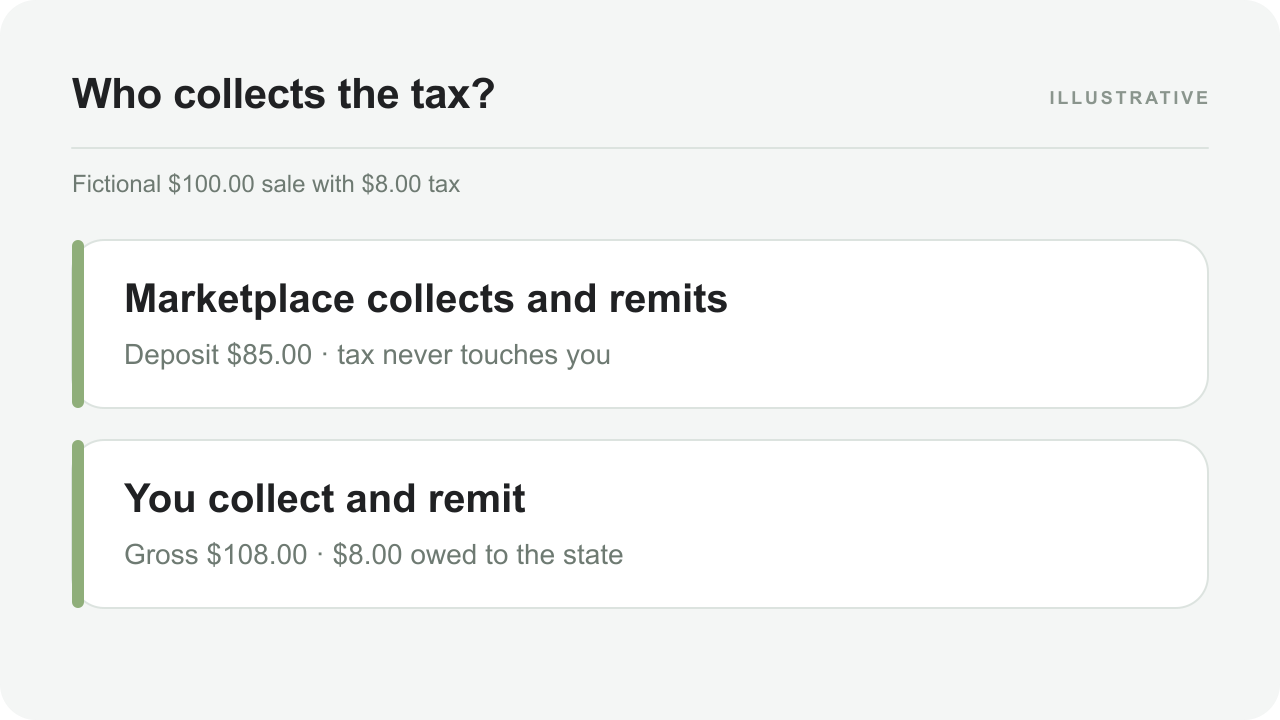
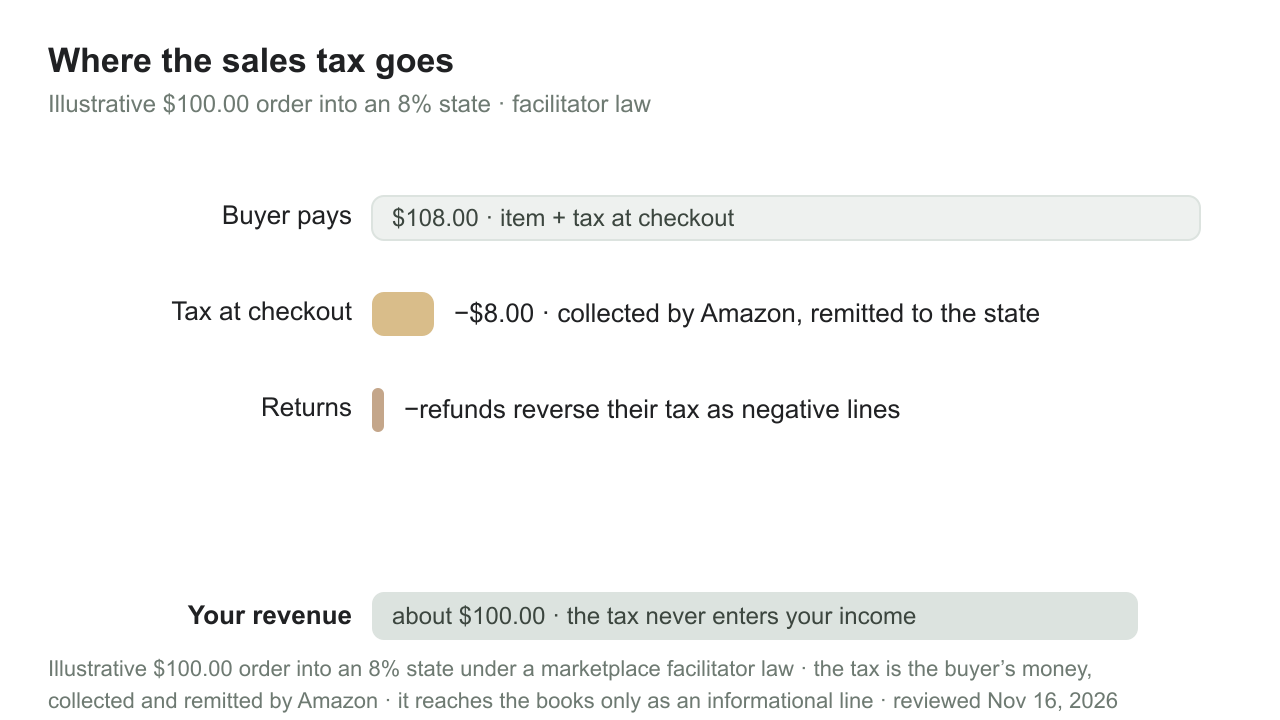
Sales tax is a pass-through tax: the buyer pays it, the seller merely carries it to the government. For most of ecommerce history the carrying was the seller's problem. Today, on Amazon, it mostly isn't. Under marketplace facilitator laws, Amazon is legally responsible for calculating, collecting and remitting sales tax on orders made through the marketplace — the buyer sees tax added at checkout, Amazon files the money with the state, and the seller is generally relieved of collecting and remitting on those orders.
The coverage question that dominated older guides is settled. In 2021 a guide could write "up to 45 states"; Kansas and Florida were recent arrivals; Missouri was a holdout. As of January 1, 2023, every state that imposes a sales tax, plus the District of Columbia, has a facilitator law in effect — Missouri's was the last. Amazon maintains the state-by-state effective dates, and the practical upshot for a marketplace-only seller is the closest thing to good news in US sales tax: the collection and remittance you'd dread is being done, by law, on your behalf.
Read the relief carefully, though, because facilitation has exact boundaries. It covers sales made on the marketplace. It does not cover your Shopify store, your craft-fair table, your wholesale invoices, or any channel without a facilitator law behind it. And it does not repeal the underlying obligation — as the next sections cover, nexus still accrues, some states still want informational reporting, and the seller remains the party a state can audit if remittance breaks somewhere in the chain. Our marketplace facilitator bookkeeping guide covers what the facilitator's tax line looks like inside your books; this guide covers everything around it.
The ruling that built this machine #
Two dates explain the whole landscape. For a quarter century, Quill v. North Dakota (1992) let states tax only sellers with physical presence — a warehouse, an employee, a store. Internet-era states watched billions in sales escape their bases, and in South Dakota v. Wayfair (2018) the Supreme Court overturned Quill: a state may require an out-of-state seller to collect tax based on economic activity alone — South Dakota's law used $100,000 of sales or 200 transactions, and the vast majority of states copied that structure. Marketplace facilitator laws arrived alongside, on the states' very reasonable logic that policing one Amazon is easier than policing a million sellers. Economic nexus is the obligation; facilitation is the states' chosen shortcut for marketplace orders. Both exist at once, which is exactly why "Amazon handles it" is only half a sentence.
Economic nexus: the obligation that survives facilitation #
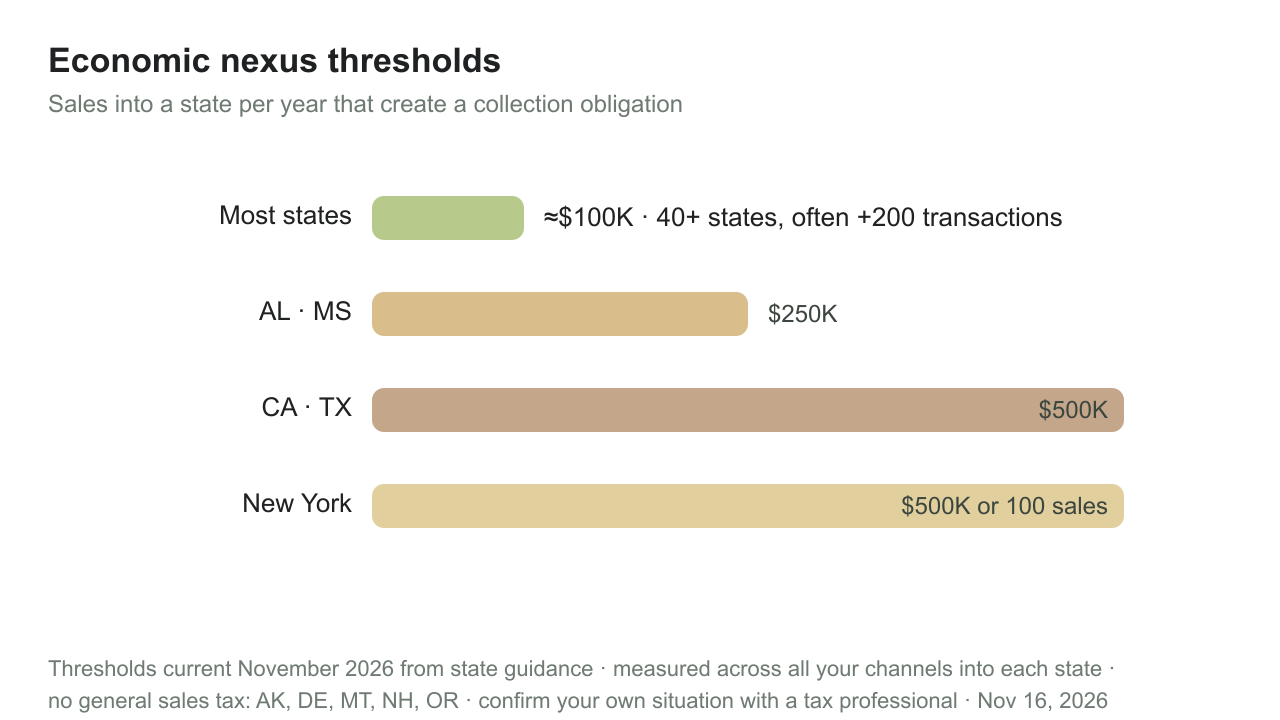
Nexus is a significant connection to a state that gives it jurisdiction to tax you. Under economic nexus rules the connection is your sales volume into that state, measured per state, per year, across your business — not per channel. Amazon's facilitation covers its own marketplace orders; your Shopify orders, your Etsy sales and your wholesale invoices count toward the same state thresholds, and sales to a state through any non-facilitated channel are yours to collect on once you cross.
The thresholds, current as of November 2026:
| Trigger | States |
|---|---|
| $100,000 of sales into the state in a year (many add: or 200 separate transactions) | The standard in roughly 40+ states — the default assumption |
| $500,000 of sales | California, Texas |
| $500,000, or 100 transactions | New York |
| $250,000 of sales | Alabama, Mississippi |
Thresholds are measured on retail sales into the state over the current or previous calendar year, with state-specific counting rules; a handful of states have no general sales tax at all (Alaska, Delaware, Montana, New Hampshire, Oregon), though local taxes exist in places like Alaska. Live table: Avalara's state-by-state economic nexus guide. Confirm your own figures with your tax professional before registering anywhere.
Two structural notes worth internalizing. First, crossing a threshold creates the obligation, and most states expect you to register and begin collecting promptly — tax collected before registration is a real problem, which is why monitoring your by-state volume matters even when a marketplace is remitting most of it. Second, facilitation and nexus interact state by state: in facilitator-law states, marketplace sales generally don't require your collection even when you're way over the threshold — but the moment any of that volume moves to a non-facilitated channel, the accumulated nexus is already there waiting.
FBA inventory: the nexus you never visited #
Physical presence still creates nexus exactly as it did under Quill — and FBA means Amazon warehouses your inventory across the country. Send a replenishment to FBA and cases of your product can sit in facilities in states you have never entered, each placement a physical nexus event under the traditional doctrine. Pre-Wayfair this was the famous FBA sales-tax trap; post-facilitation, its bite on marketplace orders has mostly been soothed, because those storage states' laws have Amazon remitting on the marketplace sales anyway.
It still matters at the edges, and the edges are where sellers get surprised: non-facilitated sales into storage states (your own website shipping from an FBA-like 3PL, wholesale to a distributor's warehouse there), state-level inventory and franchise-type taxes that key off property stored in-state, and any state where the facilitator law's scope doesn't cover a sale type you made. The practical discipline: pull your FBA inventory placements from Seller Central's inventory reports at least annually, know which states hold your goods, and hand that list to your tax professional alongside your by-state sales. The facilitator guide shows what those states' tax lines look like on your settlements.
Your Seller Central tax settings #
Amazon's tax machinery mostly runs itself, but three controls belong in every seller's checklist — with the caveat that Seller Central's labels move over time, so treat the locations as approximate and the functions as the point:
- Tax settings and collection obligations. Under Settings → Tax Settings, Seller Central displays your tax collection obligations by state and the registration numbers (if any) on file. Review it at least yearly: a state you've never registered in showing an obligation you didn't expect is exactly the signal to check your volumes.
- The Amazon Tax Exemption Program (ATEP). Qualifying buyers — resellers, nonprofits, government bodies — can carry exemption certificates on their Amazon account, and exempt orders come through without tax. Your job is upstream of the checkout: keep product tax codes right so exempt and taxable products behave correctly, and keep your own records of exempt sales.
- Product tax codes. Every ASIN maps to a tax code that tells the checkout whether the product is standard-taxable, exempt, or a special category (food, clothing in clothing-tax states, and so on). Mis-coded products mis-charge buyers in every self-calculated context — and muddle any reporting you do. The tax-code audit is boring and prevents real refunds.
A note on Amazon's Tax Calculation Service: it exists for contexts where you are the collector — certain sale types and configurations where facilitation doesn't apply and Amazon still computes the rate at checkout on your behalf. If your setup shows a "calculation service" fee line on settlements, that's this service doing your calculating; keep the registration story for those sales straight, because calculated-by-Amazon is not the same as remitted-by-Amazon.
Verify the remittance, don't assume it #
Here is the discipline this site exists to teach, applied to tax: the fact that a law assigns remittance to Amazon does not mean a seller stops looking. The verification loop is cheap and monthly:
- See what was collected. Seller Central's sales tax reports (and the settlement report's facilitator tax lines, named with a MarketplaceFacilitatorTax-style prefix) show tax collected by state and period. These lines ride beside your sales and fees on every settlement — the facilitator bookkeeping guide shows the entry pattern.
- Tie collection to the period. Sales tax belongs to periods, not payouts. A settlement straddling a month end mixes two months' tax; keep the split rule you use for sales consistent for tax (the settlement booking guide writes that rule down).
- Watch returns unwind tax. Refunded orders reverse their tax the way they reverse their commission — expect negative tax lines and make sure filings and reports reflect them rather than burying them.
- Confirm the state agrees. For states where you hold registrations (home state, non-facilitated exposure), reconcile your records against the account's filing history annually. Facilitator remittance reports exist for states that require Amazon to report facilitated sales to them — and several states, Missouri for one, expect sellers to keep reporting facilitated sales informationally on their own returns.
None of this is heavy: it is one report, one reconciliation note, once a month. It turns "Amazon handles sales tax" from an assumption into a fact you can show — to a state auditor, to your tax preparer, or to yourself at 1 a.m.
TidyPayouts splits every settlement into sales, fees, refunds and tax lines — facilitator tax stays out of your income and visible on its own, every month.
Filing: registrations, frequencies, informational returns #
The filing layer is where facilitation changes least and sellers assume most. The state of play:
- Where you're obligated on non-facilitated sales, you register, collect, and file. Registration comes with a permit number; collecting on a permit you don't hold is the classic unforced error. Most states want the registration before or immediately at threshold-crossing.
- Where only facilitator-covered marketplace sales exist, most states don't require you to file — Amazon's remittance satisfies the obligation. The exceptions matter: some states (Missouri is the clearest current example) expect sellers to report facilitated sales informationally on a return even though no tax is due from the seller, and home-state rules can pull your own-state sales back to you depending on the law's design.
- Frequencies are assigned, not chosen. States start filers on annual or quarterly schedules and promote heavy sellers to monthly; due dates cluster in the middle of the month after the period closes, with state-by-state variation that the state's department of revenue owns. The assignment is volume-based, so the same growth that crosses nexus thresholds also accelerates your filing calendar.
- Zero-sales returns still get filed for registrations you hold — an active permit expects a return for every period even with nothing to remit, and unanswered zero periods compound into notices.
The working habit: a one-page compliance calendar — every registration you hold, its frequency, its next due date — reviewed quarterly alongside the by-state sales report from the nexus section. Sellers who keep that page never meet the surprise version of this topic.
When it went wrong before you noticed #
The most common real-world situation is not active evasion; it is a seller whose 2019–2022 self-collected obligations outgrew their attention, or whose non-Amazon channel crossed a threshold unnoticed. The fix has a shape, and it is a professional-shaped one:
- Quantify first. By-state sales by year, channels split, nexus status per state at each point in time. The same settlement-report discipline this blog teaches reconstructs history from reports rather than memory.
- Voluntary disclosure agreements (VDAs) are the standard remediation path: a state-processed agreement that typically limits the lookback period (commonly a handful of years), abates most penalties, and requires forward compliance. Many states accept them through the Multistate Tax Commission's national program, one filing covering several states at once. Disclosure made before a state contacts you is the difference between a negotiated cleanup and an audit with teeth.
- Then forward-comply: registrations, tax settings, the monitoring loop from the earlier sections. Remediation without a monitoring loop is a repeat with extra steps.
Nothing in this paragraph is DIY guidance — VDA terms are negotiable and state-specific, and this is squarely a "hire the specialist" territory, the same division of labor as the accountant guide describes. What the seller supplies is the clean data.
The books treatment #
Sales tax's bookkeeping rule is one sentence long and eternal: collected tax is never your income, and remitted tax is never your expense. The implementations:
- Facilitator-collected marketplace tax rides your settlement as its own line and exits with it — it is never posted as revenue and never posted as an expense. It should appear in your books, if at all, only as an informational note, so the sales figure the P&L carries is the tax-exclusive number the tax professional needs.
- Self-collected tax (your own site, non-facilitated channels) lands in a dedicated sales tax payable liability account at collection, sits there per period, and leaves when the return is filed. Booking it as income overstates revenue; booking it as an expense understates nothing but muddles everything.
- Returns reverse tax symmetrically — a refunded order's tax comes out of the payable account (self-collected) or appears as a negative facilitator line (marketplace), and filings must net them rather than ignore them.
- The audit trail is the reports. Settlements for marketplace tax, the sales tax report for detail, filings for self-collected — kept per period, the way every guide in this series keeps its settlement files. When a state asks, the answer is a folder, not a reconstruction.
The full entry-level walkthrough — settlement lines, account structure, the facilitator tax line's exact behavior — lives in our marketplace facilitator sales tax guide. The tax-facing obligations in this guide and the bookkeeping in that one are two halves of the same discipline.
Common questions #
Does Amazon collect sales tax for me everywhere?+
On marketplace orders, in every US state that has a sales tax plus DC — facilitator laws have been complete nationwide since January 1, 2023, when Missouri took effect. What it does not cover: sales your business makes off the marketplace — your own website, in-person sales, wholesale, or channels without facilitation — which follow the ordinary nexus and collection rules.
Do I still need a sales tax registration if Amazon remits everything?+
For marketplace-only sellers with no other channels, most states do not expect a registration for facilitator-covered sales. Registration becomes necessary when you make taxable sales through non-facilitated channels into states where you have nexus, and a few states ask for reporting or registration in other circumstances. Home-state obligations also apply on top. Map your channels and volumes with a tax professional before assuming either way.
What is economic nexus and how much triggers it?+
Economic nexus is a state's power to tax you based on sales volume alone, no physical presence needed — established by South Dakota v. Wayfair (2018). The standard trigger is $100,000 of sales into the state in a year, often with a 200-transaction alternative; California and Texas sit at $500,000, New York at $500,000 or 100 transactions, Alabama and Mississippi at $250,000. It is measured across your whole business into each state, not per channel.
Why does FBA inventory create tax obligations in states I've never set foot in?+
Physical presence still creates nexus, and inventory inside an Amazon fulfillment center is physically present in that state. Facilitator laws have mostly soothed the effect for marketplace orders, but placements still matter for non-facilitated sales, informational filings, and certain state-level inventory taxes. Pull your FBA placement history annually and hand it to your tax professional with your by-state sales.
How do I verify Amazon actually remitted the tax it collected?+
Three sources, monthly: the settlement report's facilitator tax lines (named with a MarketplaceFacilitatorTax-style prefix), Seller Central's sales tax reports with per-state totals, and — for states where you hold registrations — the state's own account view of what it received. Also watch returns reverse their tax as negative lines. The loop costs minutes and turns an assumption into a documented fact.
Do I have to file sales tax returns if Amazon remits on my marketplace sales?+
In most facilitator-law states, no filing is required from the seller for those covered marketplace sales. The exceptions: states like Missouri expect sellers to report facilitated sales informationally on their own returns; states where you hold registrations expect returns every period even at zero; and your home-state or non-facilitated-channel obligations are unchanged. Keep a compliance calendar of every registration you hold.
What is the Amazon Tax Exemption Program?+
ATEP lets qualifying buyers — resellers, nonprofits, government bodies — attach exemption certificates to their Amazon account so exempt orders check out without tax. The seller-side work is keeping product tax codes accurate and retaining records of exempt sales. Exempt or mis-taxed orders still generate support traffic, which is why the tax-code audit belongs in your checklist.
I ignored sales tax in past years. What do I do now?+
Quantify first: by-state sales by year and channel, rebuilt from reports. Then use voluntary disclosure agreements — the state-processed path that typically limits the lookback and abates penalties, available for several states at once through the Multistate Tax Commission — before the state contacts you first. This is specialist territory: the seller's job is clean data, and the tax professional's job is the negotiation. Then install the monitoring loop so it never recurs.
Sources and review date #
Written November 16, 2026. Sales tax rules are state law and change; the threshold and facilitation figures here were checked against the sources below but are not tax advice — confirm your own situation with a tax professional before registering, filing or remitting anything.
- South Dakota v. Wayfair (2018) — case summary
- TaxJar: marketplace facilitator laws by state
- Streamlined Sales Tax Governing Board: marketplace facilitator guidance
- Sales Tax at Scale: facilitator rules by state
- Avalara: economic nexus by state guide
- Missouri DOR: marketplace facilitator FAQ
- IRS: understanding your Form 1099-K