Tidy
In this article
- The specialty is real: settlements that bundle sales, fees, refunds and reserves do not book themselves, and a generalist learning on your file bills you for the education.
- Most sellers need less than the ads suggest: clean books are a software-plus-review routine, a tax professional is usually separate, and the two roles are priced differently.
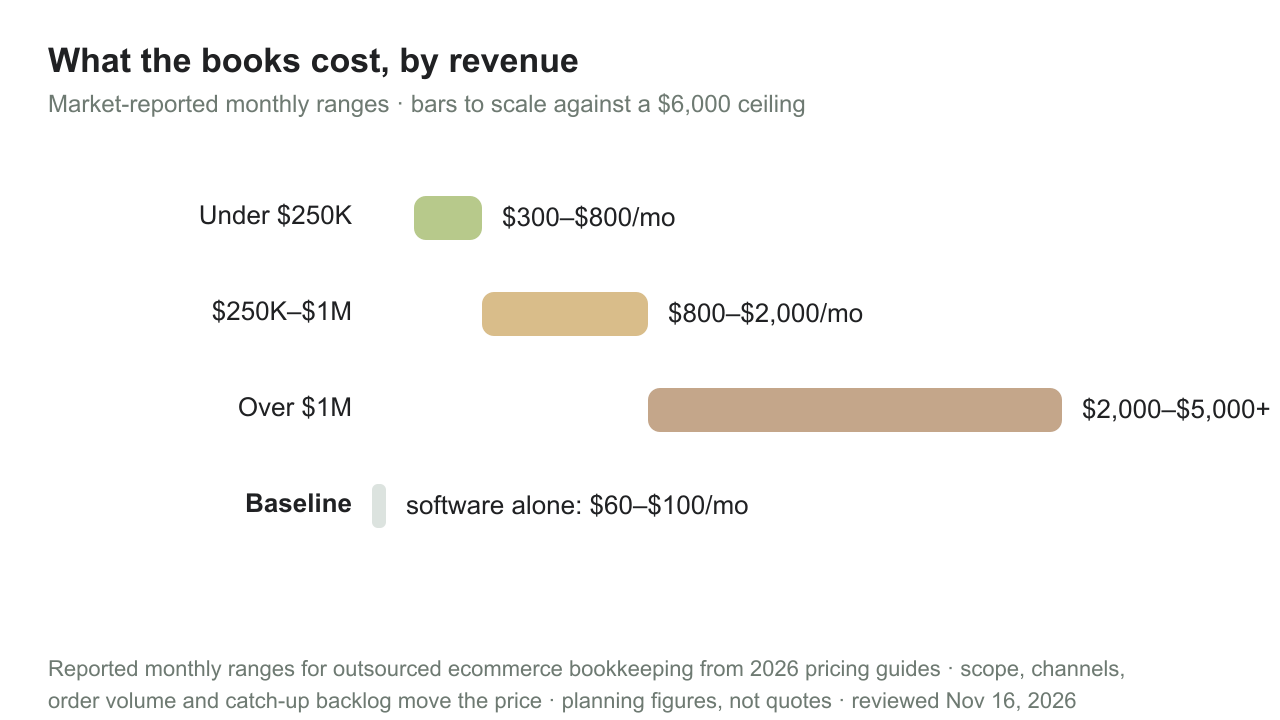
- Market-reported monthly pricing runs roughly $300–$800 under $250K revenue, $800–$2,000 to $1M, and $2,000–$5,000+ above — driven by channels, order volume and backlog, not revenue alone.
- Verify any CPA license yourself on CPAverify, ask to walk through one real settlement on the call, and pay for catch-up work as its own written scope.
What the work actually is, month to month #
Marketing copy makes “Amazon accountant” sound like a job title. It is really a bundle of five distinct deliverables, and knowing which ones you are buying is the difference between paying for value and paying for a logo on an invoice. A competent month looks like this:
| Deliverable | Cadence | What you should receive |
|---|---|---|
| Settlement closes | Every payout | Each settlement booked with sales, refunds, fee buckets, reimbursements and reserve movements separated, tied to the bank deposit to the penny |
| Month-end close | Monthly | A reconciled profit and loss statement and balance sheet, with every account tied to a statement or report |
| Margin reporting | Monthly | Profit by SKU or product line after fees, so pricing decisions rest on numbers rather than the Seller Central dashboard |
| Sales tax verification | Quarterly | Confirmation that marketplace-collected tax stayed out of your income, plus a nexus check as you add states or channels |
| Tax positions | Annual, with check-ins | Estimated tax amounts, entity and basis questions, the return itself — usually a different professional from the bookkeeper |
The first two are bookkeeping: mechanical, monthly, and exactly the kind of work that good software collapses from hours into minutes. The third is where an ecommerce specialist earns their premium, because fee-by-fee margin is invisible in a generic books-only P&L. The last two are tax work, and they are licensed and priced separately for a reason.
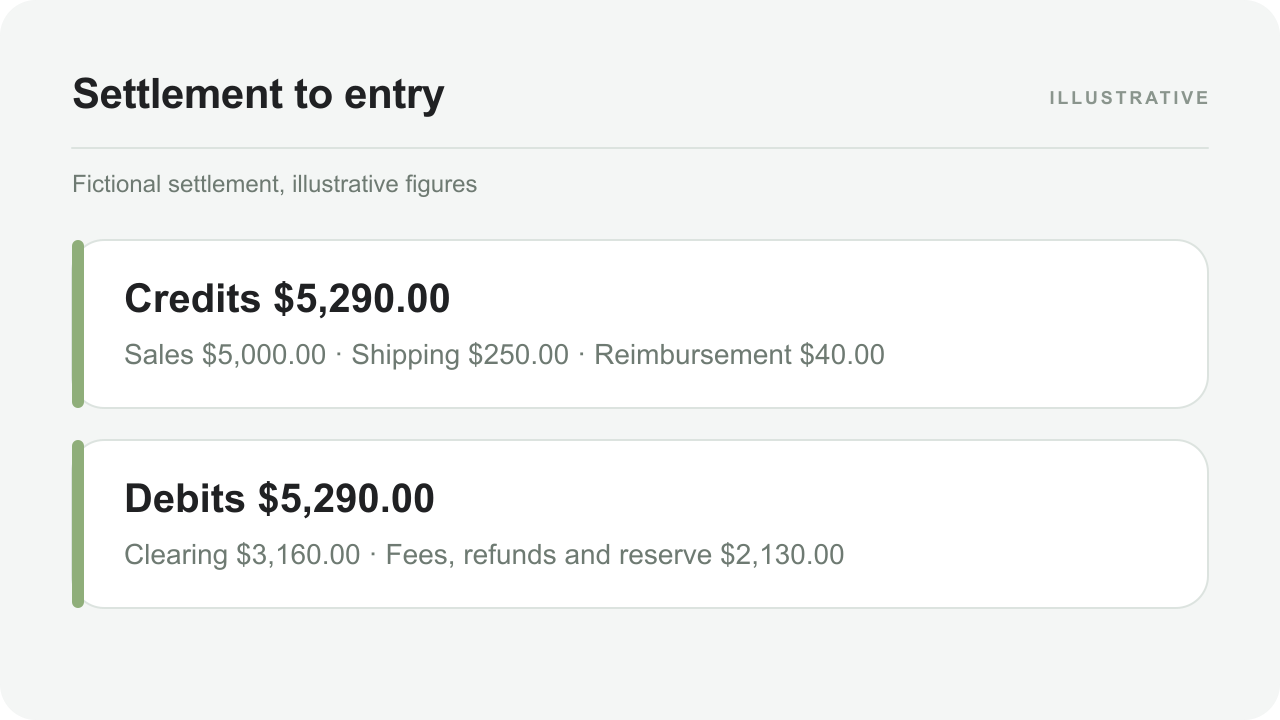
Amazon makes the first deliverable genuinely specialist. A settlement is one bank deposit carrying hundreds of lines: sales, shipping, promotions, refunds, reversal lines for each fee, reimbursements, storage, and reserve movements — and the settlement period usually crosses the month end, so a written rule decides which month owns the sales. Our settlement booking guide walks the entry line by line, and the deposit versus sales guide shows why the deposit total never equals your sales number.
The four ways to buy the work #
Almost every offer in the market is some mix of four models, and clear-eyed hiring means knowing which one you are looking at:
- Software plus your own hours. A payout tool groups settlements, drafts entries, and matches deposits; you review and approve. Cheapest in cash, most expensive in attention. See the division of labor below.
- A freelance bookkeeper. A person executes the monthly close using your stack. Prices lowest; quality varies most; tax filing usually excluded.
- A specialist ecommerce firm. A team with a documented settlement-to-books process, often bundled with inventory and multi-channel handling. The premium buys process, not just effort.
- A CPA or enrolled agent, for tax. Licensed for tax positions, elections and representation. Many also sell bookkeeping; some excel at it. The license certifies tax competence, not ecommerce bookkeeping skill — check the bookkeeping separately.
Most sellers at modest scale buy the first and fourth, and hire the second or third only when volume or complexity stops the first from staying clean. The failure mode is buying the fourth while believing you bought the first — paying CPA rates for work that software now does.
When you don’t need one yet #
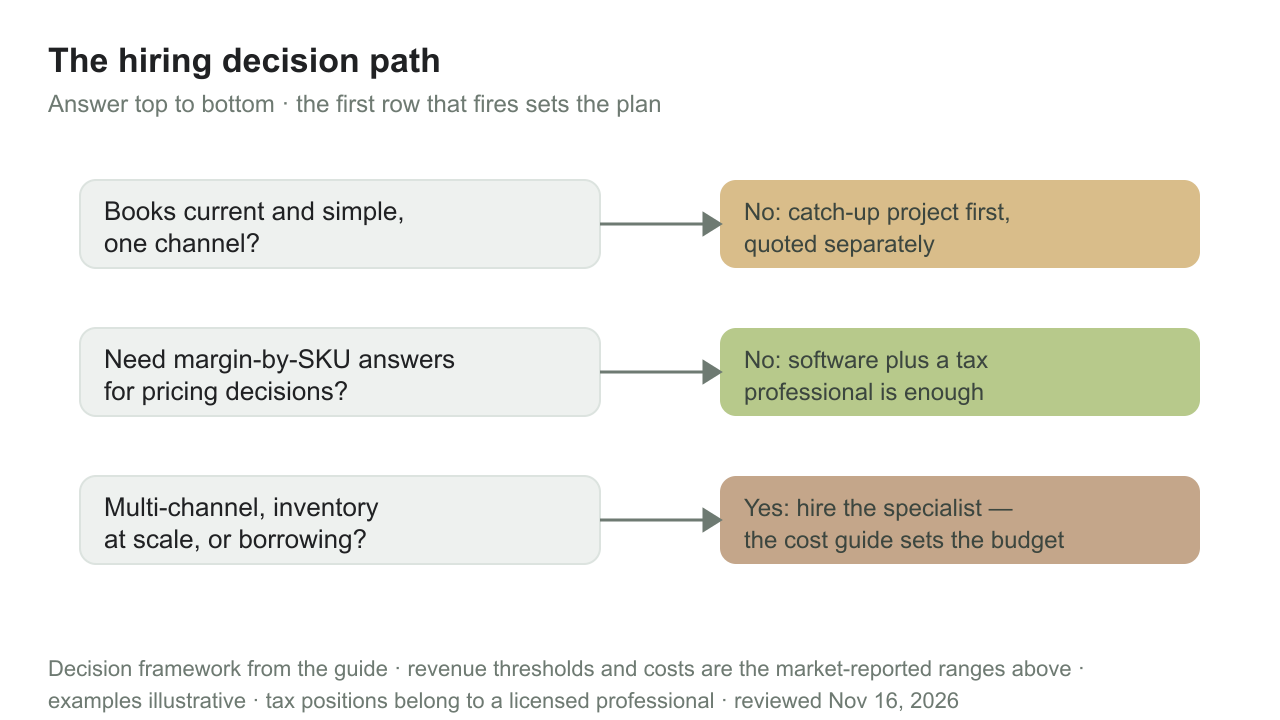
An honest guide to hiring starts with the case against it. If you sell on one channel, generate a handful of settlements a month, run a simple single-member entity, and your books are current, the mechanical work is well inside what software plus a weekend routine handles — the routine is the month-end close checklist, and the entry is the one in the settlement booking guide.
What the DIY zone never removes is the tax layer. Accurate records remain your obligation regardless of who touches the keyboard, estimated taxes are pay-as-you-go with quarterly deadlines on the IRS calendar, and business income and expenses live on Schedule C (or the equivalent partnership or corporate returns). Publication 334 is the IRS’s plain-language guide to the whole subject. The DIY zone is legitimate precisely because the record-keeping is now the easy part — not because the tax obligations went anywhere.
Software also cannot exercise judgment. Entity elections, inventory accounting methods, basis questions, nexus studies, representation in an audit: these are decisions with years of consequence, and no payout tool makes them for you. The right posture is honest division — let software do the mechanics, and buy human judgment in the narrow slices where judgment is actually the product.
Six signals it’s time #
The signs worth acting on are the ones you can put a number on:
- Your profit number moves after a cleanup. If restating one quarter shifts net income by more than a rounding error, the books were wrong — and every decision made on them was made on the wrong number.
- You price from a margin you can’t trace. When “what does this SKU actually earn?” takes a spreadsheet afternoon and still ends in an estimate, fee-level reporting has fallen behind the business.
- A lender or buyer asks for statements and you flinch. Loans, credit lines and exits all begin with two years of reconciled statements. Producing them retroactively is the most expensive bookkeeping there is.
- Books fall more than a quarter behind. One missed month is a to-do; a missed quarter is a project with a price tag. Catch-up work is real money — get it quoted before it compounds.
- Tax prep is an archaeology project. If your preparer reconstructs the year from Amazon reports every spring, you are re-buying your bookkeeping annually at CPA rates instead of monthly at bookkeeper rates.
- Complexity landed that software alone won’t hold. A second channel, a first hire, inventory in a 3PL, a currency, a state tax registration — each adds a reconciliation loop a solo routine tends to drop.
One signal is not on the list: growth in revenue alone. Doubling sales on one channel with the same settlement rhythm does not change the mechanical work much. Complexity changes it; revenue by itself mostly changes the value of getting it right.
What it costs #
Published pricing is thin — most firms quote privately — but the ranges that circulate from firms and service-marketplace surveys are consistent enough to plan around. Market-reported monthly ranges for outsourced ecommerce bookkeeping:
| Annual revenue | Typical monthly range | What usually sits inside the quote |
|---|---|---|
| Under $250,000 | about $300–$800 | One channel, monthly closes, basic reporting |
| $250,000–$1,000,000 | about $800–$2,000 | Multi-channel reconciliation, inventory or COGS depth, sales tax monitoring |
| Over $1,000,000 | about $2,000–$5,000+ | Full close packages, accrual conversions, advisory hours, multiple entities |
Ranges compiled November 2026 from published pricing guides and firm surveys (sources below); they vary by country, scope and order volume. Treat them as budgeting figures, not quotes, and get scope in writing.
Hourly anchors put the tiers in context: outsourced bookkeepers commonly bill in the $25–$90 per hour band depending on seniority and market, while CPA time for tax work clusters far higher — one trade-association survey reported an average near $180 per hour for individual tax work, with overall CPA rates ranging roughly $150–$450. Preparing a Schedule C return as part of the personal 1040 is commonly quoted around $400–$1,200 depending on complexity. None of these are quotes; they are the landscape the quotes live in.
What actually moves the price: number of channels and marketplaces, order volume (transaction count, not revenue), how far behind the books are, the number of entities, currencies, and whether inventory and COGS need real accounting rather than a shortcut. Note what is absent from that list — Amazon settlement volume itself is a commodity. A seller with 30 clean settlements a month through good software can cost less to serve than one with five settlements and a year of backlog, and quotes tend to reflect that.
Three pricing shapes deserve caution. A quote with no written scope, so every “extra” is a change order. Per-transaction pricing with no cap, which quietly taxes growth. And anything dramatically below the range, which usually means unpriced catch-up later — the backlog reappears as a surprise invoice during your first tax season.
Where to actually look #
The software vendors’ partner directories are one aisle of the store, not the whole store. In rough order of usefulness:
- Referrals from sellers at your scale. A recommendation from someone whose channel mix and volume resemble yours beats any directory filter — the seller has already run the vetting for you. Seller communities and mastermind groups surface these constantly.
- Licensed-professional lookups. NASBA’s CPAverify confirms that a person claiming to be a CPA actually holds a current license, and in which state. Most state CPA societies run their own member directories, which are the traditional referral network and remain useful.
- Platform advisor directories. QuickBooks’ find-a-pro and the Xero advisor directory list practitioners by platform certification and specialty. Filter for inventory or ecommerce experience, then verify everything else yourself — directory badges certify software familiarity, not settlement literacy.
- Your own stack’s partner network. Most tools in this space — payout processors, inventory systems, accounting platforms — maintain partner lists of firms that work with their exports. If you already run one, its partners have seen your exact data shape before.
- Fellow operators in adjacent niches. If your accountant runs three other FBA clients, they know the fee codes. Ask candidates directly how many marketplace clients they hold and on which platforms — a fair question that good firms answer precisely.
However the name arrives, the first screen is the same: a specialist names channels, reports and fee buckets unprompted. A generalist says “ecommerce” and pivots to the subscription tier of their software stack.
Five questions that separate specialists from generalists #
Most checklists hand you questions and wish you luck. These five come with the answers that should raise or lower your eyebrow:
- “Walk me through how you’d book one Amazon settlement.” A specialist narrates it: group the lines into sales, shipping, promotions, refunds, fee buckets, reimbursements and reserves; post one balanced entry to a clearing account; match the deposit; write a rule for the month-end split. A generalist says “we import the bank deposit.” If the clearing account doesn’t come up in the first minute, keep looking — the guide to why is in our clearing account walkthrough.
- “Which Seller Central reports do you actually pull, and when?” A specialist names the settlement or transaction views, the date ranges, and how they tie the payout to the bank. A generalist says “whatever Amazon sends us.”
- “How do you keep marketplace-collected sales tax out of my income?” The right answer acknowledges that facilitator laws shift the remittance to the marketplace but leave the verification with you — the books must exclude the collected tax, and nexus still needs monitoring. The wrong answer is “Amazon handles the taxes now.” Our facilitator tax guide covers the distinction.
- “What exactly lands in my inbox at month end, and by when?” Strong: reconciled P&L and balance sheet, a payout-to-bank tie-out, margin by product line, and a short notes file of judgment calls, on a fixed day. Weak: “reports whenever you need them.”
- “Who signs the tax return, and who is my day-to-day contact?” Strong answers name both, and the signer’s license checks out on CPAverify or the equivalent directory for enrolled agents. Weak answers say “the team” — which can mean the licensed partner you met never touches the file.
A twenty-minute call covering those five tells you more than any badge. Ask for one anonymized client deliverable if the answers are promising; firms proud of their close process show it.
Red flags when hiring #
- Outcome guarantees. “Audits will never be a problem” is not a service; audits depend on your records and the IRS. Confidence is fine, guarantees about third parties are not.
- No written scope. If the engagement letter doesn’t enumerate deliverables, channels and the monthly cutoff day, every future disagreement is unwinnable.
- Can’t describe a settlement period cut. This is the single most Amazon-specific mechanic in the whole job (see the cash versus accrual guide for why). If the sales call fumbles it, the file will too.
- All-or-nothing access. Legitimate work needs read access to accounts and reports. Demands for your master Seller Central login — instead of a sub-user permission — or unilateral control of your bank deserve a hard no.
- Priced only against competitors. “We’re cheaper than X” with no scope is a race to the thinnest file. Price follows from scope; scope should come first.
- Vague on who does the work. A slick sales call feeding an offshore team nobody described is not disqualifying by itself — plenty of firms do this well — but you should hear the structure plainly and meet the working preparer before signing.
The handoff pack #
Whatever the engagement costs, a disorganized handoff inflates it. Assemble this before the kickoff call and the first month runs on schedule:
- The last two or three years of filed returns.
- Current books access — login or accountant invitation — plus the existing chart of accounts, or an export of it. (If you don’t have one worth exporting, the chart of accounts generator produces a marketplace-shaped starting point.)
- Read access to bank and credit card feeds, granted as view-only.
- A Seller Central sub-user permission for reports — never your master login.
- Downloaded settlement report history for at least the current year.
- Credentials or invites to anything already automating payouts, and a note of what it does and doesn’t handle.
- Your inventory or COGS method in one paragraph, and a list of open questions you already know about.
- The prior accountant’s contact, if any, and anything mid-flight — extensions, notices, filings in progress.
The pattern: give them systems and history, not just passwords. Every hour they spend excavating is an hour you pay for at specialist rates.
The first 90 days #
Engagements fail from misaligned expectations more than from incompetence, so write the shape of the first quarter down:
- Days 1–30: cleanup and baseline. Accounts reconciled through the latest statements, prior-year adjustments identified, the settlement mapping documented. If a backlog exists, this phase is quoted separately — insist on it.
- Days 31–60: the first real closes. Months closed on the documented mapping, deliverables arriving on the promised day, restated comparisons where the cleanup changed history.
- Days 61–90: rhythm and the first advisory pass. Close hits its monthly slot without chasing; the first margin report lands; estimated-tax amounts are checked against actual profit rather than last year’s guess.
“Caught up” has a precise meaning worth agreeing on in advance: every account reconciled to a statement or report through the most recent period, with a written list of any items deliberately left open. Anything vaguer invites the backlog to survive invisibly under the new relationship.
TidyPayouts reviews every payout before it posts — sales, refunds, fee credits and fees by type on separate lines, matched to the bank. Specialists bill fewer hours when the mechanics are already done.
Software versus human: the division of labor #
The reliable way to pay less for accounting is not to find cheaper humans — it is to move the mechanical work out of human hands entirely. Settlement grouping, deposit matching, fee categorization and the period cut are rule-based; software that does them consistently does them cheaper than any hourly rate, and without the transcription errors humans contribute under repetition.
What stays stubbornly human: judging the mapping when a new fee type appears, deciding whether an adjustment is income or recovery, the tax positions, entity questions, and the advisory read of the margin report. Those hours are scarce and worth their rate; data entry is neither.
TidyPayouts occupies exactly that division: it splits each payout into reviewable lines, matches the deposit to your bank, and posts nothing without your approval — the software half of the pair, priced like software (free during beta; the Amazon to QuickBooks guide shows the workflow, and our bookkeepers page shows how practitioner firms use it). Whatever you spend on the human half, spending it on judgment instead of keying is the better trade.
The same logic prices the DIY zone: at small scale the software is nearly free and your hours are the only cost; at larger scale, the honest comparison is specialist hours on judgment with software beneath them versus specialist hours on everything. The first column is smaller at every size.
A worked decision: the $40,000-a-month seller #
Three ways to staff the books, illustrated
A seller grossing $40,000 a month on Amazon alone ($480,000 a year), sole member LLC, current books, QuickBooks Online already running. Illustrative figures throughout.
Route 1 — software plus your hours. A payout tool plus the QBO subscription runs on the order of $60–$100 a month, and the close is two to four hours a month of your time. At a seller’s own effective hourly value of even $50, that is $160–$300 a month of real cost, and the tax preparer is still separate.
Route 2 — freelance bookkeeper for the close. Inside the reported $300–$800 band for this revenue tier, say $500, with the seller still reviewing and a tax professional separate at roughly $400–$1,200 for the annual Schedule C. Total cash: roughly $6,400–$10,800 a year.
Route 3 — specialist ecommerce firm with tax included. The reported band widens here, say $1,000–$1,800 a month bundling closes, sales tax monitoring and return prep — call it $12,000–$21,600 a year. The premium buys the margin reporting and the coordination that Route 2 leaves to you.
The honest arithmetic is not “which is cheapest” but “which column does my time belong in.” Route 1 prices your attention at nearly zero; Route 3 prices it at the value of whatever you’d do instead. Sellers between $250K and $1M most often land on Route 2 with software beneath the bookkeeper — the pairing this whole guide has been quietly describing.
Read the numbers as ratios, not absolutes: bookkeeping at $500 a month is 1.25% of this seller’s revenue; at $1,800 with tax bundled it is 4.5%. If margin reporting changes even one pricing decision a quarter, the specialist column can pay for itself — but only if the deliverables in the first table actually arrive.
Common questions #
Can any CPA handle an Amazon business?+
Legally yes — the license is general. Practically, settlement mechanics, fee-level margin and facilitator-era sales tax are learned specialties, and a generalist learning them bills you for the education. Ask the five vetting questions; the license tells you the tax layer is covered, not the books.
Do I need a bookkeeper, an accountant, or both?+
Most sellers need both roles at different times, not both at once. The bookkeeper (or software doing the mechanical work) keeps records current month to month; the CPA or enrolled agent takes the tax positions and files the returns. Hiring one person who does both well is a bonus, not a requirement.
How much should I expect to pay for monthly Amazon bookkeeping?+
Market-reported monthly ranges run about $300–$800 under $250K revenue, $800–$2,000 from $250K to $1M, and $2,000–$5,000+ above, with channels, order volume, entities and catch-up backlog moving the price. Hourly anchors: bookkeepers roughly $25–$90, CPA time roughly $150–$450. Get scope in writing and treat published ranges as budgeting figures, not quotes.
Can software replace the accountant entirely?+
Software replaces the mechanics — grouping settlements, matching deposits, drafting entries — and at modest scale that can be the whole mechanical job. It cannot take tax positions, make entity or method elections, or represent you in a dispute. The durable pattern is software beneath a human, with the human’s hours spent on judgment.
What should I hand a new accountant on day one?+
Filed returns for the last two or three years, books or chart-of-accounts access, read-only bank feeds, a Seller Central sub-user for reports (never your master login), a settlement report history download, notes on your inventory method, and anything mid-flight from a prior provider. Systems and history, not just passwords.
Will a new accountant clean up past mistakes?+
Only if cleanup is in the scope — and it should be a separate, written, priced phase. Catch-up and restatement are the most labor-intensive work in the engagement; bundling it invisibly into a monthly fee produces surprise invoices, while scoping it produces a number you can accept or shop.
Do I need an accountant in my own state?+
Remote service is the norm in this niche and the work is not state-bound. What matters is verification and fit: a CPA’s license is checkable on CPAverify regardless of where they sit, the tax preparer must be comfortable with your nexus states, and what you lose in proximity you gain in marketplace depth. Confirm data handling and who signs the return.
Are accountant fees tax deductible?+
Generally yes for a business — accounting and bookkeeping fees are ordinary and necessary expenses of running it, deductible on the business return the same way selling fees are. Legal and tax advice on matters with long-term structure can have different treatment, so confirm allocations with your tax professional. Our 1099-K guide explains how marketplace reporting interacts with business income.
Sources and review date #
Written November 16, 2026. Cost figures are market-reported ranges compiled from the published pricing guides below — they change with scope, geography and volume, so treat them as planning figures and get quotes in writing. Tax questions deserve your own tax professional; examples are fictional.
- NASBA: CPAverify license lookup
- QuickBooks: find an accountant
- Xero: advisor directory
- IRS: estimated taxes
- IRS Publication 334: Tax Guide for Small Business
- IRS: About Schedule C
- Uplinq: bookkeeping cost by revenue tier (2026)
- VirtuTant: bookkeeper pricing survey
- MB Accounting Group: ecommerce bookkeeping cost
- Jarvio: cost of running an Amazon business (2026)