Tidy
In this article
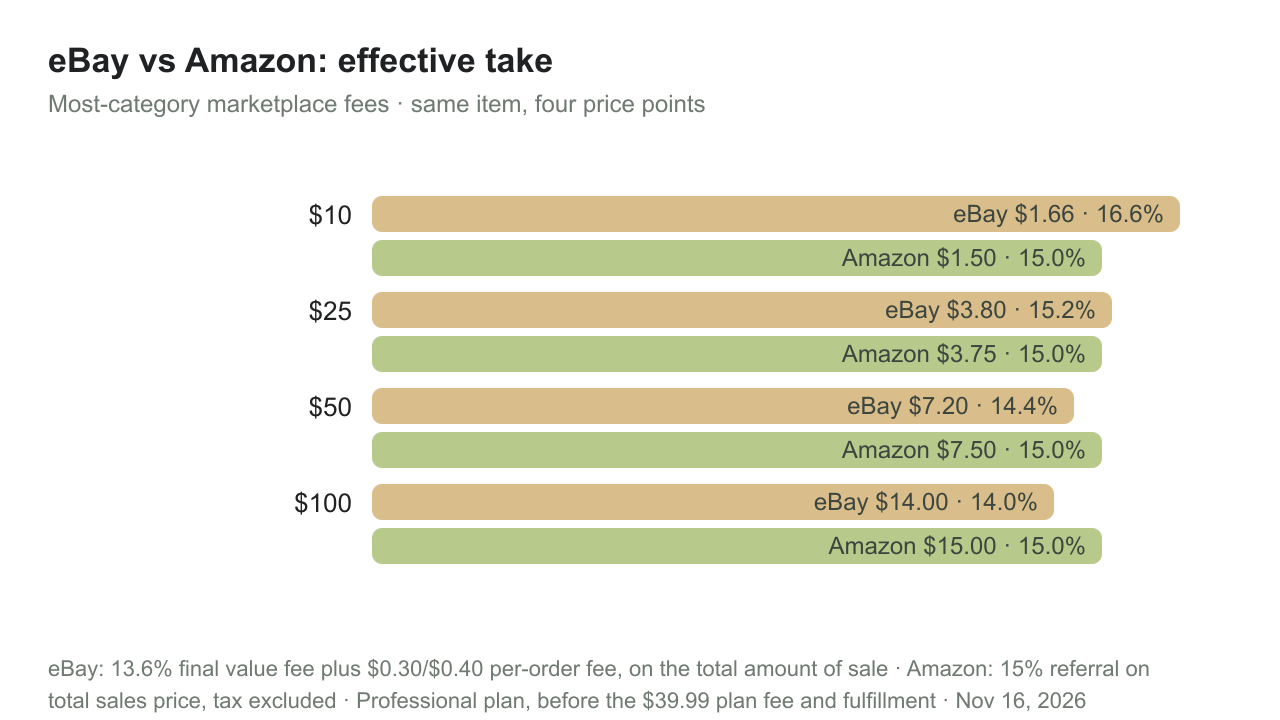
- On a typical most-category sale, eBay’s effective take (13.6% plus a $0.30/$0.40 per-order fee) sits just under Amazon’s flat 15% referral — the crossover lands around a $29 order: below it Amazon is cheaper, above it eBay is.
- The fee bases differ structurally: eBay computes on the total amount of the sale including shipping and sales tax; Amazon’s referral fee covers item price, delivery and gift wrap but excludes tax.
- eBay charges nothing to list by default and sells subscriptions that discount fees; Amazon charges a plan ($39.99/month or $0.99 per item) and has no listing fees on Professional.
- Fulfillment is where the real gap opens: FBA adds roughly $3–$15+ per unit, while eBay sellers arrange their own shipping — headline rate comparisons that ignore this mislead both directions.
Two schedules, two shapes #
The two platforms price selling in different currencies. Amazon’s schedule is a flat entry price plus a percentage: you pay for a selling plan, then a referral fee per item in most categories, and nothing else is mandatory. eBay’s schedule is à la carte: listing is free up to an allowance, every sale carries a category-rate percentage plus a small fixed fee, and an optional subscription ladder buys you lower rates and more free listings. The deep versions of each schedule live in our Amazon fees guide and eBay fees guide; this comparison condenses both to the lines that matter when you are choosing between them.
| Fee | eBay (US, most categories) | Amazon (US, most categories) |
|---|---|---|
| Entry cost | $0 — 250 zero-insertion-fee listings/month | $39.99/month (Professional) or $0.99 per item (Individual) |
| Per-sale percentage | 13.6% of the total amount of the sale up to $7,500/item, then 2.35% | 15% referral fee on the total sales price |
| Per-sale fixed fee | $0.30 on orders ≤ $10.00; $0.40 above | None (the $0.30 minimum referral acts as one on tiny items) |
| Fee base | Item + shipping + sales tax + other buyer charges | Item + delivery + gift wrap; sales tax excluded |
| Listing fees | $0.35 per listing beyond the allowance; store tiers discount | None on Professional |
| Subscription ladder | Stores $4.95–$2,999.95/month (yearly billing) | Single plan; no store-equivalent fee ladder |
| Volume discount | Yes — lower rates above price thresholds and with stores | Yes — tiered category rates (e.g. electronics 8%, PCs 6%) |
| Performance penalty | +5% to +7% surcharge when seller metrics slip | None (account health, not fees) |
| Fulfillment | Seller-arranged; eBay International Shipping optional | Self-ship or FBA (roughly $3–$15+ per unit + surcharges) |
US rates, most-categories defaults, reviewed November 16, 2026 against eBay’s and Amazon’s published fee pages. Category rates vary widely on both platforms — media, watches, jewelry, electronics and shoes all have their own lines — so run your actual category before deciding.
Read the table as two philosophies. eBay prices the transaction and stays free when nothing sells; Amazon prices the presence (the plan) and then takes a straight percentage. That philosophical difference drives almost every practical consequence below.
The fee bases differ before the rates do #
Before comparing percentages, compare what the percentage is computed on — because the platforms disagree.
eBay’s final value fee is calculated on the total amount of the sale: the item price, the shipping the buyer pays, other buyer charges, and applicable sales tax — even though eBay itself collects and remits that tax as marketplace facilitator. When a listing offers several shipping options, the fee base is even calculated on the cheapest domestic option offered, not the one the buyer chose.
Amazon’s referral fee is calculated on the total sales price: the item price plus delivery and gift-wrap charges, with taxes excluded. Same sale on both platforms, and eBay’s fee includes the tax slice while Amazon’s does not.
The consequence is easy to miss in a rate table. A $100 item with $10 shipping and 8% sales tax ($8.80) generates an eBay fee on $118.80 but an Amazon referral on $110. eBay’s “13.6%” is effectively charging on about 19% more base than Amazon’s 15% on that order. For low-ticket items in high-tax states the gap is meaningful; for tax-free-delivery categories it vanishes. Any honest comparison has to hold the base constant, which is why the worked examples below state their assumptions.
The per-sale fees, side by side #
Both platforms charge a percentage that steps down for expensive items, plus a fixed component — but the fixed components behave differently:
- eBay’s per-order fee ($0.30 ≤ $10, $0.40 above) is a flat cost per checkout, charged once per order even when the buyer combines items. It is the platform’s smallest line and its most disproportionate: on a $10 order it adds 3 points of take, on a $500 order it is noise.
- Amazon has no per-order fee on Professional — but its referral minimum ($0.30, or a per-category minimum) acts like one on the cheapest items, and on the Individual plan the $0.99 per-item charge is a per-order fee in disguise, charged per item rather than per checkout.
- Category rates diverge more than most sellers expect. eBay’s schedule has expensive tails (books/movies/music at 15.3%, watches stepping 15%→6.5%→3%); Amazon’s has cheap tech (electronics 8%, computers 6%) and expensive niches (device accessories 45%, jewelry 20% down to 5% above $250). The right platform for a category is sometimes decided by one line of the other platform’s table.
Two worked category contrasts show the range. A $15 used book: eBay charges 15.3% × $15 + $0.40 = $2.70 (18.0%); Amazon charges 15% × $15 + the $1.80 media closing fee = $4.05 (27.0%) — media is an eBay market at low prices. A $1,200 watch: eBay charges 15% × $1,000 + 6.5% × $200 = $163 (13.6%); Amazon charges 16% (under its $1,500 threshold) = $192 (16.0%) — high-ticket watches favor eBay’s earlier step-downs. Neither platform is universally cheaper; the tables cross constantly.
The same item on both platforms #
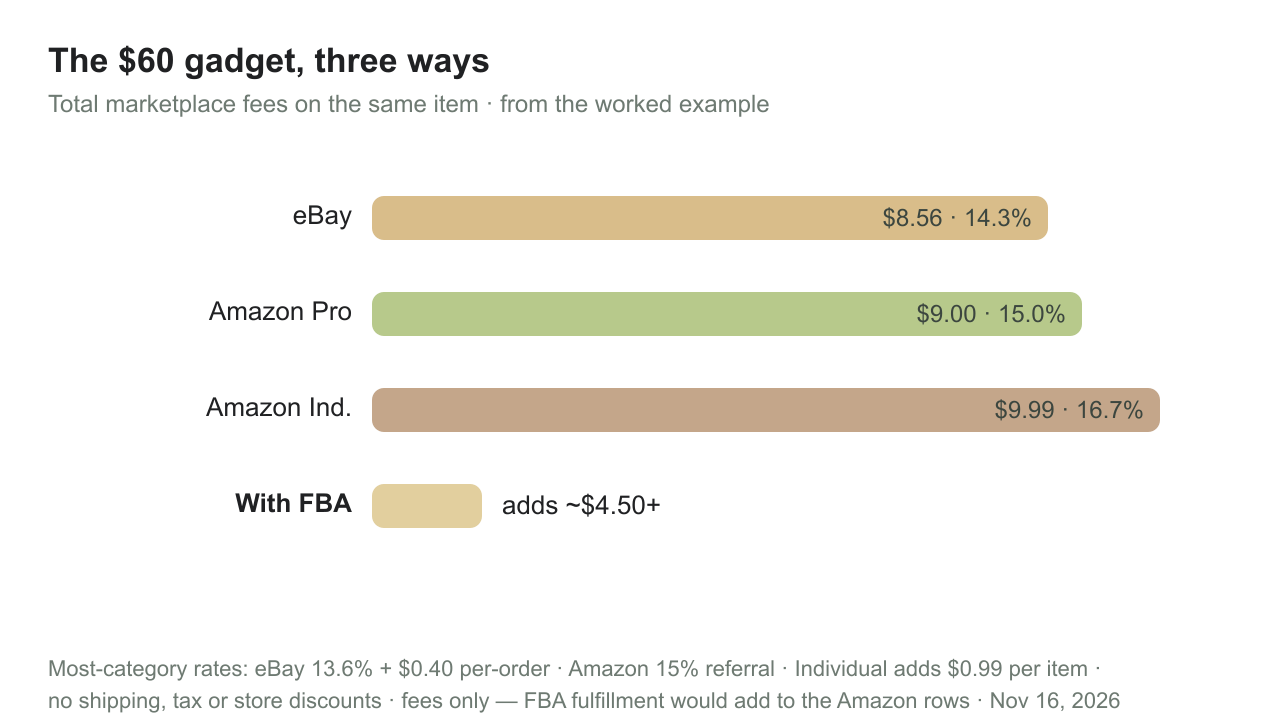
A $60 kitchen gadget, three ways — fictional
eBay, most categories: 13.6% × $60 + $0.40 per-order fee = $8.56 — an effective take of 14.3%.
Amazon, Professional plan: 15% × $60 = $9.00 — 15.0%. The $39.99 plan fee then spreads across the month’s sales; at 100 sales/month it adds $0.40 per order, at 25 sales a painful $1.60.
Amazon, Individual plan: 15% × $60 + $0.99 = $9.99 — 16.7%. The per-item charge is why Individual only makes sense under roughly 41 items a month, where it beats the plan fee.
Now add shipping and tax reality: the buyer pays $60 + $8 shipping + 7% tax ($4.76). eBay’s fee base becomes $72.76: 13.6% × $72.76 + $0.40 = $10.30. Amazon’s base becomes $68: 15% × $68 = $10.20. With shipping in the base the two schedules nearly converge — the tax slice keeps eBay’s slightly wider — and both takes now sit above 17% of the item price alone. Base effects are not a footnote; they are the comparison.
Illustrative computations on published rates; actual category, store level and fulfillment change every number. Sales tax reaches eBay’s fee base even though eBay remits it; it never reaches Amazon’s referral fee.
Effective take at six price points #
With most-category rates, no shipping, no tax and no plan amortization — the cleanest possible comparison — the two schedules produce this:
| Order total | eBay take | Amazon Professional take | Amazon Individual take | Cheaper |
|---|---|---|---|---|
| $10.00 | $1.66 (16.6%) | $1.50 (15.0%) | $2.49 (24.9%) | Amazon Pro |
| $25.00 | $3.80 (15.2%) | $3.75 (15.0%) | $4.74 (19.0%) | Amazon Pro, barely |
| $50.00 | $7.20 (14.4%) | $7.50 (15.0%) | $8.49 (17.0%) | eBay |
| $100.00 | $14.00 (14.0%) | $15.00 (15.0%) | $15.99 (16.0%) | eBay |
| $500.00 | $68.40 (13.7%) | $75.00 (15.0%) | $75.99 (15.2%) | eBay |
| $1,000.00 | $136.40 (13.6%) | $150.00 (15.0%) | $150.99 (15.1%) | eBay |
eBay: 13.6% + $0.30/$0.40 per-order fee. Amazon: 15% referral, $0.30 minimum (never binding at these prices). No shipping, tax, category exceptions, store discounts or plan amortization — add those back for your own items before trusting the ranking.
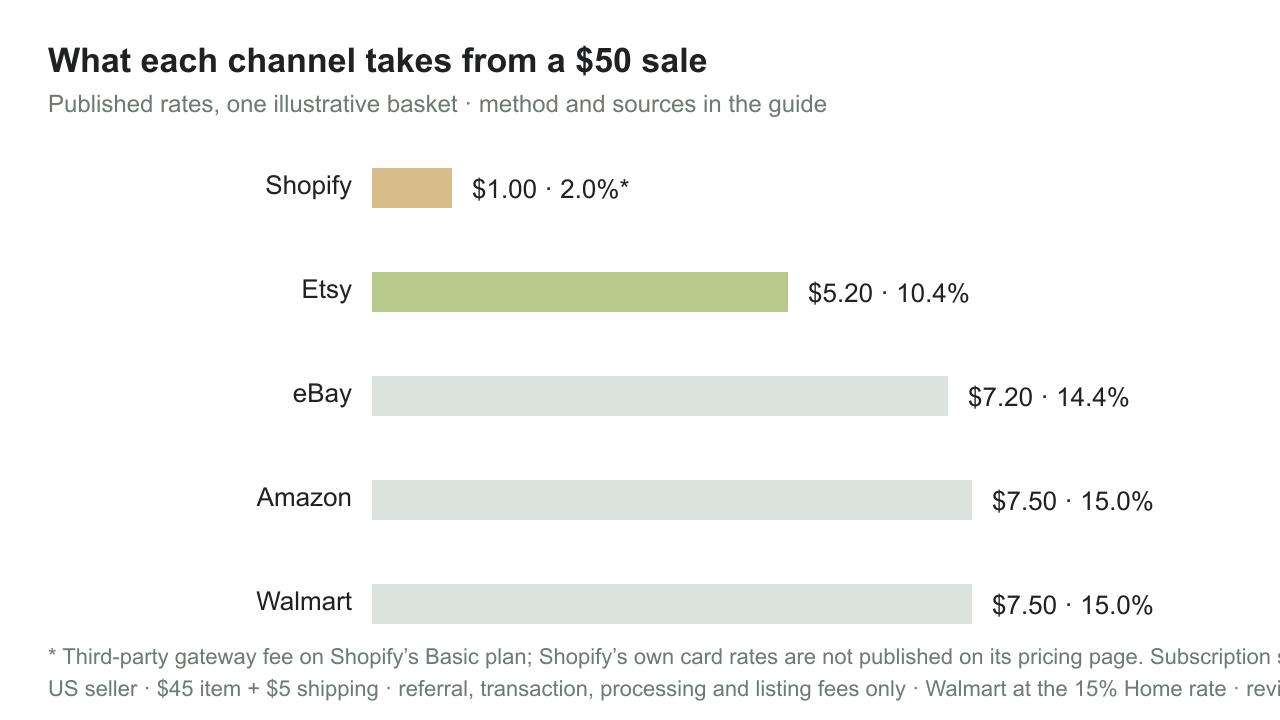
The crossover is arithmetic: eBay’s 13.6% plus its fixed fee equals Amazon’s flat 15% at an order of about $29 (0.40 ÷ 0.014). Below $29, Amazon’s flat rate undercuts eBay’s percentage-plus-fee; above it, eBay’s lower percentage wins by a widening margin — a penny short of 1.4 points at any price. These are also exactly the numbers behind the five-channel comparison in our take rates guide, which computes the same $50 basket across eBay, Amazon, Etsy, Walmart and Shopify.
But treat the table as the start of the comparison, not the end. Store-subscriber rates drop eBay’s percentage (12.7% in most categories at Basic and above, with the step-down threshold moving from $7,500 to $2,500), FBA fulfillment adds dollars no referral table shows, and category exceptions can invert every row. The general shape — eBay winning on percentage above ~$29, Amazon winning below it and on cheap-tech categories — survives all of that; the margins do not.
Subscriptions: store ladder versus selling plan #
eBay monetizes volume through an optional ladder; Amazon monetizes presence through a mandatory one.
eBay’s free tier gives 250 zero-insertion-fee listings a month and the standard rates. The Store ladder — Starter $4.95, Basic $21.95, Premium $59.95, Anchor $299.95, Enterprise $2,999.95 per month on yearly billing — buys bigger allowances, discounted insertion fees beyond them ($0.25 fixed-price on Basic, down to $0.05 at Anchor), and reduced final value rates: 12.7% in most categories at Basic and above, with the 2.35% tail starting above $2,500 instead of $7,500. Whether a Store pays for itself is checkable arithmetic — roughly 61 sales a month at $40 averages, or about 65 over-allotment listings, and it wins — the full walkthrough is in the eBay fees guide.
Amazon’s ladder is one rung: pay $39.99 a month or $0.99 an item. The plan beats per-item pricing at about 41 items a month, and virtually every serious seller is on it. There is no subscription that discounts the referral percentage — Amazon’s volume lever is not fees but fulfillment (FBA) and programs like Vine. So the subscription question differs by platform: on eBay it is “do my volumes justify the Store?”; on Amazon it is only “Professional or Individual?”, which the 41-item answer settles.
Surcharges and the long tail #
This is where the schedules really diverge, because the platforms punish different sins.
eBay attaches fees to behavior. Slip below standard seller level and an extra 6% lands on final value fees the next month (7% after four consecutive months); run a very high “item not as described” rate in a category and it is 5% (6% persistent). International buyers add a 1.65% fee, currency conversion adds 3.25%, certain payment disputes cost $20 each, and listing upgrades — including a reserve price at $5 or 7.5% of the reserve, capped at $250, charged whether or not the item sells — ride the monthly invoice. A seller with clean metrics avoids nearly all of it; a struggling seller can see effective fees jump by half.
Amazon prices logistics instead. There is no performance surcharge on the referral fee — account health affects visibility, not rates. The money leaks through fulfillment-adjacent lines instead: FBA fulfillment roughly $3–$15+ per unit, monthly storage $0.78/cu ft rising to $2.40 October–December, the 181-day aged-inventory surcharge, inbound placement $0.14–$0.32 per small-standard unit, returns processing around $1.65, and refund administration up to $5 per item capped at $10 per order. The full stack, with the April 2026 fuel surcharge and 2027 changes, is in the Amazon fees guide.
The practical read: eBay’s tail fees are avoidable by operating well, Amazon’s are incurred by selling at all through FBA. A self-fulfilled eBay seller and an FBA seller with clean metrics may both think they are on the headline rate — one is, one is not even close.
Refunds: two clawback systems #
When a sale unwinds, both platforms return most of the percentage fee — with different rules at the edges.
eBay’s fee credits depend on the reason: buyer’s-remorse full refunds typically earn back the category fee and the per-order fee; item-problem, not-received and partial refunds earn back the percentage proportionally but not the fixed per-order fee; refunds issued outside eBay earn nothing. The pattern — percentage back readily, fixed fee often kept — is worth internalizing because it silently raises eBay’s effective take on problem orders. The full credit table is in the eBay fees guide.
Amazon refunds the referral fee proportionally when you refund an order, and books it back on the settlement — but FBA orders also carry the refund administration fee (up to $5 per item, $10 per order cap) and possible returns processing, so an Amazon refund is cheaper on the fee side yet never free on the logistics side. Our eBay refunds and fees reconciliation guide shows what the credit lines look like in practice.
Which platform costs less — honestly #
The defensible verdict, fee by fee:
- Below about $29 per order, Amazon Professional is cheaper on most-category rates; above it, eBay’s 13.6%-plus-fixed-fee undercuts the flat 15%, widening with price.
- By category, the tables cross constantly. Cheap tech (electronics 8%, PCs 6%) is an Amazon market; media at low prices, watches, guitars (6.7%) and used goods generally are eBay territory. Device accessories at 45% means the wrong Amazon category can cost triple the eBay rate.
- Fulfillment is the decisive line, not the rate. Self-fulfilled goods: eBay’s model is native. FBA-able goods where fast Prime delivery drives conversion: Amazon’s 15% plus FBA can still beat a higher-converting eBay listing — the take-rates guide’s whole point is that take percent alone doesn’t decide profit per month.
- Volume changes eBay, not Amazon. The Store ladder meaningfully reprices a big eBay business (12.7%, larger allowances, cheaper insertion); Amazon’s rate is the same at any volume.
- Risk pricing differs: eBay surcharges poor performance; Amazon prices logistics and inventory. Your operating strength decides which tail you fear.
And the honest caveat every fee comparison owes: fees are rarely why a platform wins. Buyer demographics, sell-through for your specific items, used-versus-new fit and advertising economics move profit more than the seventh-of-a-sale both platforms roughly charge. The fee comparison tells you which platform to price on; it cannot tell you where your item sells.
TidyPayouts splits every eBay and Amazon payout into sales, refunds, fee credits and fees by type, then matches the deposit — so a two-platform business stays two clean ledgers.
Where the fees land in your books #
Both platforms net transaction fees out of the payout before it hits your bank, so the books face the same problem twice: a deposit that hides its own fee detail. The structures differ at the edges. eBay bills non-transaction charges — insertion fees, store subscriptions, upgrades, ads — on a monthly invoice separate from the payout; Amazon charges the plan fee to your card on file and bills FBA-adjacent services inside the settlement cycle. A two-platform seller therefore has four fee streams to keep apart: eBay payout-netted fees, eBay invoice fees, Amazon settlement-netted fees, and Amazon’s separately-billed plan.
The account structure that keeps them honest is the one both deep guides teach: sales, refunds, fee credits and fees by type on separate lines per channel — never one “marketplace fees” bucket, and never the deposit booked as income (the duplicate sales guide shows what that does). The clearing account pattern works identically for both channels, and the month-end close closes them side by side. That structure is exactly what TidyPayouts builds automatically — reviewable lines, matched deposits, per-channel books — which is the short version of why this site exists.
Common questions #
Are eBay or Amazon fees cheaper overall?+
Neither, universally. On most-category rates the crossover is about $29 per order: below it Amazon’s flat 15% referral undercuts eBay’s 13.6% plus $0.30/$0.40 per-order fee; above it eBay wins by up to 1.4 points. Category tables, store discounts and fulfillment choice rearrange the answer constantly — the fee comparison is per item, not per platform.
What percentage does each platform take from a $50 sale?+
eBay: $7.20 — 14.4% (13.6% final value fee plus the $0.40 per-order fee). Amazon Professional: $7.50 — 15.0%. Those are the same numbers our five-channel take-rates comparison uses for the $50 basket. Add shipping, tax and category exceptions and both move; add FBA and Amazon’s real take roughly triples.
Do eBay or Amazon fees apply to shipping and sales tax?+
eBay charges on both: its fee base is the total amount of the sale, including buyer-paid shipping and sales tax it remits itself. Amazon’s referral base includes the item price, delivery and gift wrap but excludes tax. With shipping charged the bases nearly converge; on sales tax they never do.
Is it cheaper to sell with FBA on Amazon or self-ship on eBay?+
Different money. FBA adds roughly $3–$15+ per unit plus storage, placement, aged-inventory and returns fees — a logistics bill eBay sellers pay in postage and their own time instead. Per order, self-shipping is usually cheaper in fees; per profit, FBA can win where Prime delivery and Buy Box ownership drive conversion. Compare profit per month, not fee percent.
Do I need an eBay Store or the Amazon Professional plan?+
Different questions. Amazon’s is binary: Professional at $39.99/month beats the $0.99 Individual per-item fee past roughly 41 items a month — that is the whole decision. eBay’s Store ladder is optional at every level and pays for itself through lower rates and allowances only past meaningful volume — roughly 61 sales or 65 over-allotment listings a month at $40 averages, per the store math in our eBay guide.
Which platform refunds more of its fees when I refund a buyer?+
Both return the percentage fee on most refunds; the edges differ. eBay keeps its fixed per-order fee on item-problem, not-received and partial refunds (it credits it on buyer’s-remorse full refunds) and credits nothing for refunds issued outside eBay. Amazon returns the referral proportionally but charges FBA refund administration up to $5 per item. Plan for the percentage back, the fixed fees not always.
Which platform punishes poor seller performance with fees?+
eBay, explicitly: a below-standard month adds 6% (7% persistent) to final value fees, a very high “item not as described” rate adds 5% (6% persistent) in the affected category. Amazon has no performance surcharge on fees — but its tail is logistics-priced instead, through storage, aged-inventory and returns fees. eBay punishes metrics; Amazon prices fulfillment.
Can I sell the same item on both eBay and Amazon?+
Yes, and most multi-channel sellers do. Price each platform on its own fee math — the bases and rates differ enough that one price rarely suits both — and keep the two payout streams in separate books accounts, since each nets its own fees and bills its own extras. The take-rates guide’s basket method is the clean way to set a price that works on both.
Sources and review date #
Written November 16, 2026 against the platforms’ published fee pages below; the per-platform deep dives (Amazon, eBay) carry the full verified schedules. Rates change — confirm the current tables before pricing decisions. Examples are fictional; account-mapping questions deserve your bookkeeper.