Tidy
In this article
- Shopify’s costs come in two layers: a fixed subscription ($5 Starter, $39 Basic, $105 Grow, $399 Advanced, from $2,300 Plus) and variable fees on what you sell.
- Using Shopify Payments, the card rate (2.9% + 30¢ online on Basic, lower on higher plans) is the whole variable cost. Using any other gateway, Shopify adds a platform fee on top: 2% on Basic, 1% on Grow, 0.5% on Advanced, 0.15% on Plus.
- The smaller surfaces add up quietly: $15 per chargeback (US, refunded if you win), 1.5% currency conversion on cross-currency Shopify Payments transactions, tax calculation free to $100,000 then 0.35%, and POS Pro at $89 per location.
- Unlike marketplaces, Shopify does not collect sales tax for you or take a percentage cut — you are the seller of record. The fees are smaller; the obligations are bigger.
Shopify fees at a glance #
Shopify is not a marketplace — it is software you rent. There is no listing fee, no referral fee and no commission on sales, and by default Shopify keeps none of your revenue beyond the payment processing charge. What you pay is a subscription plus the fee surfaces below, most of which are optional or avoidable.
| Fee | When it applies | Typical amount (US) |
|---|---|---|
| Subscription | Always, monthly | $5 Starter · $39 Basic · $105 Grow · $399 Advanced · from $2,300 Plus (about 25% less on annual billing) |
| Card processing (Shopify Payments) | Every card sale | 2.9% + 30¢ online on Basic, ~2.7% + 30¢ Grow, ~2.5% + 30¢ Advanced, lower on higher tiers; in-person rates are lower |
| Third-party gateway fee | Only when not using Shopify Payments | 2% Basic · 1% Grow · 0.5% Advanced · 0.15% Plus · ~5% Starter |
| Dispute fee | Each chargeback on Shopify Payments (US) | $15, deducted from the payout, refunded if you win |
| Currency conversion | Customer pays in a different currency than your payout | 1.5% for US stores (2% in some countries) via Shopify Payments; higher for some wallet flows |
| Tax calculation (Shopify Tax) | After your first $100,000 of global sales per year | 0.35% of the order (0.25% on Plus), capped at $0.99 per order; $75 per automated tax filing |
| POS Pro | Optional, per location | $89 per location per month (POS Lite is included in plans) |
| Apps | Optional, monthly | Free tiers exist; paid apps commonly run $10–$100+ per month each |
| Theme | Optional, once | Free themes included; paid themes roughly $150–$500 one-time |
| Domain | Optional, yearly | Custom domains typically cost low tens of dollars per year |
| Shopify Email | Marketing sends | 10,000 emails free per month, then $1 per 1,000 |
| Marketplace Connect | Syncing orders from other marketplaces | First 50 orders free each month, then 1% per order, reported to be capped around $99 per month |
US figures reviewed November 13, 2026 against Shopify’s pricing page, help pages and current third-party breakdowns. Shopify revises plans and rates periodically, and its pricing page shows card rates as “from” figures — the exact rate for your store appears in your admin once Shopify Payments is activated. Confirm current numbers before modeling your margins.
Subscription plans #
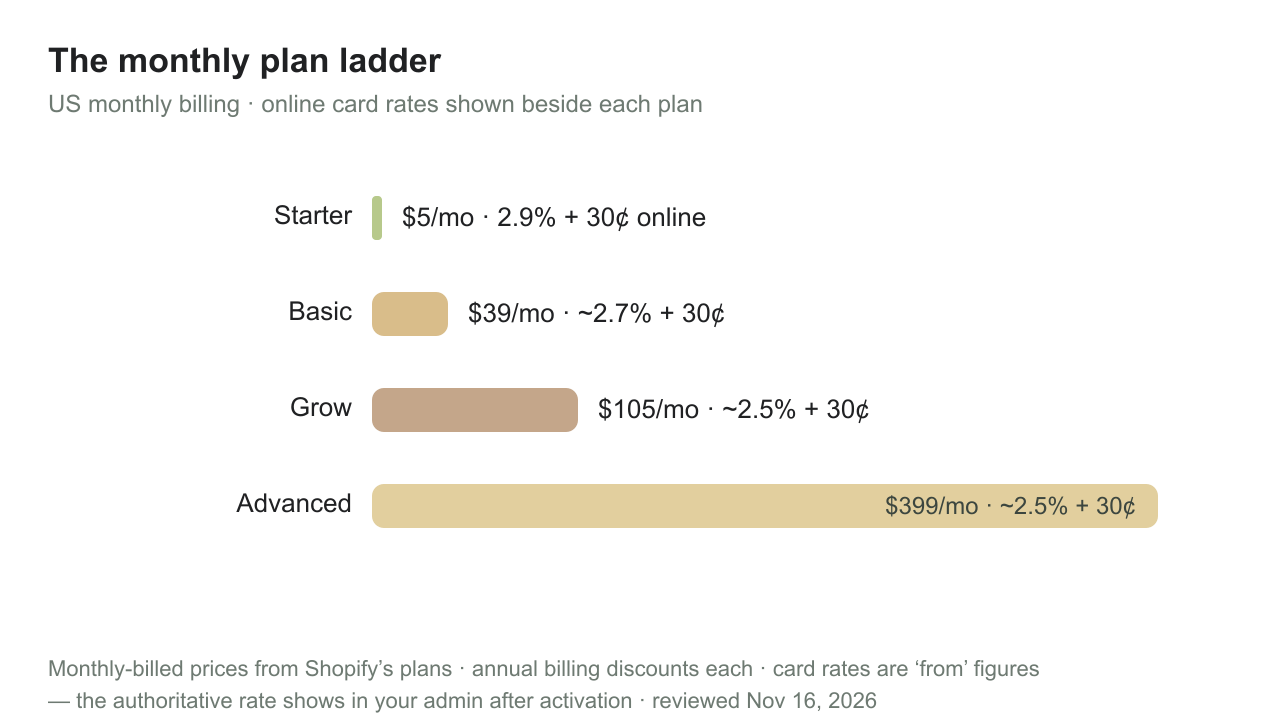
The subscription is the floor of Shopify economics — you pay it whether you sell nothing or a warehouse full.
| Plan | Monthly billing | Annual billing (per month) | Gateway fee if not using Shopify Payments | Online card rate (“from”) |
|---|---|---|---|---|
| Starter | $5 | — | ~5% | — |
| Basic | $39 | $29 | 2% | 2.9% + 30¢ |
| Grow | $105 | $79 | 1% | ~2.7% + 30¢ |
| Advanced | $399 | $299 | 0.5% | ~2.5% + 30¢ |
| Plus | from $2,300 (term-based) | 0.15% | negotiated, lower | |
US prices per month as displayed for each billing cycle, reviewed November 13, 2026. The middle tier was renamed from “Shopify” to Grow in 2024; older guides still using the old names and prices are out of date. Promotional offers (for example $1 per month for the first months) appear regularly for new merchants.
Choosing the plan is arithmetic on your own volumes. The upgrade from Basic to Grow costs $66 more per month and buys roughly a 0.2-point card-rate reduction, half the gateway fee, and better analysis tooling: on $20,000 of monthly sales, the card-rate saving alone is about $40 — worth it only when the tooling matters or the volume is several times higher. Annual billing cuts the subscription by about a quarter, but only commit a year when the store is proven.
Shopify Payments: the card rates #
For most stores, the card processing rate is the only variable fee that ever matters. Shopify Payments — Shopify’s built-in processor, powered by Stripe — charges per online transaction: 2.9% + 30¢ on Basic, roughly 2.7% + 30¢ on Grow, and roughly 2.5% + 30¢ on Advanced, with lower quoted rates on Plus. Shopify’s pricing page presents these as “from” figures: the definitive rate for your store, including any negotiated or regional variation, shows in the admin’s payments settings once Shopify Payments is activated. Rates differ by country, and card-present transactions have their own (lower) schedules.
Two properties of the fee matter for your books more than the percentage itself. First, it is deducted inside the payout: the deposit that reaches your bank is already net of processing fees, so a $50 sale lands as roughly $48.25. Second, the fixed 30¢ component dominates small orders: on a $8 sale the fee is 53¢ — an effective 6.6% — while on a $200 sale it is 6.10¢ of margin noise. The percentage headline undersells the cost of cheap orders and oversells the cost of expensive ones.
The third-party gateway fee #
If you use any payment provider other than Shopify Payments — PayPal as the primary processor, Authorize.net, a local acquirer — Shopify adds a platform fee on top of whatever the gateway charges: 2% on Basic, 1% on Grow, 0.5% on Advanced, 0.15% on Plus, and about 5% on Starter. This is the fee most “Shopify fee” confusion traces back to, because it stacks: the gateway’s own processing charge and Shopify’s cut are two different fees from two different parties, both visible on a single order.
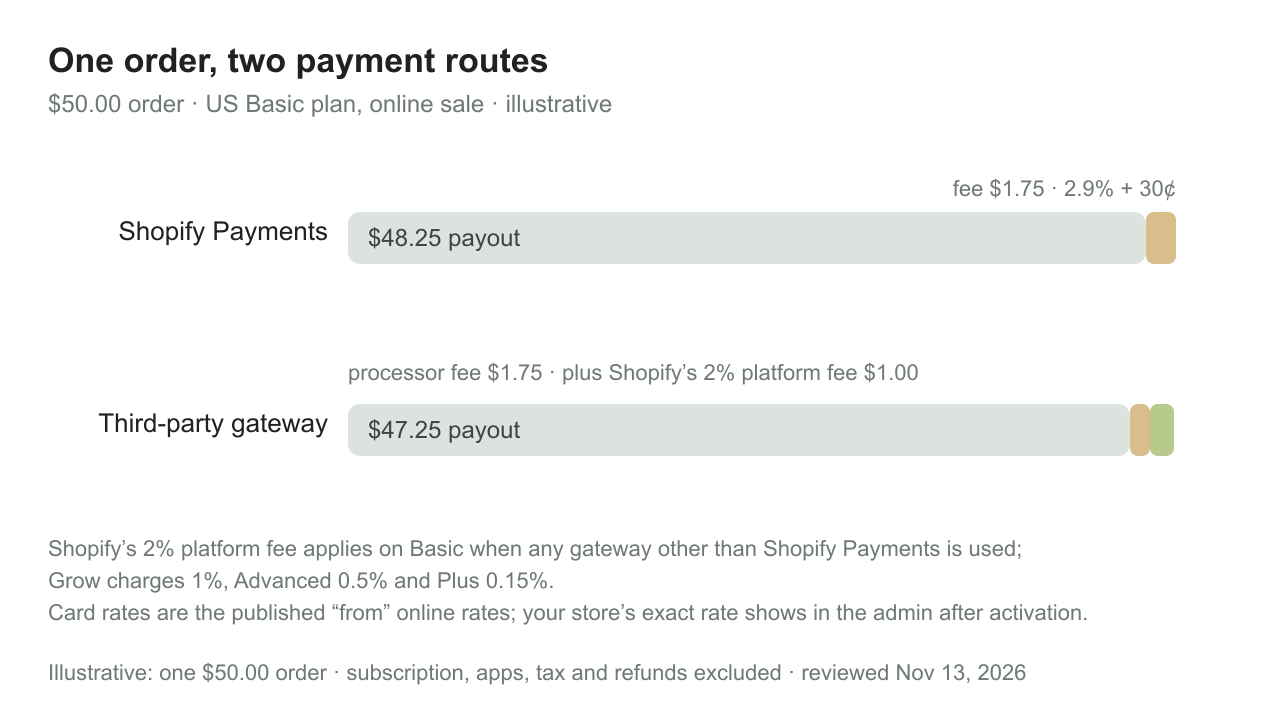
A fictional $50 order, two ways
On a Basic plan with Shopify Payments: 2.9% × $50 + 30¢ = $1.75, leaving a $48.25 payout. On the same plan with a third-party gateway charging the same 2.9% + 30¢: the processor takes $1.75 and Shopify takes its 2% ($1.00) — total $2.75, payout $47.25. At 100 orders a month on $5,000 of sales, that difference compounds to about $100 per month, which is exactly why most stores default to Shopify Payments and why the gateway fee appears in nearly every “reduce Shopify costs” checklist.
Legitimate reasons to pay the gateway fee exist: merchants in countries where Shopify Payments is unavailable, stores whose acquirer offers materially better rates at volume, and businesses with special processing needs. The decision is checkable, and it should be checked annually — gateway pricing changes.
In-person and POS fees #
Selling in person changes the rate schedule. Shopify POS comes in two shapes: POS Lite, included in every plan, takes payments and records sales; POS Pro, at $89 per location per month, adds staff permissions, deeper inventory tooling and checkout customization. Card-present transactions through Shopify Payments carry lower in-person rates than the online schedule — the exact figures vary by plan and hardware, and your admin shows them once POS is set up. For a market stall or pop-up, the economics are usually excellent compared with a standalone card reader; for a permanent store, the POS Pro subscription is a real line that belongs in fixed costs alongside the platform subscription.
Dispute fees and currency conversion #
Two quieter Shopify Payments fees appear on payouts irregularly. A chargeback costs $15 in the US, deducted from your payout when the dispute is opened and refunded if you win — unlike the marketplace pattern, where dispute fees (eBay’s $20) are charged on adverse outcomes, Shopify takes its fee up front and returns it when the dispute resolves your way. Our chargebacks guide covers the recording.
Currency conversion applies when a customer pays in a currency different from your payout currency: Shopify Payments charges 1.5% for US stores (2% in some other countries) on the transaction amount, and some wallet flows convert at higher rates. Selling internationally through a single store currency means this fee rides on every foreign order; Shopify Markets, cross-border pricing and multi-currency stores shift where it lands but rarely eliminate it. Our multi-currency payouts guide covers the bookkeeping when payouts and sales currencies diverge.
Apps, themes and domains #
The platform fee is where Shopify’s pricing starts, not where it ends. The average growing store carries a stack of monthly app subscriptions — reviews, email, upsells, loyalty, analytics — and $30–$100 per month of apps is common long before revenue justifies it. Apps bill through Shopify’s billing system and appear on the same monthly bill as the subscription, which makes them easy to lump into “Shopify costs” and hard to attribute to the decision that bought them.
Themes are a one-time cost: free options are genuinely usable, and paid themes run roughly $150–$500 depending on the vendor. A custom domain renews yearly for low tens of dollars. Neither recurs monthly, which is why they matter less than the app stack — but all three are costs a marketplace seller simply doesn’t have, and they belong in fixed overhead, not in per-order economics.
Shopify Tax and filing fees #
Shopify Tax calculates US sales tax at checkout. Its pricing: the calculation is free until your store crosses $100,000 of global sales in a calendar year, then 0.35% of the order (0.25% on Plus), capped at $0.99 per order. Automated filing of the returns it prepares costs $75 per filing ($50 on Plus).
The structural point matters more than the percentages: Shopify is not a marketplace facilitator. Amazon, eBay, Etsy and Walmart collect and remit sales tax on your behalf in most states; Shopify does not. The tax Shopify calculates is collected for you, but remitting it is your obligation, the liability sits in your books until it is paid, and the filing deadlines are yours to track. Our marketplace facilitator guide explains the marketplace version of this — Shopify sellers carry the version where you are the remitter.
Email and Marketplace Connect #
Two smaller surfaces complete the map. Shopify Email includes 10,000 sends per month free, then charges $1 per additional 1,000 emails — negligible at small volumes, a real line once email marketing scales. Marketplace Connect, Shopify’s app for syncing listings and orders with Amazon, eBay, Etsy and Walmart, includes the first 50 synced orders each month free, then charges around 1% per synced order with a reported cap near $99 per month. For a store using Shopify as its hub and marketplaces as channels, that fee is worth tracking separately — it is a cross-channel cost, not a Shopify-sales cost, and it should not be blended into platform fees when you compare channel profitability.
What Shopify takes from one sale #
All three examples are fictional, on US plans, with Shopify Payments where stated. Real payouts also reflect refunds, chargebacks and currency effects.
One $50 order on Basic
Card fee: 2.9% × $50 + 30¢ = $1.75. Payout: $48.25. Effective take: 3.5%. If sales tax was added at checkout, the payout nets it out separately — Shopify Tax calculation is free below $100,000 of annual sales, and the tax itself is never your income.
A month of 100 orders on $5,000, Basic
Card fees: 100 × $1.75 = $175. Subscription: $39. Total: $214 — an effective 4.3% of revenue, before apps. The same month on a third-party gateway would add roughly $100 of gateway fee for a 6.3% effective take. And the same $5,000 on Grow costs $165 in card fees (2.7% + 30¢) plus $105 of subscription — $270, or 5.4%: the higher plan only wins when volumes or tooling justify it.
A cross-border order
A £40 order from a UK buyer on a US store paying out in dollars: the card fee applies at the US rate, plus Shopify Payments’ 1.5% currency conversion on the transaction amount. The conversion fee is invisible in the checkout price and shows up only as a payout that doesn’t quite match the order total at the day’s headline exchange rate — the reconciliation habit from our multi-currency guide exists precisely for this line.
Shopify versus marketplace fees #
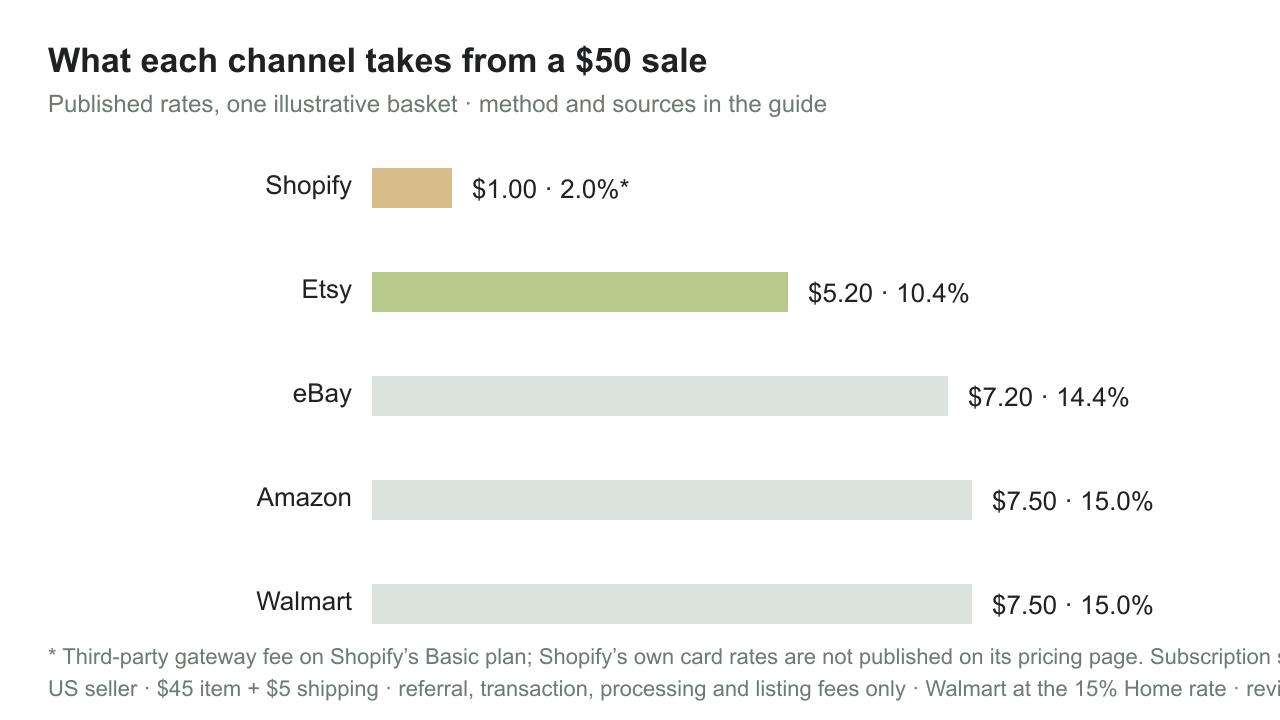
Our take rates piece computes one $50 basket across channels: Amazon and Walmart take $7.50, eBay $7.20, Etsy $5.20 — and Shopify, on a Basic plan with a third-party gateway, $1.00 of platform fee, with no processing fee from Shopify itself. With Shopify Payments the same order pays $1.75 of processing and nothing else. By headline take, Shopify is the cheapest venue in the comparison.
The honest comparison adds what the marketplace cut buys. A marketplace fee includes the audience: traffic, buyer trust, dispute infrastructure, and — under marketplace facilitator laws — sales tax collection and remittance. On Shopify, every one of those is either your job or an app: you buy traffic, you build trust, you handle disputes, you remit tax, and the app stack is the a-la-carte version of services marketplaces bundle. Comparing the two on percentages alone flatters Shopify; comparing them on total cost of a working channel is the analysis that matters, and it will differ store by store.
Where each fee lands in payouts and books #
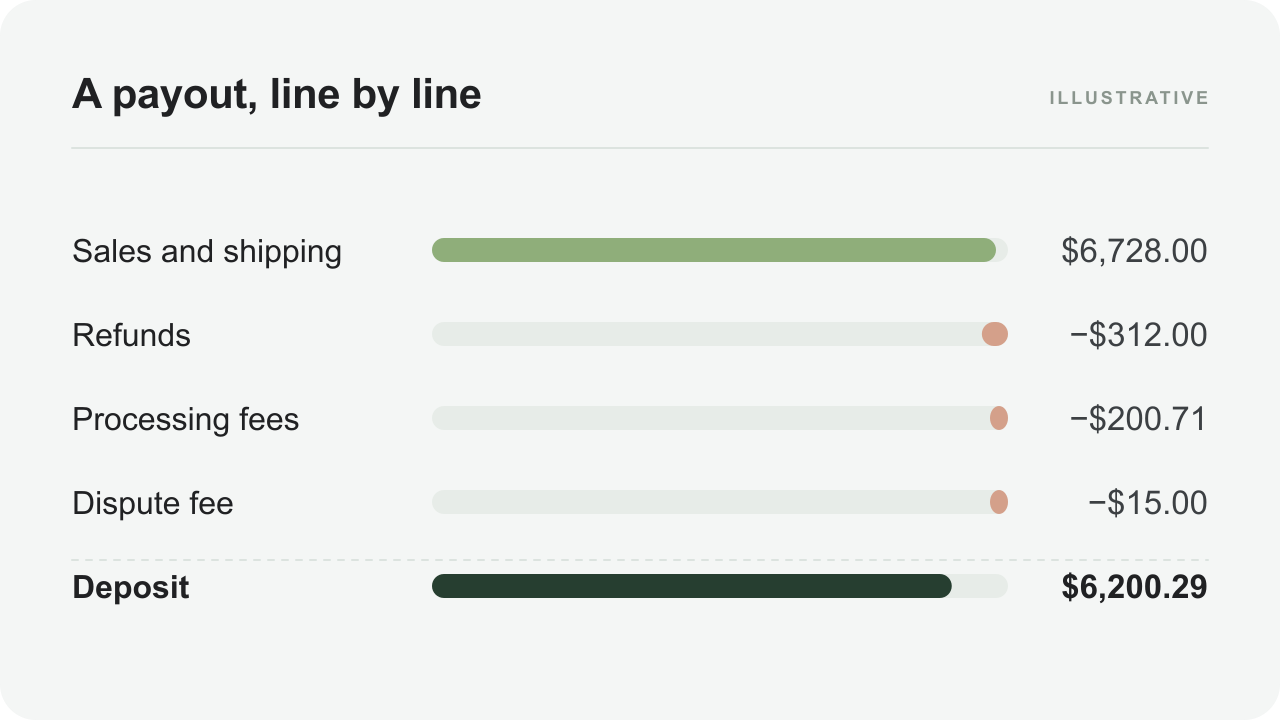
Shopify’s payout mechanics are friendlier than the marketplaces’ — payouts are typically daily on business days, not monthly — but the netting is the same: the deposit arrives already reduced by card processing fees, refunds processed that day, dispute fees, and currency conversion. Charges without their own payout, like the subscription, apps, themes and POS Pro, bill to your card on a monthly billing cycle instead. That split — payout-netted variable fees versus invoice-billed fixed costs — is the Shopify shape of the two-ledgers problem our anatomy of a Shopify payout guide walks through line by line.
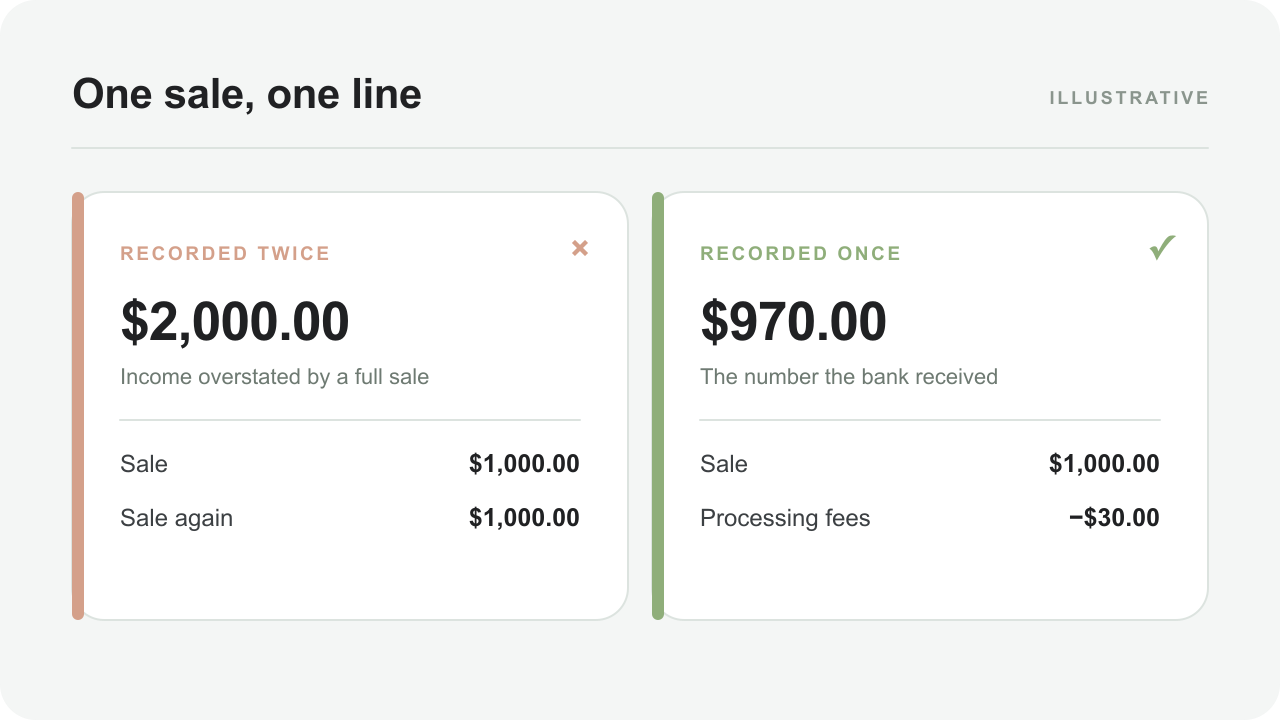
The books structure that holds up: record gross sales (Shopify is where you are the seller of record — unlike marketplaces, no platform nets your revenue down to a royalty), then processing fees as their own expense, then refunds, sales tax collected (a liability, not income), and gift-card and discount movements on their own lines; the monthly subscription-and-apps bill is a single expense entry split by account. The commonest failure we see is duplicate revenue — booking the payout as income on top of the sales already recorded — and the fix lives in our duplicate sales guide. The account structure that prevents both is in the chart of accounts guide, and the monthly routine in the month-end close checklist.
TidyPayouts splits each Shopify payout into sales, fees, refunds and tax lines, then matches it to the bank before anything posts.
Keeping Shopify fees down #
- Use Shopify Payments wherever it is available. The gateway fee (2%/1%/0.5%) is the single most avoidable percentage in Shopify economics. If you must use another acquirer, model both routes annually.
- Audit the app stack quarterly. Sum the monthly app bill and ask what each app earns or saves. Apps are the most common place a lean store quietly spends more than its subscription.
- Match the plan to volume, with arithmetic. The upgrade pays for itself when card-rate savings plus tooling value exceed the subscription jump at your real monthly volume — compute it, don’t guess it.
- Billing cycle is leverage. Annual billing cuts the subscription about a quarter once the store’s survival is not in question.
- Watch dispute rates, because $15 per chargeback plus the lost merchandise compounds fast, and high dispute rates risk Shopify Payments restrictions. Clear descriptions, tracked shipping and fast responses are the documented prevention.
- Keep tax compliance on purpose, not autopilot. Shopify Tax calculates; you remit and file. Missing the remittance is far more expensive than the 0.35% calculation fee — decide whether automated filing ($75 per return) is cheaper than your time or your accountant’s.
- Price small orders with the fixed 30¢ in mind. Below roughly $12, the fixed component pushes the effective processing rate past 5%; minimum order values, bundling or flat-rate pricing are the standard counters.
Common questions #
How much does Shopify cost per month?+
The subscription runs $5 (Starter), $39 (Basic), $105 (Grow), $399 (Advanced) and from $2,300 (Plus) per month, with annual billing cutting the mid tiers to roughly $29, $79 and $299. Beyond the subscription, expect payment processing on every sale and whatever apps, themes and tools the store adds.
Does Shopify charge transaction fees?+
Not on sales processed through Shopify Payments — the card rate is the whole cost. When you use a third-party gateway, Shopify adds a platform fee: 2% on Basic, 1% on Grow, 0.5% on Advanced, 0.15% on Plus, around 5% on Starter. That fee is on top of whatever the gateway itself charges.
What percentage does Shopify take per sale?+
With Shopify Payments on Basic, 2.9% plus 30¢ per online sale — about 3.5% on a $50 order, higher on small orders, lower on big ones and on higher plans. The exact rate for your store shows in the admin after activation, because rates vary by country and are presented as “from” figures publicly.
Do I have to use Shopify Payments?+
No. Any compliant gateway works, but Shopify charges its platform fee on top of the gateway’s charges when Shopify Payments is not used, and some Shopify features depend on its built-in processor. Merchants in countries where Shopify Payments is unavailable pay the gateway fee as a cost of operating there.
Why is my Shopify payout less than my sales?+
The payout is net of card processing fees, any refunds processed that day, chargeback fees and currency conversion; the subscription and apps bill separately and never appear in payouts. If the deposit is less than sales minus known fees, the usual suspects are refunds, cross-currency conversion, or sales recorded twice — our duplicate-sales guide covers the last one.
Does Shopify collect sales tax for me?+
Shopify calculates, collects and reports sales tax — but unlike Amazon, eBay, Etsy or Walmart, it is not a marketplace facilitator and does not remit it for you. The money collected at checkout is a liability in your books until you file and pay it yourself. Shopify Tax’s calculation is free up to $100,000 of annual global sales, then 0.35% per order capped at $0.99; automated filing costs $75 per return.
What does Shopify charge for chargebacks?+
$15 per dispute in the US, deducted from the payout when the dispute opens and refunded if the dispute resolves in your favor. Unlike eBay’s $20 dispute fee on adverse outcomes, Shopify’s fee is refundable — but the merchandise value, shipping and time are not.
Is Shopify cheaper than selling on a marketplace?+
On percentages, yes — roughly 3.5% on a $50 order versus $5.20–$7.50 on the major marketplaces. On obligations, no: a marketplace fee bundles the audience, the buyer trust, dispute handling and sales-tax remittance, and on Shopify each of those is your job or an app. Compare total cost of a working channel, not just the take rate.
Sources and review date #
Reviewed November 13, 2026 against Shopify’s published pages below and current third-party fee breakdowns. Shopify revises plans and rates periodically, and its pricing page presents card rates as “from” figures — confirm the numbers in your own admin before modeling margins. Worked examples are fictional.
Change log. November 13, 2026: Page title and summary shortened for search results; the guidance is unchanged.