Tidy
In this article
- At a fair or market, you are the collector: no marketplace facilitator works the table. Nearly every state requires registration — often a temporary vendor permit even for a single weekend — and handmade goods are taxable like anything else.
- Collect at the table using the rate at the venue’s location, keep the tax in a separate sales tax payable line, and remit on the state’s schedule — never let tax sit inside revenue.
- The weekend’s costs are deductible business expenses: booth fees, table rent, travel, packaging and the samples — with receipts, on the business return.
- If you also sell on marketplaces, in-person sales join the same books on their own income line: the channel whose fees are zero and whose tax burden is entirely yours.
Why in-person is different from your marketplace #
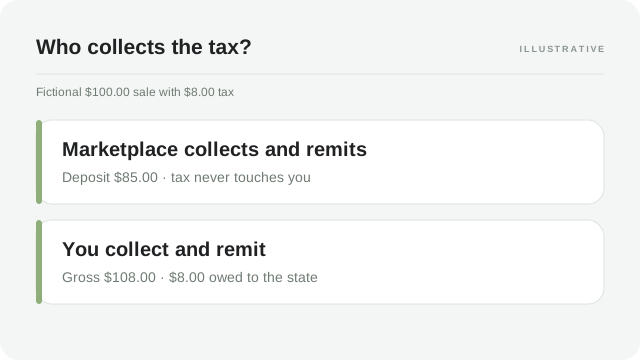
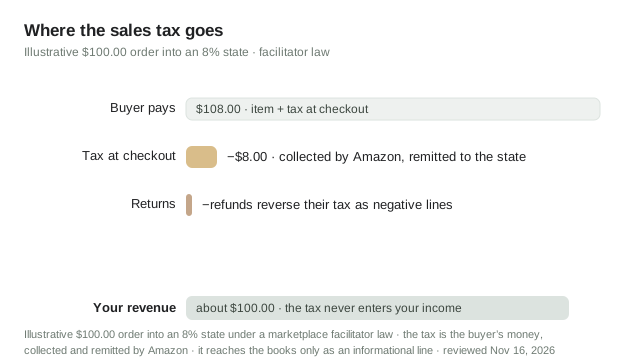
Everything this site teaches about marketplace selling rests on one structural fact: a marketplace facilitator calculates, collects and remits sales tax on your behalf. At a craft fair, farmers market, trade show or pop-up, that structure is absent. You quote the price, you work the register, you collect the tax from every cash and card sale, you hold it, and you remit it to the state on the state’s schedule. The marketplace’s automation is replaced by your discipline — which is why the in-person weekend, small as it looks, deserves more tax attention than a month of marketplace orders.
Two more differences matter to the books. In-person sales are cash-and-card at the moment of sale — no payout lag, no settlement reports — so the timing question that complicates marketplace books mostly disappears. And the weekend carries up-front costs marketplace selling doesn’t have: booth fees, travel, fixtures — all deductible, all needing receipts. The sales tax rules for in-person selling vary state by state, and this guide gives the general pattern; the state’s own department of revenue page is the authority for your specific event.
Permits: before you sell, not after #
Nearly every state that has sales tax requires a seller to register before collecting — and for event sellers, most states offer either a temporary vendor permit for the event or accept your existing state permit. California, for example, requires temporary sellers making three or more taxable sales in a twelve-month period to hold a seller’s permit; Texas expects event vendors to report their sales and collect state plus local tax at the venue. Some states issue special short-term event permits through the event promoter; others require the full registration. The rule of thumb: contact the state a few weeks before the event, ask for the temporary-vendor requirement, and get the permit (or confirm your existing one covers it) in hand before the first sale.
Three details sellers miss. First, the venue’s state is what matters, not your home state — a seller from Oregon (no sales tax) selling at a Texas market collects Texas tax. Second, some events have the promoter collect and remit tax on the seller’s behalf — ask the organizer in writing, and record your sales net of that arrangement. Third, handmade is not exempt: the taxable-goods rules apply to handmade items exactly like manufactured ones. A few states exempt specific categories or small-scale handicraft sellers — check the state’s own guidance rather than assuming.
Collecting at the table #
The rate you charge is the rate at the venue’s location — state plus any local district taxes, which is why a Texas show bills 6.25% plus up to 2% local, and why the same seller at two different fairs collects two different rates. In destination-based states, that venue rate applies; in the few origin-based states, your own location sets it for in-state sales. The practical tools: a point-of-sale app that computes tax by location (Square, Stripe, or your existing processor — the fee mechanics of card processing at the table follow the payment fees guide), or a printed tax table for cash sales.
Every sale should produce a record: the app’s receipt, a numbered paper ticket, or a daily tally sheet. The record needs taxable sales, tax collected and non-taxable sales as separate numbers per day. That per-day split is what the remittance return will ask for, and reconstructing it from a cash box in January is the error this whole guide exists to prevent.
Remitting: deadlines and the tax payable line #
Collected tax is the state’s money that you are holding — the books carry it in a sales tax payable liability line from the moment of collection, and remitting moves it out. Never run it through revenue and never expense it; the sales tax guide covers the liability mechanics in depth. The remittance schedule is assigned by the state — annual or quarterly for small vendors, monthly for larger ones — with due dates mid-month after the period closes, and many states offer a small timely-filing discount retained by the filer.
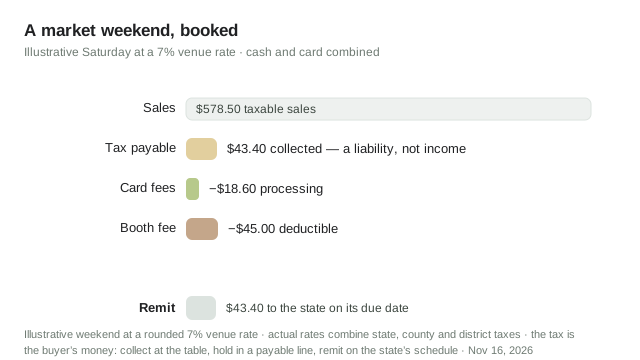
A market weekend, booked — fictional
A Saturday market: $620.00 of sales at a 7% venue rate — $578.50 taxable sales, $43.40 tax collected (taxable base $620 at 7% ≈ $43.40 rounded), card fees $18.60, booth fee $45. The books: Sales $578.50, Sales tax payable $43.40 (liability, remitted on the state’s due date), Card processing fees $18.60, Booth fee $45.00. The cash box totals $663.40 minus card settlements — and the tax line never touches income.
Illustrative figures at a rounded 7% venue rate. Actual rates combine state, county and district taxes and change — the venue’s state department of revenue publishes lookup tools.
Folding in-person sales into marketplace books #
If in-person selling is a second channel alongside marketplaces, the books want it as a separate income line — In-person sales, not blended into Amazon or Etsy revenue. The reasons compound: the tax treatment differs (self-collected versus facilitator-collected), the fee structure differs (booth fees are advertising/rent, not per-order commissions), and the margin comparison between channels only works if each channel’s revenue and costs are separate. The account structure follows the chart of accounts guide with one more income line and the same fee-bucket discipline.
The COGS story carries over unchanged: units sold at the fair consumed inventory the same way marketplace sales did — the COGS guide’s average-cost method applies, with one bookkeeping habit added: record the units each weekend took from stock (a count at pack-up is enough), so inventory and COGS stay honest without a per-sale entry. And returns work differently in person — a buyer who comes back to a later market for a refund is a refund against the in-person line, not the marketplace one; keep weekend tally sheets long enough to honor it.
What the weekend cost you: deductions #
The deductible set is generous and receipt-driven: booth and table fees, event insurance, travel to the venue (mileage at the standard rate or actual costs — the IRS small-business guide covers the rules), lodging for overnight events, packaging and bags, display fixtures, the card reader and its fees, and the samples. What the books need is the same receipt discipline every guide here preaches: one folder per event — the application, the booth receipt, travel records, the tally sheets — because an in-person weekend generates more paper per dollar of revenue than any marketplace month, and that paper is the deduction.
One boundary worth stating: personal-use assets converted to booth stock, and meals during the event, follow their own rules (meals are typically half-limited); the 1099-K guide covers how the income side reports, and anything beyond the ordinary list belongs with a tax professional.
Card fees and point-of-sale at the table #
In-person card processing at a craft fair carries the same percentage-plus-fixed structure as any other card-not-present gateway — but the effective rate can be higher because many event sellers use tap-to-pay or manual entry rather than a chip reader, and manual entry typically carries a higher percentage. The same seller who pays 3% + $0.25 online might see 3.5% + $0.15 at the table depending on the processor and the card type. The practical response: use the same processor you already have (Square, Stripe, PayPal Here, or your existing provider’s mobile app), confirm the event rate before the weekend, and — the habit this site preaches everywhere — reconcile the processor statement against your tally sheets monthly rather than assuming the fees are what you expected.
The card fee is a selling cost, not a tax adjustment: it goes in its own processing-fee account, never netted into sales or into the tax payable line. A $40 sale at 3.5% + $0.15 carries $1.55 of processing — 3.9% of the sale — which is more than many sellers expect and enough to matter on a $200 weekend if the seller is also paying a 6% marketplace commission on the online half of the same inventory. The PayPal fees guide and the fee list guide carry the full per-processor detail.
Seasonal cash flow and inventory planning #
The in-person calendar is intensely seasonal: the craft-fair circuit concentrates in October–December, and the cash from those weekends needs to fund January’s inventory purchases and the tax bill in April. The planning pattern is the thirteen-week cash forecast from the payout schedules guide, adapted for events: map each fair’s expected gross (from last year’s actuals or the organizer’s attendance figures), deduct booth fees and travel booked in advance, and calendar the state tax remittances alongside. A seller who made $8,000 at holiday markets in December faces a January cash position shaped by three forces: the December sales cash is already in hand (not waiting on a payout), the January return wave from the online channels is arriving, and the inventory for spring production needs to be ordered now.
The inventory count matters especially for in-person sellers: units sold at fairs leave stock without a marketplace deduction, and a seller who doesn’t count post-weekend will find the books’ inventory figure drifting from physical reality. The COGS guide’s count-and-reconcile routine handles it; the habit is simply a physical count after each event, with any variance recorded rather than silently absorbed.
Common questions #
Do I have to charge sales tax at a craft fair?+
In almost every state with a sales tax, yes — sales at fairs, markets and shows are taxable, and handmade items are taxed like any other goods. Most states require even one-weekend vendors to hold a permit (temporary or regular), and a few let the event promoter handle collection. The venue’s state department of revenue is the authority; ask before the event, not after.
What rate do I charge at the venue?+
The combined rate at the venue’s location — state plus local district taxes. In destination-based states (the majority), that is the buyer-side rate at the fair’s address; in origin-based states, your own location sets it for in-state sales. A point-of-sale app that computes tax by location handles the detail; a printed table works for cash.
Do I need a permit for a single weekend?+
Usually yes — many states issue temporary vendor permits for event sellers, and several (California, for example) require a permit for anyone making three or more taxable sales in a year. Some events let the promoter collect and remit for all vendors; get that arrangement in writing from the organizer, and otherwise register before the first sale.
Where does the tax I collect go in my books?+
Into a sales tax payable liability line at collection, and out when remitted to the state on its due date. It is never income and never an expense. Reconcile the payable quarterly: tax collected per the tally sheets minus remittances should equal the balance — the same discipline as any marketplace settlement line.
Are booth fees deductible?+
Yes — booth and table fees, event insurance, travel, lodging for overnight events, packaging, display fixtures and samples are ordinary business expenses of an in-person sale, deductible with receipts. Keep one folder per event; the paper is the deduction.
Can I sell at fairs if I also sell on Etsy?+
Yes — and many sellers do both. Run in-person sales as a separate income line in the same books, with self-collected tax in its own payable line, and keep the per-weekend unit counts feeding the same inventory and COGS records as your marketplace sales. The channels differ in fees and tax mechanics, not in the underlying business.
Sources and review date #
Written November 16, 2026. In-person sales tax rules are state law and change; the pattern here is general, and the state department of revenue is the authority for permits, rates and deadlines at your specific events. Tax questions deserve a licensed professional.