Tidy
In this article
- All three providers are free to start — paid plans (Printify Premium, Printful Growth) are optional discounts that pay for themselves around 10–17 orders per month.
- Printify is a marketplace of print providers: base costs vary by provider, quality varies with them, and the per-order cost is base product + shipping + your channel’s fees.
- Printful is in-house fulfillment: higher base costs, more consistent quality, subscription discounts in the same shape.
- Amazon Merch pays a royalty, not a margin: Amazon sets the retail price, prints, ships and takes its cut — the per-unit royalty is fixed per price point, and the books record a royalty line, not sales-minus-costs.
Three providers, three fee shapes #
The deep-dive provider in this series is Amazon Merch on Demand — royalty-only, tiered, Amazon-priced (the Merch guide carries the full mechanics). This comparison adds the two marketplaces most POD sellers actually route through their own listings: Printify, a network of third-party print providers you list under your own brand on Etsy, Shopify, Amazon or eBay; and Printful, an in-house fulfiller with the same listing model and tighter quality control. Both are free to start, both charge per order, and both sell optional subscription plans that discount the per-order cost.
| Printify | Printful | Amazon Merch | |
|---|---|---|---|
| Model | Print-provider network; you list and price | In-house fulfillment; you list and price | Amazon prints, prices and sells; you earn royalties |
| Monthly fee | Free; Premium $39/mo ($24.99 annual) | Free; Growth $24.99/mo | None |
| Per-order cost | Provider base cost + shipping (Premium: up to 33% off products) | Base cost + shipping (Growth: up to ~33% off select products) | None — Amazon’s cut comes from the royalty structure |
| Your revenue | Your retail price − base cost − channel fees | Your retail price − base cost − channel fees | Fixed royalty per price point |
| Quality | Varies by chosen print provider | Consistent (in-house) | Amazon’s standard |
Plan prices reviewed November 2026 from the providers’ pricing pages below; both providers change plans and discounts periodically. The Merch royalty schedule is in the Merch guide.
Printify: marketplace costs plus an optional plan #
Printify routes each order to a third-party print provider you choose — which means base cost and shipping vary by provider, sometimes widely, for the same blank shirt. The economics: your retail price (on Etsy, Shopify, Amazon, eBay — wherever you list) minus the provider’s base cost and shipping equals your gross margin; then the sales channel takes its ordinary fees on the full retail price. The Etsy fee stack and the channel comparisons in the take rates guide apply unchanged.
The Premium plan ($39 monthly, $24.99 on annual billing) discounts product costs by up to 33% across up to ten stores. The break-even is the per-order saving times monthly orders versus the plan price — commonly reached around 16–17 orders per month at typical savings, sooner on annual billing. The plan is a pricing decision like any other: compute your top sellers’ monthly savings, compare to the fee, and cancel the months that don’t clear (the plan pays for itself only while volume holds).
Printful: fulfillment pricing and the Growth plan #
Printful fulfills from its own facilities: higher base costs than Printify’s cheapest providers, but consistent quality, predictable lead times, and in-house branding options (inside labels, pack-ins) that raise perceived value. The Growth plan at $24.99 per month discounts select products up to ~33% and unlocks sample-order perks. The fee mechanics are identical to Printify’s — per-order base cost and shipping against your retail price, with channel fees on top — so the choice between the two providers is quality-versus-cost and fulfillment-reliability-versus-variety, not accounting structure.
Amazon Merch: royalties only #
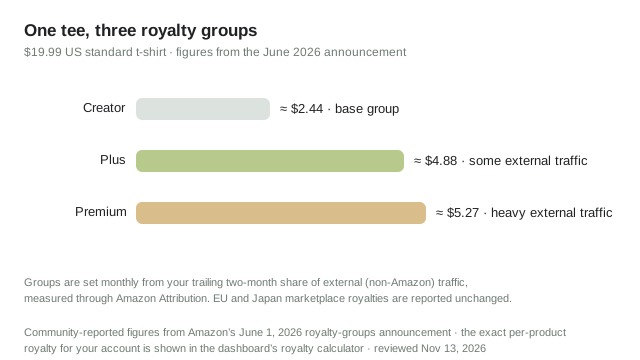
Amazon Merch on Demand inverts the model: no provider costs, no pricing control, no channel fees. Amazon sets the retail price for your design on its products, prints and ships, and pays you a fixed royalty per sale — on US shirts, roughly $2.21–$5.27 across the common $19.99–$45.99 price points (the royalty schedule and the 2026 royalty-groups change are in the Merch guide). There are no orders to reconcile fees against: the settlement line is a royalty. The trade-off is the tier system (design slots grow with sales), Amazon’s pricing control, and no customer list.
The per-order math, side by side #
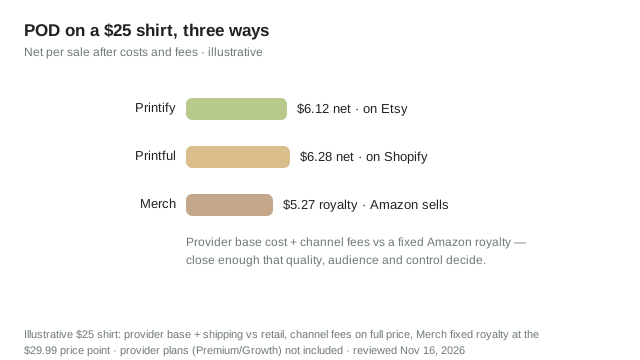
The same $25 shirt on three channels — fictional
Printify on Etsy: provider base cost $11.50 + shipping $4.50 = $16.00; retail $25.00 on Etsy carries Etsy’s stack (6.5% + 3% + $0.25 ≈ $2.88): net ≈ $6.12 per sale before the Premium plan fee.
Printful on Shopify: base cost $13.00 + shipping $4.69 = $17.69; retail $25.00 through Shopify Payments (2.9% + 30¢ ≈ $1.03): net ≈ $6.28, before the Growth plan fee.
Amazon Merch: Amazon sets retail at $24.99 and pays a fixed royalty of about $5.27 (the $29.99-tier royalty in the guide’s schedule — illustrative). No channel fees, no plan fee, no pricing control.
The three columns land within a dollar or two of each other on net per sale — which is exactly why the decision is usually decided by quality, audience and control rather than the per-order fee. But the per-order fee is where surprises hide: the Etsy column’s fee grows with the retail price, the Printify column’s base cost varies by provider choice, and the Merch column’s royalty is fixed while Amazon reprices — model your actual product on each before committing designs.
Illustrative figures on November 2026 published pricing. Provider base costs vary by product, provider and destination; marketplace fees vary by channel and plan.
Where POD fees land in the books #
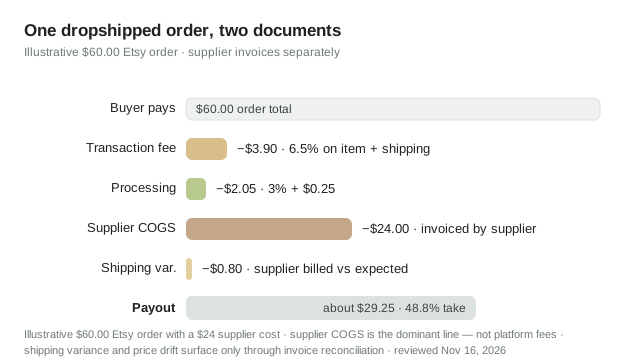
The account structure splits cleanly by model. Printify and Printful behave like dropshipping with a printing partner: each order’s provider charge is COGS (booked per order or matched monthly to provider statements — the dropshipping guide’s supplier-invoice reconciliation applies directly, including refund recovery rates and price-drift checks), the channel’s fees go to selling-fee lines, and the optional subscription is a monthly subscription line. Merch posts a royalty line per settlement — no COGS, no provider costs, the Merch guide’s royalty treatment unchanged.
The one habit that matters across all three: keep the provider charges and the channel settlements in separate reconciled lines, because the per-order math above is only computable when the two documents can be matched per sale. That is the standard two-document pattern this blog teaches — the dropshipping guide is the same structure with a different supplier.
TidyPayouts keeps provider costs, channel fees and royalties on separate reviewable lines — every provider’s real margin, readable.
The per-order cost breakdown, layer by layer #
The per-order fee stack for a POD sale is the sum of five layers, each with its own account. Provider base cost — the blank plus printing — is COGS, booked per order or matched monthly to the provider statement. Provider shipping is also COGS (it delivers the product to the buyer). Channel fees — Etsy’s transaction, processing and Offsite Ads lines, or Shopify’s payment processing and app fees — go to the selling-fee accounts per the channel guide. The optional subscription (Printify Premium, Printful Growth) is its own monthly line, amortized across the month’s orders if you want per-unit accuracy. And advertising is its own account, never blended. Five lines per sale, each reconcilable to a source document — the same two-document discipline as the dropshipping guide, with the provider statement and the channel settlement as the pair.
Choosing the sales channel for your POD designs #
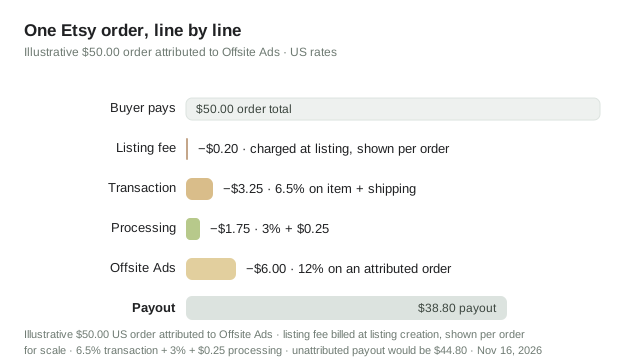
The channel decision for POD is the take-rates arithmetic applied to a different product type, with one additional factor: the marketplace’s audience quality for print-on-demand. Etsy’s buyer base actively searches for niche designs (the Etsy fee stack is 6.5% + processing + Offsite Ads); Amazon’s Merch handles the Amazon audience but with zero pricing control and royalty-only economics; Shopify gives you the store but no built-in traffic. The practical answer for most POD sellers is two channels: Etsy for the niche-search audience and Merch for the Amazon one, with the provider (Printify or Printful) routing orders from both. The books stay clean because the provider charge is COGS regardless of channel, and the channel fee stacks live in their own lines per the pattern this site teaches.
Common questions #
Do Printify or Printful charge a monthly fee?+
Not to start — both are free with per-order pricing. The paid tiers are optional discounts: Printify Premium ($39 monthly, $24.99 annual) discounts products up to 33%, and Printful Growth ($24.99 monthly) discounts select products similarly. Both break even around 10–17 orders per month depending on your per-order savings.
Which is cheaper, Printify or Printful?+
Per order, Printify’s cheapest print providers usually cost less than Printful’s in-house base prices; Printful’s premium is consistency and lead-time predictability. For a given blank and destination, compare both providers’ base cost plus shipping — the total per order, not the base cost alone, is the number.
How does Amazon Merch pay me?+
As a fixed royalty per sale, paid roughly 30 days after the end of the sales month. Amazon sets the retail price and takes its share; your royalty is a fixed amount per price point (the schedule is in the Merch guide). There are no channel fees, no provider costs and no subscription — the royalty is the whole economics.
Do I charge sales tax on print-on-demand orders?+
On marketplace channels, the facilitator collects it and it never touches your income. On your own store with Printify or Printful, you collect where you have nexus — the provider ships from their facilities, which generally does not create inventory nexus for you the way FBA stock does. The sales tax guide covers the nexus and registration logic.
Is the Printify Premium plan worth it?+
Compute it: your top designs’ monthly order count times the per-order product saving (Premium discounts up to 33%) versus $39. Most sellers cross the line around 16–17 orders a month. The plan can be cancelled in slow months — treat it as a volume decision re-checked quarterly, not a permanent fixture.
How do I record the provider charge for a print-on-demand order?+
As COGS for that order, booked when the provider charges (or accrued at sale on accrual books, trued to the provider invoice). Keep provider charges separate from channel fees and match them to orders monthly — the dropshipping reconciliation is the same document pair: channel settlement plus provider charge per sale.
What happens to fees when a print-on-demand order is refunded?+
Layer by layer: the channel usually refunds its transaction or referral fee per its refund rules (Etsy within 180 days, marketplaces per their schedules); the provider’s base cost may or may not be refunded depending on the reprint policy and whether the goods were returned; and your channel fee stack (like Etsy’s processing line) may be retained. Track each layer separately — the refund is three recoveries, not one.
Can I sell the same designs on Merch and through Printify?+
Yes — and many sellers do, because the models complement: Merch for Amazon’s audience at Amazon’s price with royalty simplicity, Printify-on-a-channel for price control and margin. Check Amazon’s content policy on duplicate designs across platforms, and keep each channel’s revenue in its own books line so the margin comparison (royalty versus priced order) stays honest.
Sources and review date #
Reviewed November 16, 2026 against the providers’ published pricing pages below. Provider plans, discounts and base costs change periodically — confirm current pricing before committing designs or plans. Examples are fictional.