Tidy
In this article
- You never hold inventory or talk to buyers: Amazon prints, ships, handles service — and is the seller of record. Your income is a royalty, not the sale price.
- Amazon’s official formula: the royalty is based on the product’s offer price less applicable tax and Amazon’s costs, with a multiplier applied by your royalty group. The customer’s actual paid price counts, not the portal list price.
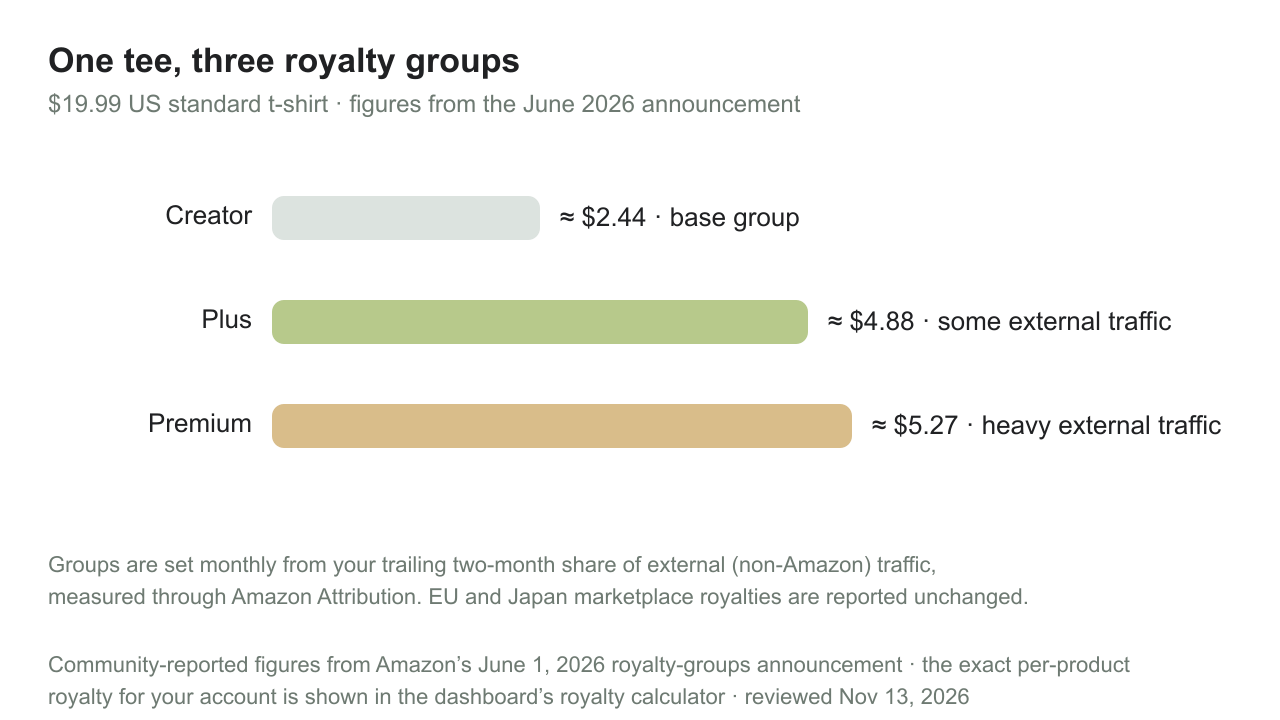
- Since June 1, 2026, US royalties depend on your royalty group (Creator, Plus, Premium), set monthly from your share of external traffic measured through Amazon Attribution. Community-reported figures put a $19.99 standard tee at roughly $2.44 for Creator and $5.27 for Premium.
- Royalties are paid roughly 30 days after the calendar month in which the item shipped — so a bank deposit belongs to activity from two calendar months back. Books built on bank dates will lag reality.
What Merch on Demand is — and isn’t #
Amazon Merch on Demand (launched in 2015 as Merch by Amazon) is Amazon’s print-on-demand program for designers. You upload artwork, choose products and set list prices; Amazon builds the listing, prints the item only after a customer buys it, ships it, handles customer service — and pays you a royalty. There is no inventory to buy, nothing to fulfill, and no customer to chase.
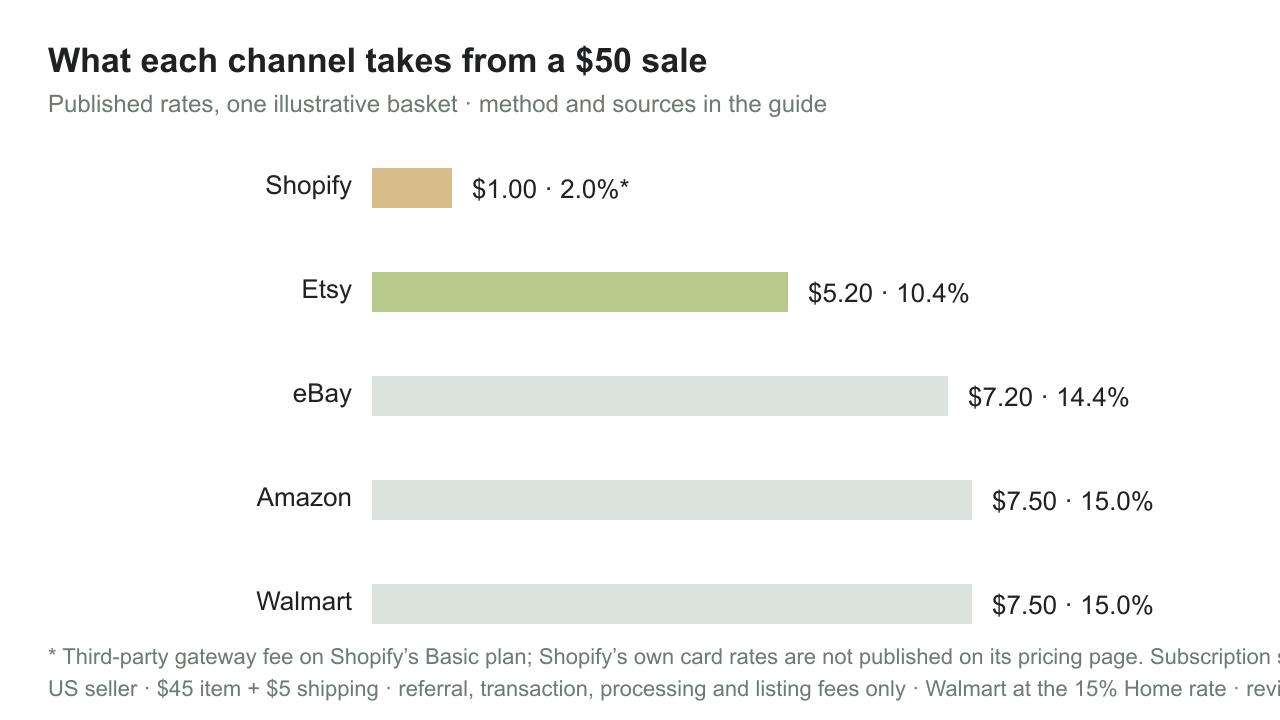
The structure differs from ordinary Amazon selling in a way that matters for everything downstream, especially your books. In a normal Seller Central arrangement, you are the seller: revenue lands in your account gross, then Amazon deducts referral and fulfillment fees. On Merch, Amazon itself is the seller of record. The buyer’s money belongs to Amazon; what you receive is a royalty — a license payment for your design — calculated and netted before you ever see it. On our $50 take-rate basket, an Amazon seller pays $7.50 in referral fees and books the rest as revenue. A Merch creator never books the $50 at all — only the royalty that survives Amazon’s costs.
Membership is not automatic: you request an invitation at merch.amazon.com, Amazon reviews the application, and approval can take weeks. There is no guarantee of acceptance, and account limits start small even for approved creators.
How the program works, end to end #
The lifecycle is short enough to summarize in one paragraph, but each step has a rule attached:
- Request an invitation at merch.amazon.com, describing your brand and design experience. Amazon approves or declines; timing varies from days to weeks.
- Upload designs to the product catalog. Uploads are rationed by your tier (see the tier system) with daily limits that reset at midnight Pacific time.
- Amazon reviews each submission — for image quality, policy compliance and originality. Approved designs become listings; rejected ones come back with a reason.
- Set products, colors and list prices. Amazon shows a projected royalty per product at pricing time, using its current costs for that marketplace.
- Customers buy; Amazon produces and ships. The listing, checkout, printing, delivery, returns and buyer messages are all Amazon’s side of the fence.
- Royalties accrue per sale and are aggregated into a monthly payment to your bank account, roughly 30 days after the month in which the item shipped (see when royalties are paid).
One nuance worth knowing early: a royalty is earned when the product ships, not when the design is uploaded or even ordered — and if a buyer returns an item, the associated royalty can be clawed back or adjusted. Expect small negative movements in your royalty statements from time to time, and don’t treat every statement line as permanent income until the return window has closed.
What you can sell, and where #
The catalog started with t-shirts and has expanded repeatedly: standard and premium tees, hoodies, sweatshirts, tank tops, pullovers, phone cases, PopSockets grips, mugs, tote bags and throw pillows have all appeared. Amazon adds and retires product types periodically, so treat your dashboard’s product catalog — not any blog post, including this one — as the current truth.
Approved designs sell across Amazon’s participating Merch marketplaces: the United States, United Kingdom, Germany, France, Italy, Spain and Japan. The same design can be live in all of them simultaneously, which multiplies your listing reach without extra upload work. It also means your royalty arrives as a multi-currency aggregate: UK, German and Japanese sales are earned in pounds, euros and yen, then converted into your payout currency with conversion costs borne on your side of the ledger. Printing costs and price points differ by marketplace, so the same tee at the same converted price can pay a different royalty in Tokyo and in Texas — the dashboard’s royalty calculator shows the per-marketplace figure before you publish.
The royalty formula #
Amazon’s official royalties page states the formula compactly: your royalty is based on your product’s offer price, less any applicable tax and Amazon’s costs, with a multiplier applied based on your royalty group. Three parts of that sentence deserve unpacking.
“Offer price” means the price the customer actually paid, not the list price you set in the portal. If a sale closed through a promotion, coupon or price match, the royalty is computed on what the buyer actually paid. Sellers who see a royalty smaller than the calculator projected are usually looking at a discounted sale.
“Less applicable tax” means the royalty is calculated on the pre-tax portion of the price. Amazon, as marketplace facilitator, collects and remits sales tax, VAT or GST on the transaction; the tax slice never passes through your royalty at all. This is the same pattern as marketplace facilitator rules elsewhere: the tax is real money the buyer paid, but it is never your income to book.
“Amazon’s costs” are the printing and fulfillment costs for that product in that marketplace — the blank, the print, the packing and the shipping that Amazon performs. They differ by product type and by country, and they change; your portal shows the current per-product figure rather than publishing a fixed table. This is why the same design pays different royalties on a hoodie than on a tee, and different again in each marketplace.
The practical consequence: you cannot compute your royalty from the list price alone. The honest calculation needs the customer-paid price, the applicable tax treatment, Amazon’s current costs for that product and marketplace, and your royalty group multiplier — which is exactly why Amazon shows a projected royalty in the dashboard instead of letting you do the arithmetic.
Royalty groups: the 2026 change #
The single most consequential change to the program since launch took effect June 1, 2026, for the US store: Amazon replaced a single royalty schedule with three royalty groups, and the group you land in is set by how much of your traffic you bring from outside Amazon.
| Royalty group | Who lands there | Reported $19.99 standard-tee royalty |
|---|---|---|
| Creator | The base group — sales driven by Amazon’s own organic traffic | ≈ $2.44 (roughly half of earlier per-sale earnings, as widely reported) |
| Plus | Creators with a meaningful share of external traffic | ≈ $4.88 (about 2× Creator) |
| Premium | Reportedly requires at least ~35% of unit sales from external traffic | ≈ $5.27 (about 2.16× Creator) |
Per-tee figures are community-reported from Amazon’s June 2026 announcement and vary by product; the authoritative number for your account is in the dashboard’s royalty calculator. Reviewed November 13, 2026.
The mechanics, as announced: Amazon computes a trailing two-month average of your external-traffic share — the portion of your unit sales arriving from links you placed outside Amazon, measured through Amazon Attribution tags — and assigns your group from that average, refreshed monthly. Sellers whose designs live entirely on Amazon organic traffic were moved toward the Creator base rate; creators who actively market their designs on social media, newsletters or their own sites, with properly tagged links, qualify for Plus or Premium. Reported at launch, the change left EU and Japan marketplace royalty schedules unchanged, applying to the US store first.
For decision-making, read the change as Amazon repricing demand generation: organic reach on the marketplace is now priced into the royalty rather than given away. If you already market your designs, tagging those links with Attribution is the difference between roughly $2.44 and roughly $5 per standard tee at the reported rates. If you do not, the math has to come from somewhere else — higher list prices, better niches, or accepting the base rate as the cost of pure passive distribution.
What a typical royalty looks like #
With formula, groups and costs in hand, the honest answer to “how much does a shirt pay?” is a range, not a number. Community-reported figures for the US standard tee at $19.99 cluster around $2.44 per sale for Creator-group sellers after the June 2026 change, with Plus and Premium near $4.88 and $5.27; before the change, the same shirt was widely reported around $4.89. Third-party guides cite lower royalties on cheaper shirts — one guide’s example puts a $15.99 tee near $1.93 — and higher royalties on premium products at higher price points. Treat all of these as illustrations of the spread, not as quotes.
A fictional month with one design
A design sells 60 standard tees at $19.99 in the US in Creator group, plus 12 units in the UK at £16.99. The US royalties compute from Amazon’s US costs and the Creator multiplier; the UK royalties compute from UK costs in pounds, converted to dollars on payout. The two lines on the statement will not match any single per-unit constant — 72 identical sales, two price points, two cost bases, two currencies. A books entry of “72 × $2.44” would be wrong before it was typed.
Two pricing behaviors follow from the formula. Raising the list price raises the royalty more than proportionally once Amazon’s costs are fixed — but demand usually falls, so the calculator’s projected royalty should be compared against realistic conversion, not maximized in isolation. And running a promotion cuts the royalty on every unit sold through it, because the customer-paid price drops; a sale that “feels free” in exposure terms is not free in royalty terms.
The tier system #
Uploads are rationed by tiers named for their slot counts: 10, 25, 100, 500, 1,000 and beyond. Your tier is the number of live designs you may have published at once, and higher tiers also carry larger daily upload limits, which reset at midnight Pacific time. Amazon’s own tier FAQ gives the flattening example: a Tier 10 creator can publish up to 10 designs, which across colors, sizes and marketplace variants can produce up to 640 individual products — a “design slot” is much larger than it sounds.
Graduation between tiers is the program’s longest-running mystery: Amazon does not publish exact criteria. Community consensus, consistent across years of discussion, is that steady sales matter most, with a commonly cited guideline that the large majority of your published designs should have made at least one sale before Amazon invites the next tier. Deleting designs frees slots within your current tier, which is the lever you control directly; tier upgrades arrive when Amazon decides, not when you ask.
For planning, treat the tier as a ceiling on experimentation. A Tier 25 account should assume every upload has to earn its slot — there is no room to park twenty long-shot designs the way a Tier 500 account can.
Design rules and content policy #
Submissions pass a review for quality and policy before they go live. The technical baseline for most apparel, per Amazon’s own resources: a transparent-background PNG at print size — 4,500 × 5,400 pixels (15 × 18 inches at 300 DPI) for standard tees — under 25 MB, in sRGB. Photography-based designs may use JPEG; designs composed directly in Amazon’s tooling accept smaller images. Check the per-product template before designing, because print areas differ across product types.
The content rules are stricter than the file rules, and rejections are common on first attempts:
- No intellectual property you do not own — trademarks, character likenesses, song lyrics, celebrity names and fan art of protected properties are the most frequent rejections and the most common cause of post-publication takedowns.
- No imitation of Amazon’s own branding or packaging.
- No prohibited content — the policy bars material that is violent, hateful, sexually explicit, or otherwise listed in the program’s content policy, along with designs that solicit reviews or include contact information.
- Quality minimums — low-resolution, pixelated or empty-design submissions are rejected at review.
Two quieter rules catch people later. First, listing edits can send a live design back through review while the original stays purchasable during the check — a change that improves nothing can still freeze a bestseller temporarily. Second, long-unsold designs are subject to removal: Amazon historically removed designs with no sales for extended periods, and recent reports describe listings without sales being deleted after roughly eighteen months. The precise window is not something to rely on — treat slots as meant for designs that sell, and re-upload a retired design only if you can genuinely improve its case.
When royalties are paid #
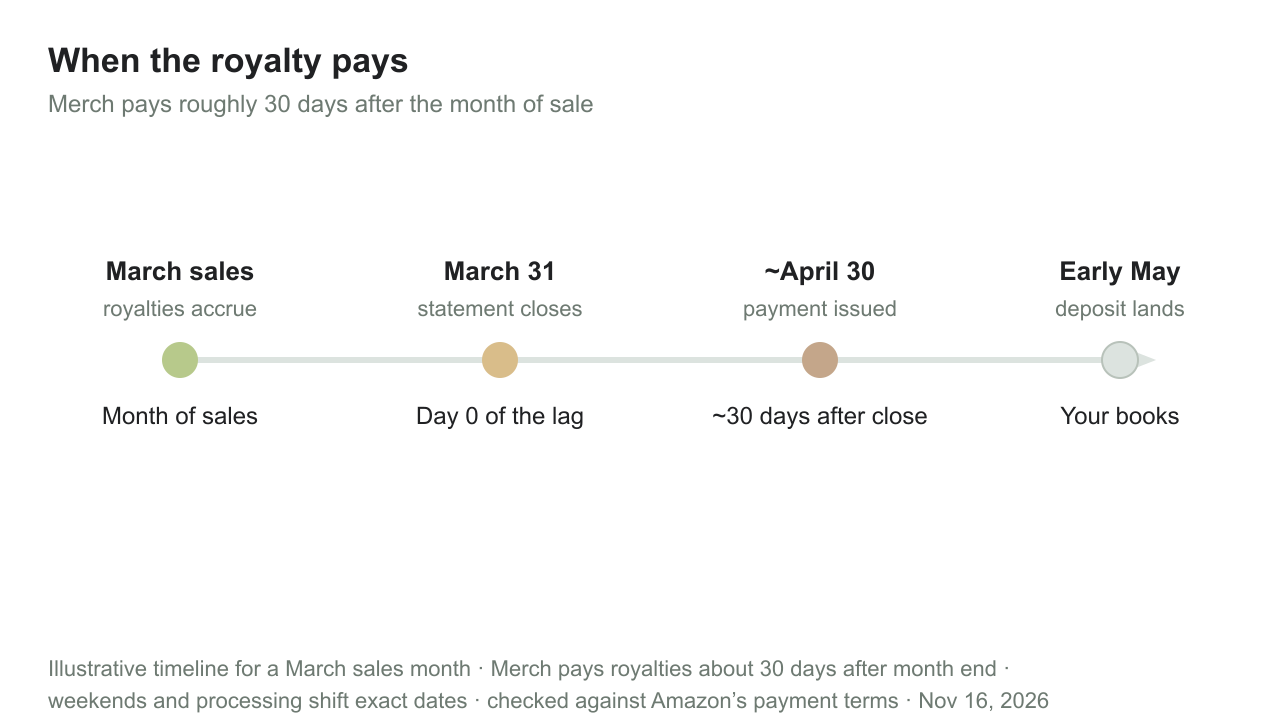
Payments run on a monthly cycle with a lag, defined in Amazon’s Merch services agreement: royalties are paid approximately 30 days after the end of the calendar month in which the final sale occurred, and the “sale” that starts the clock is the shipment. Royalties are aggregated across all marketplaces and paid by electronic transfer to your bank account; Amazon does not publish a minimum payout threshold, and community reports place actual arrival dates around the end of the following month.
A fictional timing chain
Tee A ships June 28: its royalty belongs to June’s cycle, paid around July 30. Tee B is ordered June 30 but ships July 1: the shipment date, not the order date, controls, so its royalty waits for July’s cycle and arrives around August 30. A launch week straddling a month boundary splits its royalties across two payments a month apart. None of this is a delay in any meaningful sense — it is the schedule — but a books system that books income on the bank date will put November’s sales into January’s ledger.
The corollary for returns: a return processed after payment reverses the royalty in a later statement as a negative line. Reconciling statements to payouts line by line catches these before they become “the number doesn’t match” mysteries.
From royalty statement to bank deposit #
The royalty statement is the source of truth; the bank deposit is the outcome. They differ predictably, and the differences are exactly where bookkeeping breaks:
- Period cut. The statement covers a calendar month of shipment activity; the deposit arrives ~30 days later. A deposit in the bank in December is November activity.
- Marketplace aggregation. One payment pools US, UK, German, French, Italian, Spanish and Japanese royalties. The statement breaks them out by marketplace; the deposit is a single number.
- Currency conversion. Non-US royalties are converted to your payout currency at Amazon’s applied rates, with the conversion embedded in the deposit rather than shown as a separate bank line.
- Adjustments. Returns, clawbacks and corrections appear as reductions in later statements.
The reconciliation habit that survives all of this is the same one we recommend for marketplace payouts: take each deposit, find the statement period behind it, bridge the statement total to the deposit through the conversion and adjustment lines, and only then mark it reconciled. Our Amazon deposit versus sales guide covers the same bridge for FBA settlements; the multi-marketplace currency side is in the multi-currency payouts guide.
Recording Merch royalties in your books #
Merch royalties force three bookkeeping decisions that ordinary sellers never face.
Book the royalty, not the sale. The buyer paid $19.99, but $19.99 was never yours — Amazon’s costs and the platform’s margin come out before your royalty is computed. Revenue for a Merch creator is the royalty amount. Recording gross product sales and then “Amazon fees” as an expense double-counts the platform’s share and inflates revenue, which matters when margins, valuations or loan applications are built on the books.
Pick the timing deliberately. On a cash basis, income is the deposit — two months after the underlying sales. On an accrual basis, the royalty is earned when the sale ships, and the month-end accrual bridges the gap. Either is defensible; mixing them mid-year is not. The trade-off is laid out in our cash versus accrual guide, and the monthly routine that keeps either honest is in the month-end close checklist.
Expect the per-unit constant to drift. After the 2026 royalty-group change, the same design at the same price can pay differently from month to month as your traffic mix moves your group, and Amazon’s costs change without announcement. Books that record “royalty per tee = $2.44” as a standing rule will drift away from the statements within a quarter. Book from the statement, and let the per-unit number be an output you review, not an input you assume.
One pleasant surprise: there is no inventory or cost-of-goods problem. Amazon’s printing costs are Amazon’s costs — netted out before your royalty. A creator books no inventory asset, no COGS, no write-offs of unsold stock, which makes Merch one of the cleanest Amazon income streams to keep books for. Our cost of goods sold guide covers the contrast for sellers who do hold inventory.
TidyPayouts was built for deposit-to-books reconciliation: split income streams, match every deposit, flag the difference before it posts.
Taxes on Merch royalties #
Royalty income is still business income. For creators operating as a business, Merch royalties are generally reportable income, deductible expenses are generally limited — there is no COGS — and the accounting treatment of the program (licensing royalty versus sales proceeds) can affect how the income is characterized on a return. Amazon collects tax information during onboarding and may issue tax forms depending on your account setup, jurisdiction and activity; the exact forms and thresholds vary, so treat Amazon’s tax pages and your own tax professional as the authorities rather than this post.
Marketplace reporting rules (the 1099-K world our 1099-K guide covers) were written around marketplace sellers, not royalty programs, and reporting practice for Merch income may not match a settlement-based seller’s. Do not reconcile your tax paperwork against another creator’s forms without checking whose situation actually matches yours — and keep the monthly royalty statements archived, because they are the underlying records any return will need.
Merch versus other print-on-demand routes #
Merch is not the only way to sell print-on-demand on Amazon, and the bookkeeping differs as much as the economics:
- Merch on Demand — invite-only, no seller fees, royalty-only income, Amazon as seller of record. Trade-off: no customer data, limited pricing control, and now traffic-dependent royalty groups.
- Third-party POD (Printful, Printify and similar) through Seller Central — you are the seller: your listing, your margin, your brand on the package. You pay Amazon’s referral fees (typically around 15% of the sale, per Amazon’s published schedules), fulfillment via the POD partner, and either the per-item fee of an individual selling plan or a professional subscription. More control, more cost lines, and books that look like normal FBA/MFN books. Check current fee schedules before comparing margins — they move.
- POD marketplaces off Amazon (Redbubble and similar) — their audience, their base prices, your artist margin set as a percentage on top. Simpler books, smaller reach, and royalties that resemble Merch’s model more than Seller Central’s.
The chooser’s shortcut: if you want Amazon’s demand and minimal operations, Merch is the lowest-lift route — its cost is the royalty structure described above. If you want customer ownership, pricing power and a brand, the Seller Central route costs more in fees but books like a real store. Many creators run both and let the statements, not the lore, decide where designs go first.
Getting in — and getting accepted #
Applications ask for your background, your brand and your intent. Approvals take anywhere from days to weeks, and rejection is common enough that the community maintains lists of what tends to work: a real web presence or portfolio to point at, a concrete description of your niche and audience, original designs rather than trend-chasing, and honest answers about trademarks you hold or license. An empty application box is a rejection.
Rejections usually cite design quality, policy problems, lack of originality, or simply too little information to judge the application. None of these are permanent: tightening the portfolio and reapplying is the documented path, and accounts that get in start at Tier 10 regardless of experience elsewhere.
A candid note on “is it worth it”: the program’s economics changed materially with the 2026 royalty groups, and the creators who still do well are the ones who bring traffic, pick niches carefully, or operate at scale in higher tiers. As a zero-capital side channel it remains one of the lowest-risk ways to sell designs; as a business plan, it deserves the same math as any other channel — which is the point of the rest of this post.
Common questions #
How much does Amazon pay per shirt on Merch on Demand?+
It depends on the product, the marketplace, the customer-paid price and your royalty group. Community-reported figures for a $19.99 US standard tee put Creator-group royalties near $2.44, with Plus near $4.88 and Premium near $5.27 after the June 2026 change. The authoritative number for your design is the projected royalty in your dashboard’s calculator.
Is Amazon Merch on Demand free?+
There are no joining, upload, listing or subscription fees, and Amazon’s printing costs come out of the sale before your royalty — so you never pay out of pocket for a sale. The “cost” is structural: Amazon’s share is already netted out of the royalty, and you receive only the remainder.
When does Amazon pay Merch royalties?+
Approximately 30 days after the end of the calendar month in which the product shipped, per Amazon’s services agreement — with sales aggregated across marketplaces into one electronic transfer to your bank. A sale shipped in June is paid around the end of July; month-end shipments can roll into the next cycle.
Do I handle printing, shipping or customer service?+
No. Amazon produces each item after the sale, ships it, and handles buyer service and returns. Returns can adjust or claw back the associated royalty in a later statement, which is worth expecting rather than being surprised by.
Why did my Merch royalty go down in 2026?+
Most likely the June 1, 2026 royalty-group change: US royalties now depend on your group (Creator, Plus, Premium), assigned monthly from your trailing two-month share of external traffic measured through Amazon Attribution. Sellers relying on Amazon organic traffic were widely reported moving to the lower Creator base rate; tagging your outside links with Attribution is the documented path to higher groups.
What are the Merch on Demand tiers and upload limits?+
Tiers are named for live-design slots: 10, 25, 100, 500, 1,000 and beyond, with daily upload limits that reset at midnight Pacific. Amazon’s FAQ notes a Tier 10 creator can publish 10 designs, producing up to 640 product variants across locales. Promotion criteria are not published; community guidance centers on consistent sales across most of your published designs.
Are Merch royalties taxable?+
Royalties are generally reportable income for creators operating a business. Amazon gathers tax details at onboarding and may issue forms depending on your account and jurisdiction, and marketplace reporting rules do not always map cleanly onto royalty programs. Confirm your own reporting with a tax professional and keep the monthly royalty statements as support.
Do Merch royalties appear in Seller Central?+
No. Merch on Demand is a separate program with its own dashboard, statements and payment cycle — it does not flow through Seller Central settlements. If you also sell through Seller Central, expect two different Amazon income streams with different statement formats, different timing, and different bookkeeping treatment, each reconciled to the bank on its own.
Sources and review date #
Reviewed November 13, 2026 against Amazon’s Merch on Demand pages below. Program terms, royalty groups and product catalogs change — confirm current figures in your own dashboard and on Amazon’s pages before making decisions. Community-reported figures are labelled as such; examples are fictional.
Change log. November 13, 2026: Page title and summary shortened for search results; the guidance is unchanged.