Tidy
In this article
- A negative payout means a period’s refunds, fees and adjustments exceeded its sales.
- The shortfall is recovered in one of three ways: netted against the next payout, collected from a bank or card, or paid by you.
- Record the shortfall in the channel’s clearing account so it shows as an amount owed, not as a lost deposit.
- Always compare the next payout with the carried-forward amount before investigating anything else.
What a negative payout is #
A payout is the net of everything in a settlement period: sales and shipping in, refunds, fees, advertising, reserves and adjustments out. Usually the sales are larger, so the net is a deposit. When a period has few sales but large refunds or fixed charges, the net can be below zero. The marketplace then has a shortfall to recover from you, and what it does next depends on the channel and the account.
It is a normal enough outcome for a seasonal business, a seller with a bad refund week, or an account whose subscription and storage fees outrun a quiet month. It becomes a problem only when it is not recorded.
The common causes #
- Refunds for earlier sales. A large return wave after a busy period is paid out of a quiet one.
- Fixed and recurring charges. Subscriptions, storage and monthly service fees do not depend on this period’s sales.
- Advertising deducted from payouts. Campaign spend can exceed sales in a launch or a slow week.
- Chargebacks and disputes. A reversal can arrive long after the sale it relates to.
- Reimbursement reversals or adjustments. A credit given earlier is sometimes withdrawn.
- Reserve changes. A hold can turn a small positive payout into a negative one.
Identify which of these is behind the shortfall from the settlement’s own lines, before deciding how to book it. Our guides to returns and chargebacks explain the first and fourth in detail.
Three ways the shortfall is recovered #
Platforms differ, and an account’s own terms decide which applies, so check the payment page for your account instead of assuming. In practice you will see one of these:
| Outcome | What you see | How it reaches your books |
|---|---|---|
| Carried forward | The next payout is smaller by the shortfall | The clearing account holds a negative balance until the next payout clears it |
| Collected from a bank or card | A separate debit appears on a statement | The debit clears the negative balance in the clearing account |
| Paid by you | You transfer or pay an invoice | The payment clears the negative balance |
In all three, the shortfall is the same amount, owed by you to the marketplace. The only difference is how it is settled.
A worked example: carried forward #
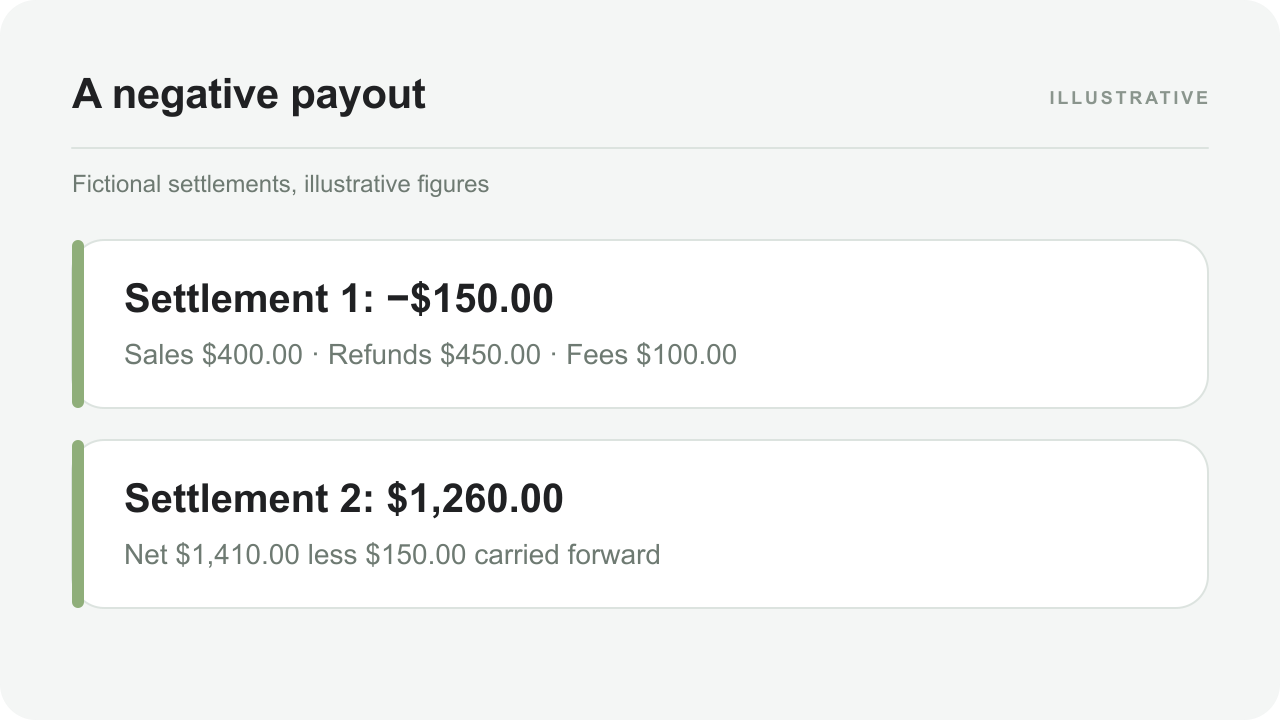
Two fictional settlements
Settlement 1 has $400.00 of sales, $450.00 of refunds and $100.00 of fees, so the net is −$150.00 and nothing is deposited. Settlement 2 has $1,800.00 of sales, $120.00 of refunds and $270.00 of fees, a net of $1,410.00 before the carried amount. The marketplace deducts the $150.00 shortfall, so the deposit is $1,260.00.
Illustrative figures. Check: $400.00 − $450.00 − $100.00 = −$150.00; $1,800.00 − $120.00 − $270.00 = $1,410.00; $1,410.00 − $150.00 = $1,260.00.
In the books, Settlement 1 posts its sales, refunds and fees and leaves clearing with a $150.00 credit balance, which is an amount you owe. Settlement 2 posts its parts, leaving clearing with a $1,410.00 debit before the carry, and the $1,260.00 deposit plus the earlier $150.00 credit nets clearing to zero. If the deposit were booked as sales, revenue would be overstated and clearing would never reach zero.
When the shortfall is collected elsewhere #
If the marketplace debits your bank or card instead, the bank feed will show an outgoing line with no sale behind it. Match it to the clearing account rather than categorizing it as an expense. The settlement already recorded the refunds and fees that caused the shortfall, so booking the debit as an expense counts them twice. The same applies when you pay an invoice from the marketplace: the payment settles an amount already recognized.
How to investigate before you book #
- Open the settlement and total each group: sales, refunds, fees, advertising, reserve and adjustments.
- Find the group that moved the most compared with a normal period.
- Trace large refunds to their original orders to confirm they are valid and in the right period.
- Check for charges unrelated to sales, such as subscriptions or storage.
- Read the account’s payment page to see how the shortfall will be recovered.
- Write a one-line note with the settlement ID and the expected recovery date.
The payout reconciliation calculator rebuilds a payout from its parts so you can see which component caused the negative, and the fee list helps identify unfamiliar charges.
Forecasting around a shortfall #
A carried-forward amount is cash you will not receive, so subtract it from the next expected payout in your forecast. If the cause is recurring, such as a subscription that exceeds sales in the off season, the shortfall will recur, and the forecast should include it. The payout forecaster lets you adjust expected amounts per channel, and our payout schedules guide explains how to build the four-week view.
A second example: the marketplace debits your bank #
A fictional bank debit
The same −$150.00 settlement is not carried forward. Instead the marketplace debits $150.00 from your bank account. The settlement entry leaves clearing with a $150.00 credit balance; the bank debit then reduces the bank and debits clearing $150.00, returning it to zero. No expense is booked for the debit, because the refunds and fees behind it are already in the settlement entry.
Illustrative figures.
Months with only fixed charges #
A quiet month can produce a settlement with almost no sales and several fixed charges, such as a subscription, storage or a service fee. The net is negative for a simple reason, and it will recur until sales return. Book the charges in their normal expense accounts, leave the shortfall in clearing, and expect it to net against the next positive payout. If the same pattern repeats for several months, that is a business signal worth a look: those fixed costs are being funded by earlier sales.
If you disagree with a charge or refund #
Sometimes the cause of a negative payout is something you think is wrong, such as a refund on an order you never received a return for, or a fee you did not expect. Collect the settlement ID, the order or transaction ID, the amount and the date, and contact the marketplace’s seller support through the account’s normal channel. Keep the reply with your records. Until it is resolved, book what the settlement says; if a credit follows, it will appear as its own line in a later settlement and should be recorded when it does.
What to tell your bookkeeper #
- Which settlement was negative, and by how much.
- What drove it: refunds, fixed charges, advertising, a chargeback or a reserve change.
- How the shortfall is being recovered and when you expect it to clear.
- Whether the period is closed, since a correction may need to go in the current period.
A message with those four points lets a bookkeeper answer in one reply.
Avoiding surprise shortfalls #
A negative payout is easier to handle when you saw it coming. Check each channel’s pending or upcoming settlement partway through the period, because it shows refunds and fees accumulating before the total is final. Watch the refund rate and the advertising share of sales each week, since a spike in either can turn a thin period negative. Keep a cash buffer sized to the largest recurring fixed charge, so a quiet month does not collide with a bill. And when you plan inventory purchases, use the cautious cash forecast, not the expected one, as described in our payout schedules guide.
Mistakes that make it worse #
- Ignoring the negative balance until the next deposit looks too small.
- Booking the carried-forward amount as an expense instead of clearing it against the next payout.
- Treating a bank debit from the marketplace as a new expense.
- Writing the amount off before confirming how and whether it will be recovered.
- Not looking for a pattern: a recurring negative usually has a recurring cause.
When shortfalls repeat: fixing the source #
A single negative payout is an event; a pattern of them is a diagnosis. Shortfalls that recur month after month almost always trace to one of a short list of sources, and the settlement detail names which: a returns-heavy SKU whose refunds outrun its sales (the fix is pricing or listing quality, not bookkeeping), advertising spend that outruns revenue (the campaign budget becomes a fixed monthly debit), storage or subscription charges growing faster than sales (an inventory aging problem wearing a fee costume), or fulfillment charges on slow-moving stock. The way to see which is to chart the shortfall’s components for three months — the dominant component is the source, and the source has an owner outside the books.
The bookkeeping role in this is honesty about the trend line. A shortfall tracked as a single negative number every month reads as “Amazon owes us fluctuating money”; the same shortfall split by component reads as “returns on SKU B cost $640 this month.” The first invites a shrug, the second a decision. That re-sorting is exactly what the fees-by-type accounts this series recommends make trivial — the diagnosis is a report you already have.
The tax timing wrinkle #
Negative payouts interact with the tax year in a way that surprises cash-basis sellers. On cash books, income is recognized when the deposit arrives — and a deposit that arrives smaller than the fees it nets has already shrunken the year’s income by the shortfall, correctly. But the mirror case catches people: fees charged in December that reduce a January payout make December’s books look richer than the cash that will ever arrive from that activity, and January’s books absorb the hit with no offsetting revenue. The year-end consequence: a cash-basis December profit that includes fee-heavy sales is not the cash profit it appears to be, and the January return wave makes it worse.
Two mitigations, both legal on cash basis because they are disclosures rather than accruals: note the known unrecovered shortfalls in the year-end close note so the tax preparer can discuss timing, and run the thirteen-week cash forecast (above) across the year boundary so the business itself sees the January hole coming. Accrual books sidestep the wrinkle entirely — the expense and the sale land in the same period by construction — which is one more item for the cash versus accrual conversation with your tax professional.
Common questions #
Do I owe the marketplace money when a payout is negative?+
Effectively yes: the shortfall is an amount the marketplace expects to recover, by netting it against future payouts, collecting from a bank or card, or asking you to pay. Your account’s payment page shows which.
Where does a negative balance go in my books?+
In the channel’s clearing account as a credit balance until it is settled. It is not an expense; the refunds and fees behind it were already recorded.
What if the shortfall is never recovered?+
Treat that as a separate event once the marketplace has confirmed it is waived or written off, and record it with your bookkeeper. Do not write it off in advance.
Will a negative payout stop future payouts?+
It can delay them. Many marketplaces recover the shortfall first and pay out only what remains, so the next deposit may be smaller or absent until the balance is covered. Check your account’s payment page for how it applies to you.
Is a negative payout the same as a negative reserve?+
No. A negative payout is a settlement whose net is below zero. A reserve is money held back from a settlement. They can occur together, but they are recorded in different accounts.
Sources and review date #
Written November 13, 2026 from general bookkeeping practice. Provider behaviour varies by account and changes over time, so confirm the details against your own statements and the help pages below. Examples are fictional; confirm account mappings and tax treatment with your bookkeeper.