Tidy
In this article
- “Selling to Amazon directly” means the wholesale (1P) relationship: Amazon issues purchase orders, buys inventory at a negotiated cost price, resells it as the seller of record, and pays on negotiated terms.
- The program is invite-only. The open self-signup route (Vendor Express) closed years ago, and vendors today are typically strong 3P sellers Amazon approached.
- There are no per-order selling fees, but there are negotiated deductions instead: marketing co-op, compliance chargebacks and shortage or price claims that come off your invoices.
- The trade is margin density for volume and reach — and the books change shape: revenue at the PO price, a receivable instead of a clearing account, and a remittance advice to reconcile before the bank credit.
What selling to Amazon directly means #
Most of what this blog covers is the marketplace relationship: you list as a seller, buyers order, Amazon (or you) fulfills, and a settlement becomes a deposit. Selling to Amazon directly is the other arrangement. In the wholesale model — “1P,” vendor relationships run in Vendor Central — Amazon is not your sales channel; it is your customer. Amazon issues purchase orders, you ship at an agreed cost price, Amazon lists the product, sets its retail price, and sells it as the seller of record, with the “Ships from and sold by Amazon.com” stamp that carries real buyer trust.
The division of labor inverts. As a marketplace seller you do the listing, the pricing, the advertising, the customer service and the returns, and pay Amazon a percentage per order for fulfillment and reach. As a vendor you do manufacturing and shipping-to-spec, and Amazon does almost everything else — and keeps the margin between your wholesale price and its retail price, which is commonly wider than your entire marketplace fee stack.
One piece of history explains the doorway. Amazon once ran an open self-signup route called Vendor Express; it closed years ago, and the program has been invite-only since. Today’s vendors are overwhelmingly brands Amazon approached — usually because their 3P velocity on an ASIN made Amazon Retail want the item directly. There is no application form; the practical path in runs through Seller Central, not around it. (A second, narrower path — Amazon converting an invited seller’s ASINs through its Seller to Vendor flow — exists for brands Amazon specifically wants on the retail side.)
How a purchase order becomes a payment #
The 3P money cycle is fast and self-documenting: orders accrue, a settlement cuts every two weeks or so, and the deposit ties to a report. The 1P cycle is a procurement chain, and every link generates paperwork:
- The PO arrives. Amazon’s buyers decide what they want, in what quantities, at what cost price. You can accept, adjust, or negotiate — Amazon decides whether to revise or place the volume elsewhere.
- You acknowledge and ship. Shipments follow Amazon’s routing requirements: labels, carton markings, delivery windows, and an advance shipment notice describing what is coming. Get these wrong and the deductions in the next section are waiting.
- You invoice at the PO price. The invoice, not a settlement report, is the document your books book revenue against.
- Amazon receives and reconciles. Receipts are matched against the ASN and the PO. Shortages, late deliveries and compliance errors surface as claims against your invoice.
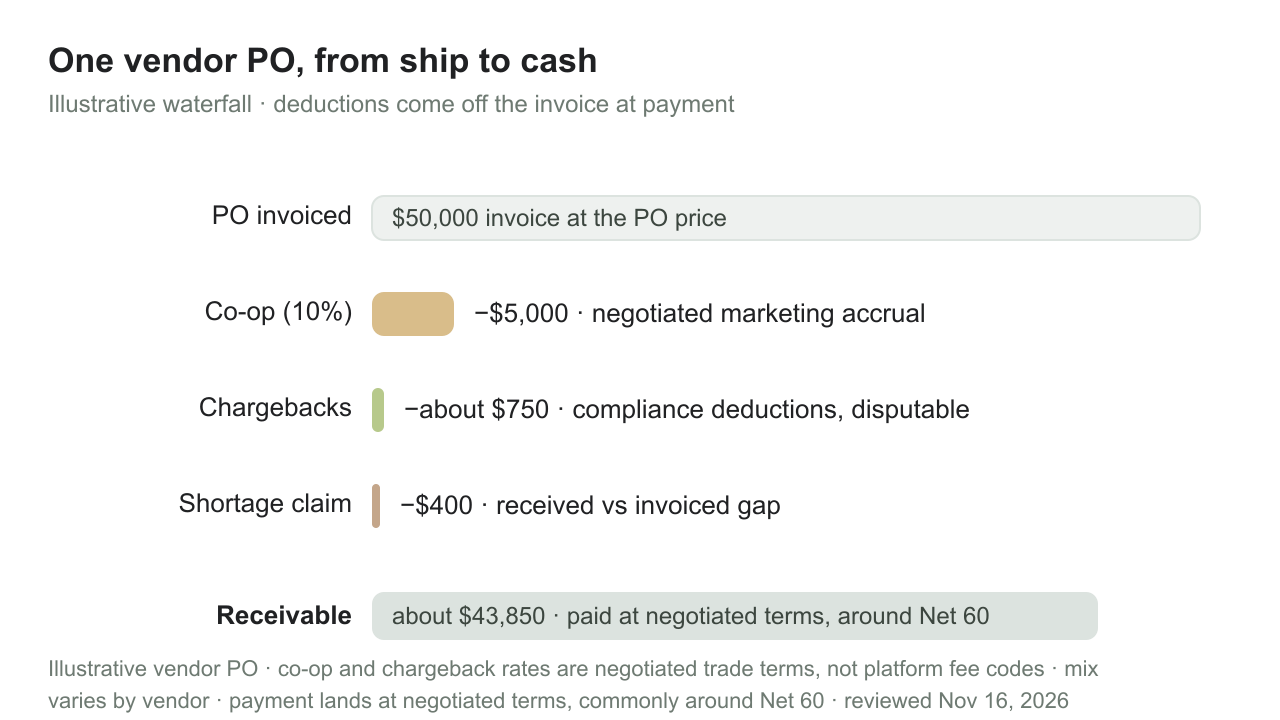
- Deductions come off. When Amazon pays, it pays the invoice less whatever deductions it has taken — negotiated marketing accruals, chargebacks, shortage and price claims — each with a reason code on the remittance advice.
- The remittance arrives, then the cash. The remittance advice is the 1P cousin of the settlement report: the document that explains why the bank credit is smaller than the invoice. Payment lands on negotiated terms — commonly around Net 60 in market-reported discussions of standard trade terms.
That last bullet is the whole reason this article exists on a bookkeeping blog: the 1P deposit is a net of a net, derived from an invoice you posted weeks earlier, minus claims you may not have seen coming. Our deposit versus sales guide makes the same point about 3P settlements; in 1P the gap is bigger and the paperwork is the only bridge across it.
Wholesale pricing, co-op and deductions #
The cost price on a PO is a negotiated number, set per product, typically anchored near half of the expected retail price — product-dependent, and worth modeling on your own volumes rather than assuming. Two structural facts matter more than any single percentage. First, Amazon sets the retail price after buying from you, so its discounts come out of Amazon’s margin — but price claims, where Amazon bills back part of a discount it took at or below your cost, are a known deduction category, which is why the contract language around price protection gets negotiated hard. Second, unlike the fixed 3P fee schedule we walk through in the Amazon fees guide, these terms are negotiable — that is the quiet upside of being a supplier to a buyer who wants your product.
The recurring deduction lines to expect:
- Marketing co-op. A negotiated percentage of invoiced sales funding Amazon-retail marketing — commonly discussed around the 10% mark for vendors whose terms include it. It accrues off invoices automatically; the fight, when there is one, is over whether the accrual matches a signed agreement.
- Compliance chargebacks. Covered properly in the next section, because they behave differently from everything negotiated.
- Shortage claims. When received quantity is less than invoiced quantity, the difference is deducted until resolved — sometimes for paperwork reasons rather than actual missing cartons.
- Price claims and other billbacks. Discounts Amazon took that it allocates back to the vendor under the terms of the trade agreement.
The discipline that keeps these honest is the same one our settlement guides teach: never let “Amazon’s net payment” be a single number in the books. Every deduction category is its own account, every remittance line maps to one, and every unexplained line gets chased while the dispute window is still open.
Chargebacks: the deduction line vendors don’t expect #
Marketplace sellers know chargebacks as buyer payment disputes. In Vendor Central the word means something entirely different: compliance deductions — penalties Amazon takes against your invoice when a shipment breaks its receiving rules. The published reason codes cover dozens of situations (guides in the trade count forty-plus types): late PO confirmation, shipment outside the delivery window, missing or inaccurate advance shipment notices, incorrect labels or carton markings, pallet and packaging failures.
Three things make chargebacks a real margin line rather than noise. They scale with volume — a packaging defect hits every PO until fixed. They are disputable with paperwork — the PO, the bill of lading, the ASN and photographs are the evidence, disputed through Vendor Central within the claim window. And they are diagnostic — a chargeback rate that creeps up is a broken process somewhere in your shipping chain, visible in the books before it is visible in the warehouse. Vendors who audit their deduction codes monthly recover real money; vendors who treat the remittance total as truth subsidize Amazon’s receiving department.
Payment terms and cash flow #
Marketplace selling pays quickly and often; wholesale pays slowly and in lumps. 3P settlements arrive roughly every two weeks, net of fees, and the money is spendable. A vendor invoice pays on negotiated terms — commonly around Net 60 — counted from invoice or delivery depending on the agreement, and that is before any dispute freezes a portion of it.
The working-capital consequence is easy to underweight because each step looks reasonable. You fund production and freight, ship, wait for receipt, wait for the terms to run, absorb deductions, then get paid — routinely two to three months between spending cash on inventory and seeing cash from Amazon Retail for it. Scale the habit across POs and the vendor relationship runs on a permanent inventory float that the same product sold 3P would not carry. This is the quiet reason some brands accept an invitation for a slice of their catalog and keep the rest in Seller Central: the float has to be financed from somewhere, and 3P settlements are a funding source that arrives every fourteen days. Our reserve balance guide covers the 3P version of held money; 1P terms are the same problem with a longer clock.
Accrual books see the truth on time: revenue lands when the invoice is issued, and the receivable carries the wait. Cash-basis books show a lumpy, seasonal-looking business that actually shipped steadily. Which basis you run is the cash versus accrual decision with the stakes turned up.
Vendor versus seller: the same item, two ledgers #
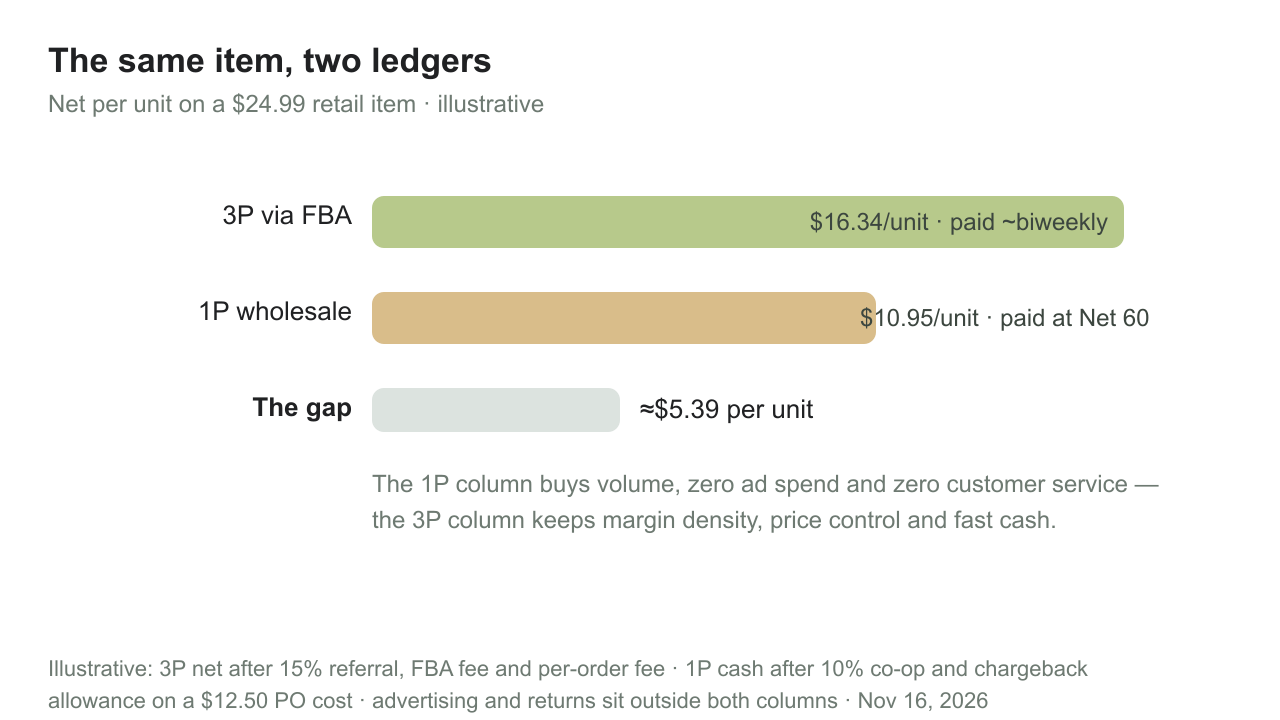
One fictional widget, sold both ways
A widget retails at $24.99. All figures illustrative.
Sold 3P through FBA: referral fee 15% ($3.75), fulfillment fee about $4.50, per-order fee $0.40 — about $8.65 of platform cost, netting roughly $16.34 before landed COGS and advertising. You set the price, own the listing and the customer relationship, and settlements arrive about twice a month.
Sold 1P: Amazon’s PO cost lands near $12.50 (half of expected retail, illustrative). Co-op at 10% takes $1.25, a modest chargeback and shortage allowance takes another $0.30, leaving about $10.95 of cash per unit — paid two to three months after the product shipped, with no advertising spend, no customer service, and Amazon’s retail reach behind it.
Per unit, 3P nets about 1.5× the cash. That is not the whole verdict: the 1P column carries no ad budget, no returns processing and volume Amazon Retail can push with its own merchandising — while the 3P column keeps price control, the customer, and fast cash. The honest comparison runs the item’s actual volumes through both columns, including the working-capital cost of the 1P float.
Illustrative arithmetic, not a quote. Wholesale prices, co-op percentages and terms are negotiated per vendor; marketplace fees vary by category and fulfillment choice.
Read the example as a shape, not a score. The 1P column wins where velocity is high, advertising is expensive, and capital is cheap. The 3P column wins where margin density funds growth, price control matters, and cash cycles are already tight. Neither column survives contact with a real catalog unchanged — which is why hybrid arrangements exist, and why the invitation deserves arithmetic before enthusiasm.
What you give up #
- The price. Amazon Retail sets its own retail price on inventory it owns. Your leverage over positioning is your negotiation, not a repricer.
- The detail page relationship. If the same ASIN sells both ways, one detail page serves both offers, and Amazon’s own retail offer generally wins the buy box on it. Running 1P and 3P on one ASIN needs deliberate coordination, or the two channels underprice each other.
- The customer. Amazon owns the buyer relationship in both models, but the 1P vendor sees even less of the demand data than a seller does — vendor analytics are widely reported to be thinner than Seller Central’s, unless bought as a premium add-on.
- Pace. PO quantities, timing and assortment are Amazon’s decisions. Inventory planning shifts from “how much do I stock” to “how reliably do I fill what they order,” and unfilled POs have consequences at renewal time.
One old differentiator is gone: Amazon Vine used to be a vendor-side perk, but it has been open to sellers for years, with enrollment tiers since October 2023 running $0 for up to two units, $75 for up to ten, and $200 for up to thirty per parent ASIN. Review access is no longer a reason to want the invitation; margin structure is.
Getting in — and staying out on purpose #
Invitations follow 3P success: a brand-registered catalog with strong velocity on ASINs Amazon Retail wants is what gets a vendor manager’s attention, and brands that want the invitation sometimes reach out to Amazon’s brand and vendor managers directly, with mixed results. There is no form to fill in and no fee to pay for access — the cost structure only begins once a PO does.
The deliberate alternative deserves equal airtime. Staying 3P keeps the margin density, the price control, the settlement cadence and the customer data; the settlement discipline that keeps those books clean is well-trodden. A vendor invitation accepted for part of a catalog — the SKUs where Amazon’s retail reach genuinely beats your own advertising, funded by the float you can afford — is a rational hybrid many brands run. An invitation accepted for everything because “sold by Amazon” feels like a trophy is how brands discover that wholesale margin, Net 60 terms and deduction overhead together can earn less than the marketplace business they replaced. Model it first: the unit-economics habit from our take rates guide is exactly the tool, pointed at a different fee schedule.
How vendor sales land in your books #
The 3P books structure this blog teaches — sales, refunds, fee buckets and a clearing account swept by each deposit — does not transfer to 1P, because the documents differ. The vendor books are built around the invoice:
- Revenue at the PO price, when you ship and invoice. Accrual books recognize vendor revenue on invoiced shipments — not when Amazon pays, and not at Amazon’s retail price. The wholesale price is your revenue; Amazon’s markup never passes through your P&L.
- A receivable, not a clearing account. 3P uses an “Amazon clearing” asset that each deposit sweeps to zero on a two-week cycle. 1P needs an “Amazon 1P receivable” account that carries invoice balances for months, per the payment terms. Mixing the two accounts turns a two-week reconciliation into a forensic project; keep them separate the way the clearing account guide keeps channels separate.
- Deductions by kind, not by amount. Co-op to a marketing or contra-revenue account (pick one policy and keep it), chargebacks to their own expense bucket, shortage claims to shrinkage or contra-revenue, price claims where the contract says they belong. A single “Amazon deductions” account hides the one number — chargeback rate — that tells you whether your shipping operation is healthy.
- The remittance advice is the settlement report. Reconcile it line by line against the invoice and the bank credit, exactly as the month-end close reconciles a 3P payout — and chase unexplained codes inside the dispute window, not at year end. Recovered disputes come back as credit lines, the same way fee credits do.
- Month-end accruals for shipped-but-unpaid POs. The receivable balance is real revenue Amazon has not paid yet; a books-only view of the bank balance will understate both income and what you are owed.
The pattern underneath all five points is the one TidyPayouts applies to every payout: separate lines, matched to source documents, before anything posts. Wholesale adds a longer document chain — PO, ASN, invoice, remittance — but the discipline is identical, and so is the payoff: books where every deduction has a name and every deposit explains itself.
TidyPayouts splits marketplace payouts into reviewable lines and matches them to the bank — and keeps 1P receivables and 3P settlements in their own lanes while it does.
Common questions #
Can you still apply to sell to Amazon directly?+
No open application exists. The self-signup Vendor Express route closed years ago, and Vendor Central is invite-only — Amazon approaches brands, usually after strong 3P velocity on their ASINs. The practical route in is to succeed in Seller Central first.
What percentage of retail does Amazon pay wholesale?+
There is no fixed percentage: the cost price is negotiated per product, commonly anchored near half of the expected retail price but varying with category, volume and competitive position. Model your own landed costs and volumes against a negotiated price rather than assuming a rule of thumb.
Does Vendor Central charge fees like Seller Central does?+
Not the same way. There is no per-order referral or fulfillment fee schedule and no subscription for basic access. Instead, negotiated deductions come off invoices — marketing co-op accruals, compliance chargebacks, shortage and price claims — plus optional paid services. The money leaves through deductions and terms rather than fee codes.
How long does Amazon take to pay its vendors?+
On negotiated trade terms, commonly discussed around Net 60, counted from invoice or delivery per the agreement — market-reported figures, since every vendor’s contract differs. Disputes can hold portions longer. Plan working capital for two to three months between shipping inventory and banking its cash.
What are Amazon vendor chargebacks?+
Compliance deductions against your invoice for shipment failures — late confirmations, missed delivery windows, bad advance shipment notices, labeling and packaging violations — each with a reason code, disputable with documents inside the claim window. Guides in the vendor ecosystem count dozens of types. Track the rate monthly; it is a margin line and a process alarm.
Is it better to be a vendor or a seller on Amazon?+
Different trades, not a ladder. 1P buys reach, retail merchandising and freedom from customer service, at the cost of roughly half your retail price, negotiated deductions, slow payment and no price control. 3P keeps margin density, pricing and two-week settlements, at the cost of doing the work and paying the fee schedule. Run the same item through both columns with your own volumes — the answer is product-by-product, which is why hybrid catalogs exist.
Can I sell the same product both 1P and 3P?+
Yes — hybrid setups are common — but both offers share one detail page and Amazon’s retail offer generally wins the buy box on it, so the channels need deliberate pricing coordination. Many brands assign SKUs rather than split a single ASIN across both.
How should I record Amazon deductions in my books?+
Recognize revenue at the PO price when you invoice, carry an Amazon receivable for the terms period, and post each deduction type to its own account — co-op, chargebacks, shortages, price claims — reconciling the remittance advice line by line against the invoice and the bank. Netting it all into “Amazon paid me less” hides the chargeback rate, which is the one number that tells you if the operation is healthy.
Sources and review date #
Written November 16, 2026. Vendor trade terms are private and negotiated, so figures marked as market-reported come from the vendor-ecosystem guides below and vary by contract — confirm everything against your own trade agreement and remittance advices. Examples are fictional; tax and account-mapping questions deserve your bookkeeper.
- Amazon Vendor Central
- Orange & Black: Vendor Central US guide (2026)
- SalesDuo: Vendor Central operations
- NovaData: every vendor deduction explained
- SPS Commerce: Amazon co-op deductions guide
- Racklify: co-op deduction vs. vendor chargeback
- MerchantSpring: tackling vendor chargebacks
- Amazon Seller Central: Vine enrollment