Tidy
In this article
- An affiliate store never owns inventory and never talks to customers: it earns a commission when someone clicks its Amazon link and buys within the attribution window — the 24-hour cookie, extended to 90 days for items the buyer parked in their cart.
- Standard commissions run from about 1% on most physical categories to 10% on luxury beauty and 20% on Amazon Games — but the affiliate’s real business is traffic, and that is where the work (and the cost) lives.
- Amazon pays monthly, roughly 60 days after the month the commissions were earned, with a $10 direct-deposit minimum — and buyer returns claw commissions back as negative lines on your earnings report.
- Affiliate income is business income: a 1099-NEC arrives at $600, Schedule C and self-employment tax apply, and the books want a commission-income account of its own — separate from any marketplace-seller income you also have.
What an Amazon affiliate store actually is #
The marketplace sellers this blog usually serves take on inventory, fulfillment, customer service and fees. An Amazon affiliate store is the other side of that machinery. You join the Amazon Associates Program, link to Amazon products with your tagged links, and earn commission when a reader clicks through and buys. You never touch the product, never set its price, never field a return. Amazon does the selling; you did the referring.
That division is why affiliate looks so attractive next to marketplace selling — no capital, no fees per order, no chargebacks — and why its economics are shaped completely differently. A seller’s income is price minus fees; an affiliate’s income is traffic multiplied by referral conversion. Everything in this guide flows from that one substitution: the asset you build is an audience, and the income scales with how well your audience trusts your recommendations.
“Affiliate store” covers a spectrum, from a review blog with affiliate links woven through it, to a storefront-styled shop page on an existing site, to a creator’s shoppable storefront on Amazon itself. All three monetize the same way. The differences are where the traffic comes from and how much the “store” part is a store at all.
The three shapes it can take #
- The content site. Reviews, comparisons, “best of” lists, buying guides — the canonical affiliate store. Traffic comes from search and social; monetization is contextual links plus list pages. This is the shape with a real business behind it: content compounds, and so does its traffic. It is also the most work — every page has to earn its visit.
- The shop tab. An existing site — a brand, a blog, a community — adds a curated “shop” page of recommended products with affiliate links. Cheap to launch, useful if you already have an audience asking “what do you use?” It fails quietly when treated as a catalog without content: a page of products nobody searched for converts at nearly zero.
- The creator storefront. The Amazon Influencer program is the social-native version: creators with a following get a shoppable storefront hosted on Amazon itself, with commission rates that mirror Associates. It suits video and social recommendations; it inherits Amazon’s platform rather than building one of your own.
One warning that saves months: the “dropshipping-style” affiliate store — a template shop full of products, no original content — is the shape Amazon’s approval process is designed to reject, and it converts terribly anyway. The affiliate model pays for recommendations, and a catalog page is not a recommendation.
Getting approved — and staying approved #
Associates is free to join and open to individuals, but it is not automatic. The application asks where you will promote, what your site or channel covers, and who it serves. Two gates matter most:
- Three qualified sales within 180 days. Amazon only reviews a new account’s site after it has driven three qualifying purchases in its first 180 days; miss the window and the account (and its earnings) close. Practical translation: have real content and real traffic before you apply, not after.
- The original-content bar. Amazon approves associates it expects to add value for its customers, and its policies exclude thin copies, trademark misusers, and sites on its unsuitable list. A dozen substantive posts is the usual folk minimum; the substance is the point, not the count.
Staying approved is its own discipline. Links must carry your tagged format (the SiteStripe toolbar in Associates builds them correctly). Certain product categories are excluded from commission entirely. You cannot buy through your own links, and purchases by your household are restricted too — Amazon’s operating agreement polices self-dealing, and accounts get closed over it. And the whole relationship runs under Amazon’s operating agreement, which changes; the affiliates who last re-read it roughly yearly.
What commissions actually pay #
Amazon publishes a fixed rate table by category — the “standard commission income” rates. The structure, from Amazon’s current table:
| Category | Standard commission |
|---|---|
| Amazon Games | 20% |
| Luxury Beauty, Luxury Stores Beauty, Amazon Explore | 10% |
| Amazon Haul | 7% |
| Most physical categories — books, kitchen, home, garden, pets, apparel and the rest | roughly 1%–4.5% |
The live table is Amazon’s standard commission income rates page; rates differ by country program and have been cut before, so model from the current table for your marketplace, not from an article — including this one. A separate, lower table applies to certain purchases made on Amazon’s own surfaces, so read both before projecting.
Two mechanics matter as much as the rates. The attribution window is 24 hours: the commission belongs to whoever referred the click nearest the purchase, and a buyer who clicks your link on Tuesday but buys Thursday usually pays someone else. The exception is the cart — items a buyer puts in their cart within your 24-hour window stay attributed for 90 days from when they were added, which is why nudging “add to cart” beats hoping for an instant purchase. And commissions are paid on the whole cart, not just the item you linked: one well-placed link that starts a $200 grocery run earns on all of it, which is where the real affiliate income hides.
When and how Amazon pays #
Associates pays monthly, about 60 days after the month closes — December’s commissions arrive around the end of February. The lag exists because returns unwind commissions, and Amazon waits for that dust to settle. Two thresholds gate each payment: a $10 minimum for direct deposit (or gift card; checks need $100), with anything smaller rolling into the next month.
The clawback mechanic is the part that surprises new affiliates: when a buyer returns a product, the commission comes back off your earnings, shown as a negative line in your earnings report. If the reversal lands after you were paid, it rolls as a negative balance against next month. Effective affiliate income is therefore always gross commission minus a return rate — a category with heavy returns (apparel, electronics) pays noticeably less than its headline rate suggests. Sellers know this phenomenon as refund reconciliation; affiliates live it inside one earnings report. Our returns bookkeeping guide covers the seller side of the same flow.
The honest economics #
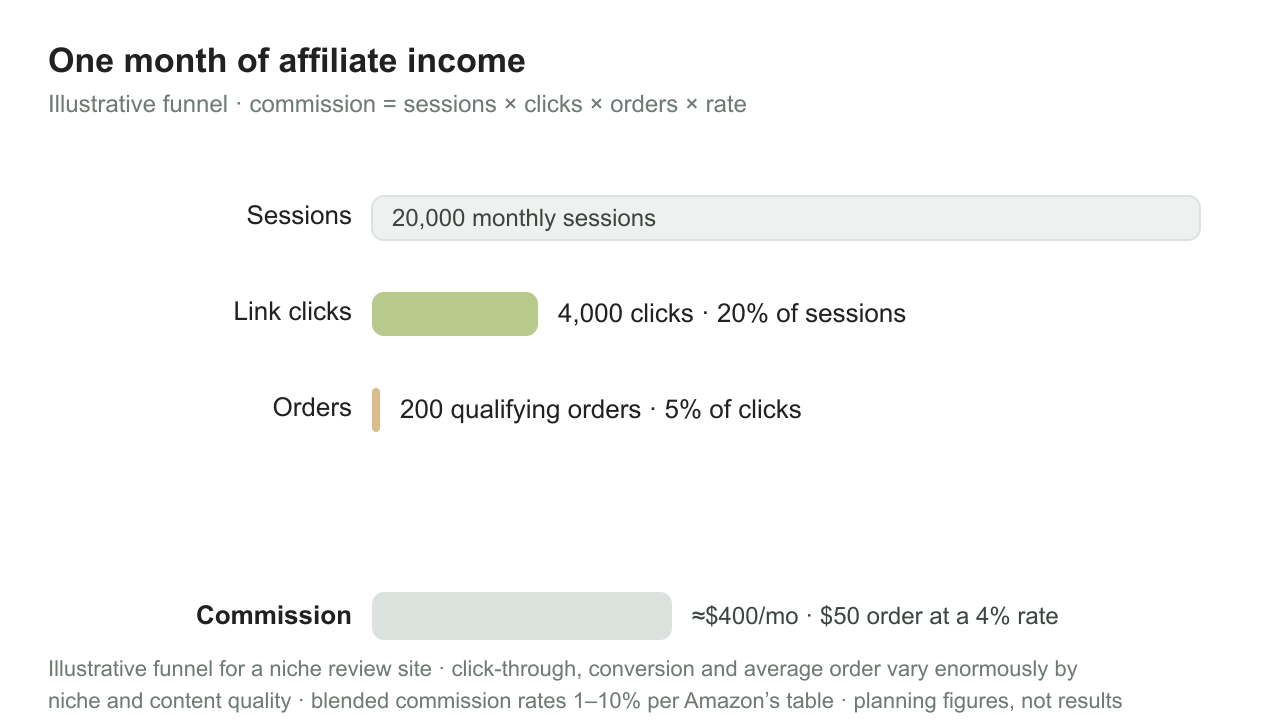
A niche review site, one month, illustrated
All figures fictional, chosen to be ordinary rather than lucky. A review site with 20,000 sessions in the month; 20% of sessions click an affiliate link (4,000 clicks); 5% of clicks convert inside the window (200 qualifying orders) at a $50 average order and a blended 4% rate: commission ≈ $400 before clawbacks, call it $380 after returns. Against it: hosting, tools, and content cost real money and, early on, months of writing before search traffic arrives.
Read the levers honestly: income scales with sessions × click-through × conversion × order value × rate. Amazon fixes the rate; the affiliate controls the audience and the trust. Doubling income means doubling one of those — usually content volume or niche selection — not adding another banner.
Illustrative funnel, not a benchmark. Real click-through, conversion and order values vary enormously by niche and audience; published “average affiliate earnings” claims vary even more.
The honest timeline: three sales inside 180 days is the gate, but a dependable monthly number typically takes quarters of consistent publishing. Affiliate income arrives late, then compounds — the exact inverse of marketplace selling, where income starts fast and margins get competed down. Which curve suits you is a portfolio question, not a loyalty question, and plenty of operators run both.
The disclosure rules that keep you compliant #
Affiliate links are paid endorsements, and the FTC’s endorsement guides require the material connection to be disclosed clearly and conspicuously — the disclosure lives near the recommendation, not buried on a footer page; the FTC’s own guidance says the closer it is to the link, the better. In practice: a short, plain disclosure above or at the start of any post containing affiliate links (“we earn a commission if you buy through links on this page”), repeated inside list items where it reads naturally.
Amazon’s operating agreement adds its own layer: no misleading statements about prices or availability pulled off the API, no using Amazon marks as your branding, no shortening or obscuring links in ways that hide the affiliation, and the self-purchase restriction mentioned above. The enforcement reality is asymmetric — affiliates lose accounts for compliance drift far more often than they lose sales for honest disclosure — so the disclosure that feels like friction is actually the cheap insurance.
Taxes on affiliate income #
Commission income is business income, and the paperwork arrives reliably: Amazon issues a 1099-NEC by January 29 to US associates paid $600 or more in the year (smaller earners still owe the tax — the form is reporting, not a trigger). The income lands on Schedule C as commissions, self-employment tax applies, and quarterly estimated taxes are the pay-as-you-go obligation on the IRS calendar. The deductible side is real too: hosting, domain, content tools, research subscriptions, the portion of home internet the work actually uses — the ordinary expenses of running a publishing business. Publication 334 is the IRS’s plain-language tour of the whole subject. Affiliates abroad are outside US forms but inside their own country’s rules; the 60-day payment lag also means a December-heavy year pays out in February, which matters for which tax year the income belongs to on accrual books.
How affiliate income lands in your books #
Affiliate books are small, but the same discipline this blog preaches for payouts applies:
- One commission-income account, named for what it is. “Affiliate commission income” — not misc revenue. If you run several programs (Amazon, other retailers, SaaS referrals), one account with program-level tracking beats a different account per network until volume justifies the split.
- Recognize it on the earnings month or the payment month — pick a rule. Amazon attributes commissions to the month the sale happened but pays ~60 days later, after clawbacks. Cash-basis books record the deposit when it lands; accrual books accrue the month’s earnings and true up for returns. The choice is the cash versus accrual question in miniature.
- Clawbacks are their own lines, never a shrug. The negative reversal lines in the earnings report are real income adjustments — recording gross commission and ignoring reversals overstates income exactly the way booking a settlement without refunds does. The deposit-versus-sales discipline translates one-for-one: tie the deposit to the earnings report, line by line.
- If you are also a seller, keep the streams apart. Marketplace settlements and affiliate commissions are different businesses that happen to share a bank account. Mixing them makes both margins unreadable — and the seller income already has its own fee-by-fee structure per the month-end close routine. Separate income accounts, separate bank-match trails.
- Reconcile the report, not just the deposit. The Associates earnings report is to the affiliate what the settlement report is to the seller: the source document that explains the deposit. Keep both, monthly.
TidyPayouts splits marketplace payouts into reviewable lines and matches them to the bank — so seller income, refunds and fees never blur into affiliate commission.
From affiliate to seller #
The affiliate store and the marketplace store are sequential more than competing. Affiliate is how you learn a niche: which products convert, what buyers actually ask, where the margin hides — with none of your own capital at risk. The seller step is what you take when you find a product where the answer to “why don’t I sell this myself?” is better than “because I earn 4% referring it.” The economics flip — capital and fees appear, margin density arrives — and the books machinery this site is built around is the machinery you inherit. When that day comes, the Amazon fees guide is the honest version of the cost side, and the Amazon to QuickBooks setup is where the books side starts. Some operators never take the step and build excellent publishing businesses on commission alone; the mistake is drifting into it accidentally, with a shop tab that slowly became an unprofitable store. Decide it on arithmetic, the way the take rates guide teaches.
Common questions #
Do you need a website to become an Amazon affiliate?+
You need a place to publish that meets Amazon’s content bar — a website is the durable base and what most applicants use, but Amazon also approves mobile apps under its app policy, and social-native creators can apply through the Influencer program, which hosts the storefront on Amazon itself. Whatever the surface, original content is the gate; a page of products without recommendations is what gets applications declined.
How much do Amazon affiliates actually make?+
It depends almost entirely on traffic and niche. The commission itself is fixed by category — roughly 1%–4.5% on most physical goods, up to 10% on luxury beauty and 20% on Amazon Games — so a store’s income is sessions × click-through × conversion × order value × rate. Modest sites earn tens or hundreds a month; established review sites earn real income; published “average earnings” claims should be read as marketing. The honest curve is slow for quarters, then compounding.
How long does the Amazon affiliate cookie last?+
Standard attribution is 24 hours from the click; commissions go to the last qualifying referral before purchase. Items the buyer adds to their cart inside that 24-hour window stay attributed to you for 90 days from when they were added — which is why recommendations that get a product into the cart are worth more than recommendations that get a click.
Why is my Amazon Associates balance negative?+
Returns claw commissions back: when a buyer returns a product, the commission reverses as a negative line in your earnings report. If it happens after you were paid, the negative balance carries against next month’s earnings. Effective income is always gross commission minus a return rate, so heavy-return categories pay less than their headline rate.
Does Amazon require an affiliate disclosure?+
Yes, twice over. The FTC’s endorsement guides require the material connection to be disclosed clearly and conspicuously — near the link, not on a distant footer page. Amazon’s operating agreement independently requires accurate representation of the relationship and prohibits obscuring or misrepresenting links. A plain sentence above affiliate-heavy content is the standard practice.
Is Amazon affiliate income taxable?+
Yes — it is business income. US associates paid $600 or more in a year receive a 1099-NEC by January 29, the income lands on Schedule C, self-employment tax applies, and quarterly estimated payments cover the tax as it is earned. Smaller earnings are taxable even without a form. Hosting, tools and content costs are generally deductible business expenses; confirm treatment with your tax professional.
Can I be an Amazon affiliate and a seller at the same time?+
Yes, and many operators are both — but keep the identities clean. You cannot buy through your own affiliate links or rely on household purchases, and the two income streams belong in separate accounts in your books: marketplace settlements have a fee-by-fee structure, affiliate deposits are commission, and mixing them destroys both margins. Watch the detail-page dynamics too — if you sell the product, your affiliate link to a competitor’s offer is rarely the right recommendation.
What is the difference between Associates and the Amazon Influencer program?+
Same economics, different surface. Associates is the general program: your site or app carries the links. The Influencer program is the creator variant — applicants need an established following on the supported social platforms, and the storefront lives on Amazon (shoppable photos, videos, livestreams) rather than on your own domain. Commission rates mirror the Associates table for both.
Sources and review date #
Written November 16, 2026 against Amazon Associates’ published help pages and the FTC’s guidance, linked below. Rates, thresholds and program rules change; confirm the current figures before making decisions. The worked funnel is fictional; tax questions deserve your tax professional.
- Amazon Associates
- Amazon: standard commission income rates
- Amazon: advertising fee schedule and 24-hour window
- Amazon: getting paid
- Amazon: payment thresholds
- Amazon: negative numbers in earnings reports
- Amazon: when you will receive a 1099 form
- FTC: endorsement guides — what people are asking
- IRS: estimated taxes