Tidy
In this article
- A sales tax return reports three numbers for the period: taxable sales, tax collected, and tax due — plus, for marketplace sellers, sales the facilitator already collected.
- Your numbers come from your own records: point-of-sale or payment-account tax lines for in-person and self-collected sales, and marketplace reports for facilitator-collected orders (reported but usually not remitted by you).
- File on time even with nothing to remit — an active registration expects a return for every period, and unanswered periods compound into notices.
- The reconciliation that makes every later return easy: tax collected per your records minus remittances equals the payable balance — checked once a filing period.
What the return actually is #
A sales tax return is the state’s form for one reporting period — monthly, quarterly or annually, as assigned — asking three things: how much you sold (taxable sales, sometimes broken by rate or jurisdiction), how much tax you collected, and how much you’re remitting. It reconciles the period’s activity, not your bank balance: sales that span the period edge follow the state’s own rules (most states assign sales to the period by sale date), and refunds during the period reduce the taxable base.
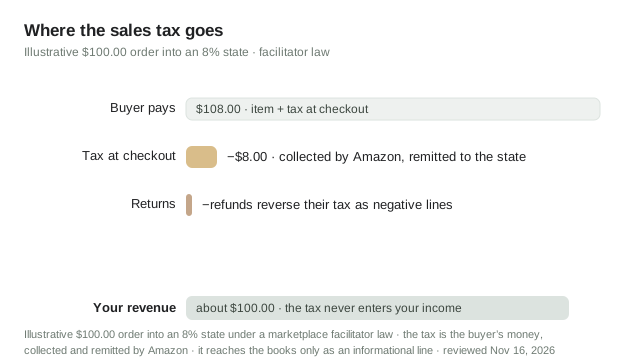
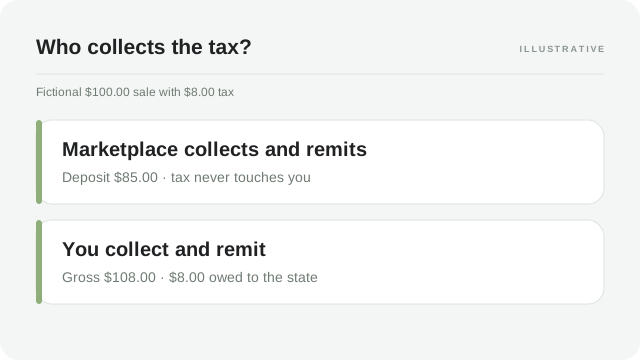
For marketplace sellers the return usually splits into two worlds. Sales on marketplaces in facilitator states were collected and remitted by the platform — the return may not need them at all, or may need them reported as facilitator-collected (some states want the amounts shown for information even though no tax is due from you). Sales from your own channels — in-person, your website, any non-facilitated venue — are the lines you’re actually remitting on. Knowing which world each number belongs to is the first step of the walkthrough, and the deeper mechanics live in our sales tax guide.
Before you file: the three numbers #
Gather the period’s numbers from the records you already keep (the tally sheets, the point-of-sale report, the payment processor’s tax report):
- Taxable sales — gross receipts on taxable items for the period, by rate if the state has multiple rates or local jurisdictions. Exempt sales (resale certificates, exempt buyers) are reported separately on most forms.
- Tax collected — what you actually charged at the table or checkout. If you under- or over-charged slightly, most states want the tax that should have been collected, with the difference absorbed or requested from the buyer.
- Remittance — tax due minus any discount the state grants for timely filing (many states keep a small percentage for the filer), minus prior credits.
The sources differ by channel: marketplace orders come from the platform’s tax reports (facilitator-collected — reported, not remitted); your own sales come from the point-of-sale report or tally sheets; and the two should never blend. The in-person sales guide covers the collection side; this walkthrough covers the filing side.
Filing: the walkthrough #
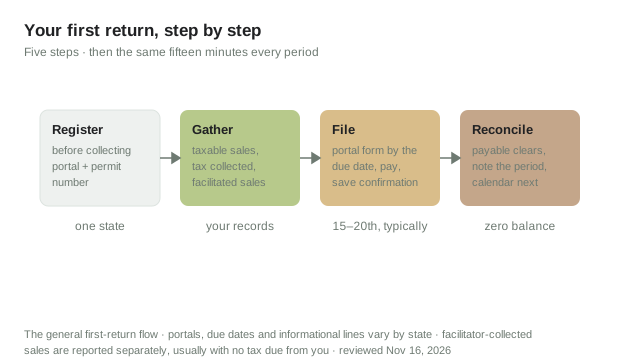
- Log into the state’s revenue portal with the credentials from your registration (the permit letter includes them). One registration, one portal, one return per period per state.
- Confirm the period and the due date. The return is for the assigned period — the due date is typically the 15th–20th of the month after the period closes, varies by state, and your frequency (monthly/quarterly/annual) was assigned at registration based on expected volume.
- Enter gross and taxable sales for the period. Marketplace-facilitated sales go in the state’s designated line (some states want them reported as exempt or facilitator-collected — the form’s instructions say which).
- Enter the tax collected for your remitted sales. If the form computes tax from sales, check its figure against your collected amount — small differences from rounding are normal, large ones mean a rate or jurisdiction was entered wrong.
- Review deductions or adjustments lines only if they apply (exempt sales, credit for prior overpayment). Leave them at zero otherwise.
- Submit and pay — ACH debit from the business account is the standard. The confirmation number is the receipt; save it with the period’s records, the same folder discipline as every settlement this site keeps.
The first return is slow because the portal is new; the second is fast because the numbers are the same source as the first. Everything after is a fifteen-minute task on the calendar.
Payment and confirmation #
Pay from the business account on or before the due date — the payment and the return are usually one submission, but some states separate them (return filed, then ACH debit scheduled). On confirmation, book the remittance against the sales tax payable line in the books: the liability you accrued at collection clears to zero for the period. If the payment date slips past the due date, expect penalty and interest lines on the next portal visit — and book those as penalties, not as tax.
Timely filing has its own small reward: many states grant a vendor’s discount or timely-filing credit (a small percentage of the tax, capped) for filing on schedule. It varies by state and can change — check the state’s return instructions rather than assuming it exists.
Zero returns and informational filings #
Two special cases catch first-time filers. A zero return: a registration you hold expects a return every period, even with no sales to remit — file a zero return rather than skipping, because unanswered periods compound into notices and eventual account problems. An informational filing: in some states (the pattern our sales tax guide describes), marketplace-collected sales must still be reported on your return as facilitator-collected, with zero tax due from you — the return is how the state sees you know the difference.
And the closing note for marketplace-only sellers: if your only sales are facilitator-covered and your state requires no informational return, your first return may legitimately be the zero kind — but that conclusion should come from reading the state’s instructions or asking, not from assuming. The sales tax guide’s filing section covers the marketplace-seller decision tree.
The reconciliation habit that makes returns easy #
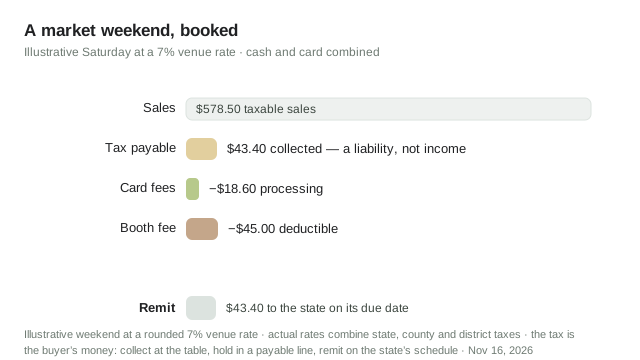
The return stops being a project when one equation holds in the books: tax collected per period − remittances per period = the payable balance. Check it once per filing period, in four lines: tax collected (from the point-of-sale or tally records), tax remitted (from the payment confirmation), the payable balance, and any difference explained in a note. This is the same discipline as reconciling a clearing account — applied to a liability instead of an asset.
The habit catches three drifts early: collections recorded but not remitted (the balance grows — a filing was missed), remittances with no matching collections (a period filed twice, or a payment posted to the wrong account), and tax that leaked into income (the balance never grows even though sales did). The month-end close carries the check as a standing line.
TidyPayouts keeps tax lines separate from income in every settlement — so the payable balance and every return tie out.
Marketplace facilitator lines on your return #
The line that confuses marketplace sellers most is the one for sales the facilitator already handled. Many states’ returns have a dedicated line — often labeled “sales delivered by a marketplace facilitator” or similar — where you report the gross amount of marketplace-facilitated sales for the period, with zero tax due from you on that line. The return is how the state reconciles its records: it sees your total in-state sales, sees that the facilitator portion is accounted for, and processes the return with no tax from your side. Entering nothing when the form has this line can trigger a mismatch notice, because the state’s own records show the facilitator’s remittance against your seller ID and the return says zero.
The source number comes from the marketplace’s own state report (Seller Central’s tax report for Amazon, Seller Hub’s order report for eBay, and so on). The facilitator’s remittance report is the cross-check: if the marketplace collected $340.22 of tax on your orders and the state’s records agree, the line is correct and the return is clean. Our facilitator bookkeeping guide covers the settlement-line side; this return line is its filing-side counterpart.
When to get help: multi-state and product-taxability questions #
The single-state, single-rate, tangible-goods return is genuinely manageable solo after the first filing. Three situations deserve professional help before you submit: multi-state registrations (each state’s nexus and informational rules differ enough that a practitioner’s review pays for itself), product-taxability questions (clothing thresholds, food and supplement classifications, digital goods — the states disagree), and any historical exposure (past periods where you collected but didn’t remit, or nexus you crossed without registering — the voluntary disclosure path is a negotiation, not a form). The sales tax guide’s remediation section describes the process; this walkthrough supplies the records the professional will ask for.
Common questions #
How often do I have to file sales tax returns?+
The state assigns your filing frequency at registration based on expected volume: annual or quarterly for small vendors, monthly for larger ones, with thresholds that promote you as you grow. The assignment arrives with your permit; due dates cluster mid-month after the period closes. Confirm the frequency in the state’s portal rather than assuming from another seller’s setup.
What happens if I file late or can’t pay in full?+
Late filing triggers penalties plus interest on the unpaid tax — which accrues until paid. If you can’t pay in full, file anyway (the failure-to-file penalty is usually larger than failure-to-pay) and contact the state about payment arrangements. Voluntary disclosure agreements exist for longer unregistered periods — the sales tax guide covers the remediation path.
Do I need to file if all my sales were on Amazon and the platform collected the tax?+
Often no — in facilitator states, marketplace-collected sales typically don’t require a return from you. But several states expect facilitator-collected sales to be reported informationally on your return even with no tax due, and home-state or non-facilitated sales change the answer entirely. The state’s instructions and your tax professional settle it for your situation.
What is a zero return and do I really need to file one?+
A zero return reports a period with no sales to remit — an active registration expects one every period regardless. Skipping zero periods is how small sellers accumulate notices and lose good standing. Filing takes minutes; the consequences of not filing take months.
What number do I put on the return: the tax I charged or the tax the rate says?+
States generally want the tax that should have been collected at the correct rate, with any under-collection absorbed or recovered from the buyer — over-collection usually must be remitted or refunded to buyers. If your collected and computed figures differ materially, fix the point-of-sale rate setup and reconcile the gap rather than filing the wrong number.
Where do marketplace-facilitated sales go on my return?+
Many states provide a dedicated line for sales remitted by marketplace facilitators — reported for information, excluded from your tax due. The line’s name varies by state (“marketplace sales”, “sales made by a facilitator”), and the marketplace’s own state report is the number source. Some states require no entry at all; the form instructions are the authority.
How long should I keep sales tax records?+
Keep the return confirmations, the period’s sales and tax records, and the payment receipts together — a folder per filing period. States can audit several years back (commonly three to four), and the records also support the income side of your federal return. The settlement-and-report discipline this site teaches everywhere is the same folder.
My state granted a “timely filing discount”. What is that?+
A small credit some states give filers for submitting and paying on time — typically a capped percentage of the tax due, taken as a deduction line on the return. It varies by state and can change, so read the return instructions each period rather than assuming last year’s discount still applies.
Sources and review date #
Written November 16, 2026. Sales tax filing is state law: portals, due dates, discounts and informational lines vary by state and change — the state department of revenue and its return instructions are the authority for your registrations. This walkthrough is general practice, not tax advice; confirm your filings with a tax professional.